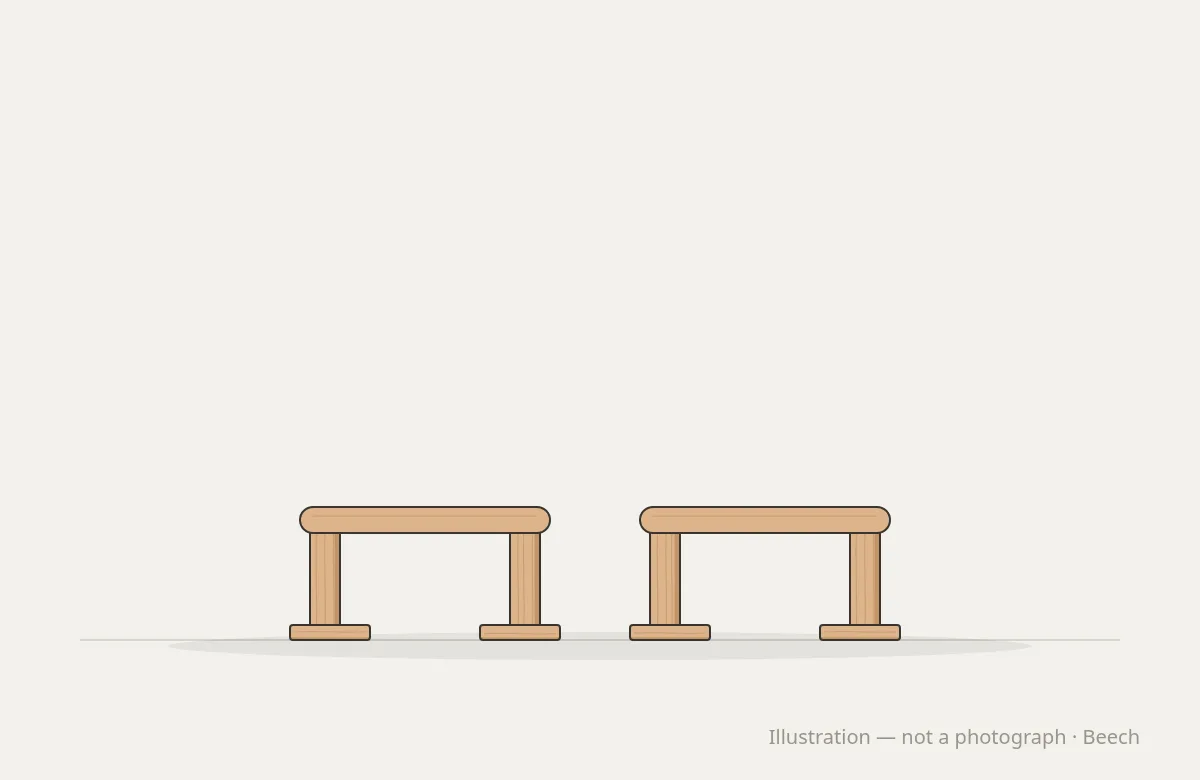
Parallettes are among the smallest pieces of equipment in a studio. A pair of low bars on feet, light enough to carry in one hand. Yet they support a wide range of bodyweight training: push-ups, dips, L-sits, tuck holds, arm balances and handstand preparation. For boutique studios, personal training rooms and hotel gyms, they add a lot of variety for very little space.
This article explains what parallettes are good for, what to check when buying them for commercial use, and how to store them.
What parallettes do
Coaches who teach bodyweight skills point to several benefits:
- Neutral wrists. Gripping a bar keeps the wrist in a more neutral position than placing the palm flat on the floor. That reduces wrist stress and lets clients train around wrist limitations.
- Pressing strength. Parallettes build both bent-arm and straight-arm pressing strength.
- More room under the body. The added height gives space to set up L-sits and tuck holds, and to press down into the bars.
- A route to harder skills. They help clients practise arm balances and work towards handstands, although experienced coaches warn against relying on them too much and recommend bridging to floor work.
Elevated hands also change the angle of the body. Push-ups on parallettes can feel easier, which makes it easier to focus on form.
Typical exercises in a class
- Push-ups and deficit push-ups.
- Dips with feet on the floor.
- L-sits and tuck holds.
- Crow and other arm balances.
- Supported shoulder and wrist conditioning.
Because they are light and quick to set up, parallettes work well at circuit stations and in mixed bodyweight classes.
What to check for commercial use
Bar diameter and shape. The grip should be comfortable for a range of hand sizes. Too thick, and smaller hands struggle to close around it; too thin, and the bar digs into the palm. Turned hardwood bars give a smooth, warm grip.
Base and stability. The feet must sit flat and grip the floor. A pair that rocks or slides is unsafe for arm balances. Wide feet help.
Joints. The joints between bar and feet take bending and twisting loads every time a client shifts weight. They must stay tight through repeated use. The Wood Handbook from the US Forest Products Laboratory notes that screws hold much better in dense timber, and only about 75 per cent as well in end grain as in side grain. Good joints do not rely on screws into end grain alone.
Timber. Dense hardwoods suit parallettes. The Wood Database describes European ash as shock resistant with good strength for its weight. European beech is stiff and smooth in the hand.
Finish. A matt lacquer protects the timber from sweat and cleaning while giving a natural, non-slippery grip.
As an example, Round Fit Studio Strength Parallettes are typically 60 cm long and 20 cm high, sold as a pair, in solid beech, ash or oak with turned hardwood grips and wide, stable feet.
Height options
Parallettes come in different heights. Low parallettes suit push-ups, L-sits and arm balances close to the floor. Taller ones give more room for dips and leg clearance. A studio teaching mixed bodyweight classes may want one height; a calisthenics-focused studio might want two. Dimensions can be adjusted to the brief.
Where they fit best
Parallettes earn their place in rooms where floor space is limited and classes change often. In a boutique studio, a set of pairs supports a whole bodyweight class with nothing else but mats. In a personal training room, one pair adds a progression path from push-ups to arm balances. In a hotel gym, a pair on a shelf gives guests a simple, self-explanatory tool that takes no floor space when not in use.
Storage
Parallettes are small, which makes them easy to lose and easy to trip over. The UK Health and Safety Executive notes that most trips are caused by obstructions in walkways.
- Store in pairs, in a dedicated slot or shelf, so the two bars stay together.
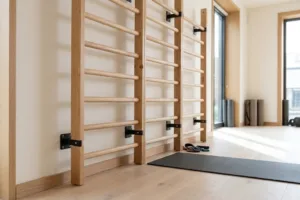
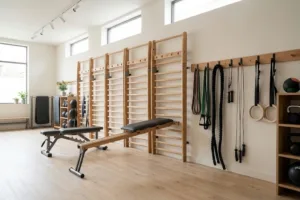
- Use wall storage near the training floor.
- Count them back at the end of each class.
Cleaning and care
Wipe the bars with a damp cloth and a mild cleaner after use. Check the joints and feet weekly. Take a pair out of use if a joint loosens or a crack appears at a bar end.
Every Round Fit piece is tested before it leaves the workshop. See wall storage options for small kit, or talk to us about quantities and finish.