Plywood is often treated as the budget option next to solid timber. That misses the point. Plywood is a different material with different strengths. Used in the right places, it does jobs that solid wood does badly. Used in the wrong places, it is a weak link.
This article explains how plywood is made, why it is so stable, and where it belongs in commercial fitness equipment and studio interiors. It also explains why particle boards such as chipboard and MDF are a different matter altogether.
How plywood is made
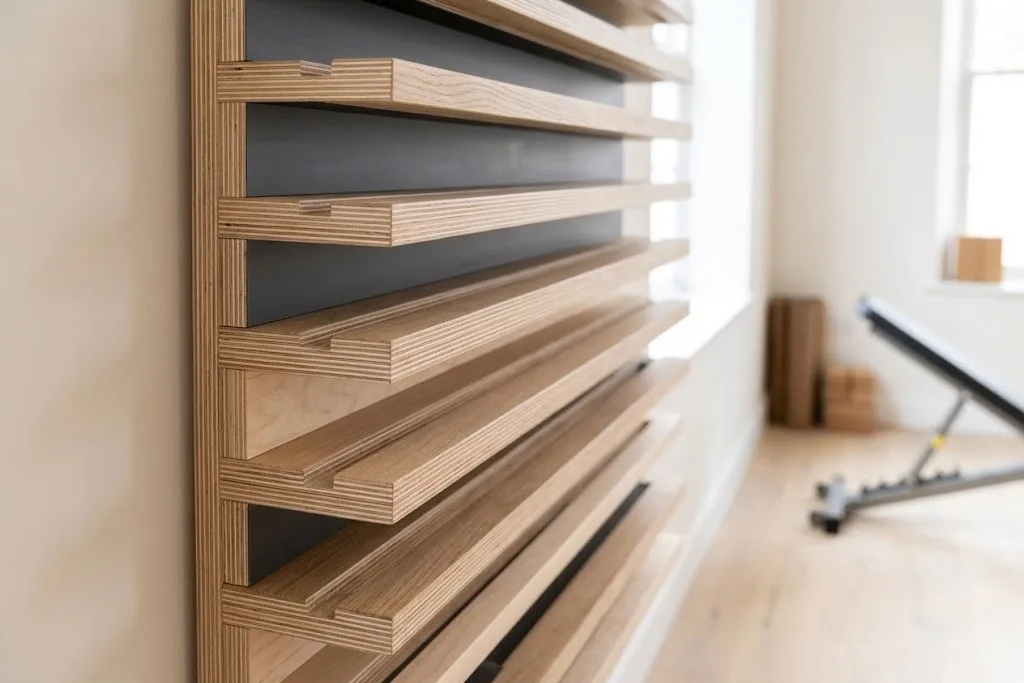
Plywood is built from thin sheets of wood veneer glued together. There is always an odd number of layers, and each layer is turned 90 degrees to the one beside it. This is called cross-lamination.
The reason is movement. Solid timber shrinks and swells with humidity, and it moves far more across the grain than along it. The US Forest Products Laboratory’s Wood Handbook notes that movement along the grain is very small, while tangential movement across the grain is roughly twice radial movement. In plywood, each layer’s tendency to move across its grain is restrained by the layers either side, which run the other way. The result is a panel that stays far more stable in width and length than a solid board of the same size.
The odd number of layers keeps the panel balanced. The outer layers run in the same direction, so the panel does not pull itself out of flat.
Where plywood earns its place
Plywood is at its best in wide, flat parts. These are exactly the parts where solid timber is most likely to cup, split or open up at the joints. Typical examples in a studio:
- Locker carcasses. Sides, tops, shelves and backs need to stay flat and square so doors keep closing properly.
- Cabinet and storage sides. Tall panels are hard to make stable in solid wood without many joints.
- Wall storage backs and slatted panels. A stable backing keeps rails and slats aligned.
- Shelving. Wide shelves in plywood resist cupping under changing humidity.
- Panels in large apparatus. A spring wall panel, for instance, can be plywood held in a solid timber frame.
In each case, plywood gives a large, stable surface with fewer joints. Fewer joints mean fewer places for movement to show.
Where solid timber is better
Plywood is not the answer everywhere. Some parts are better in solid wood:
- Frames and rails that carry concentrated loads along their length.
- Rungs and handles that people grip, where a continuous grain feels better and can be shaped cleanly.
- Parts that need shaping in three dimensions. Plywood edges show the layers and can be harder to profile and repair.
- Parts that may need refinishing. Solid timber can be sanded back many times. A plywood face veneer is thin.
A good design uses both. Solid timber does the structural and tactile work. Plywood does the flat, stable work.
Not all plywood is the same
Plywood quality varies a great deal. Three things to ask about:
The bond class. European standards classify plywood bonding by use condition. Guidance from LABC Warranty explains that EN 314-2 sets three bond classes: class 1 for dry interiors, class 2 for humid conditions or occasional wetting, and class 3 for unprotected exterior use or frequent wetting. EN 636 then classifies the panel itself on the same three levels. A panel cannot achieve a higher EN 636 class than its EN 314 bond class.
The use condition. The same guidance describes EN 636 class 1 as suitable where humidity exceeds 65 per cent only for a few weeks a year. Class 2 suits conditions where humidity exceeds 85 per cent only for a few weeks a year. That distinction matters for changing rooms, spa areas and rooms near pools, where humidity is often high.
The marking. Panels should be marked with EN 636 and the use class (-1, -2 or -3), “S” for structural or “NS” for non-structural, and the species. Ask your supplier which class has been used for each part.
Why particle boards are different
Chipboard (particleboard) and MDF are made from wood particles or fibres bonded with resin. They are flat and cheap, and they work well in many kinds of furniture. But they behave differently from plywood when moisture is involved.
A technical bulletin from the Composite Panel Association, the North American panel industry body, explains that particleboard and MDF swell more in both thickness and length than solid wood for the same humidity change. Crucially, swelling caused by high humidity is permanent. The panel does not fully recover when it dries out.
In a changing room, that is a real risk. Water reaches an exposed edge, the edge swells, and the swelling stays. Laminate faces start to lift. Hinges and screws lose their grip.
Screw holding is the other issue. The Wood Handbook warns that overtightening screws in particleboard strips the threads. In equipment that is assembled, adjusted and serviced over many years, that matters.
For these reasons, Round Fit builds in solid hardwood and plywood, and does not use chipboard or MDF.
Finishing plywood properly
Plywood still exchanges moisture with the air, through its faces and especially through its edges. The Wood Handbook notes that liquid water enters end grain 10 to 100 times faster than other faces. Plywood edges expose end grain in every other layer.
So the edges need as much attention as the faces:
- Seal all edges with the same finish system as the faces.
- Use solid timber edging where edges are exposed to knocks.
- Finish both faces equally, so the panel stays balanced.
- Avoid leaving raw edges hidden behind other parts, where moisture can collect unseen.
How to specify
When you brief a maker, it helps to say where each material should be used and why. A short checklist:
- Identify the wide, flat parts and ask for plywood there.
- Identify the load-bearing and hand-contact parts and ask for solid timber.
- Describe the room’s humidity, especially near showers, steam or pools.
- Ask which bond class and EN 636 class each panel meets.
- Ask how edges are sealed and protected.
You can see plywood and solid timber working together in our Studio Interiors collection. If you would like advice on a particular room, contact our team.