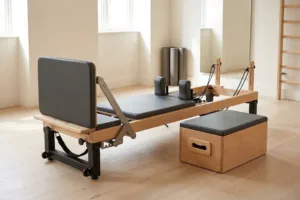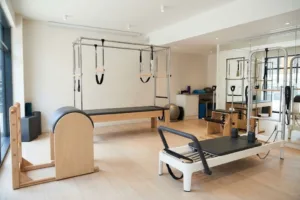
Reformers get most of the attention, but the smaller apparatus does a great deal of the teaching. A chair, a barrel or a spine corrector can challenge balance, support the spine or open up movements that are hard to teach on a reformer. These pieces also fit into spaces that large apparatus cannot use.
This article describes the main small apparatus, what each is good for, how much space it needs and how to fit it into a studio timetable.
The Pilates chair
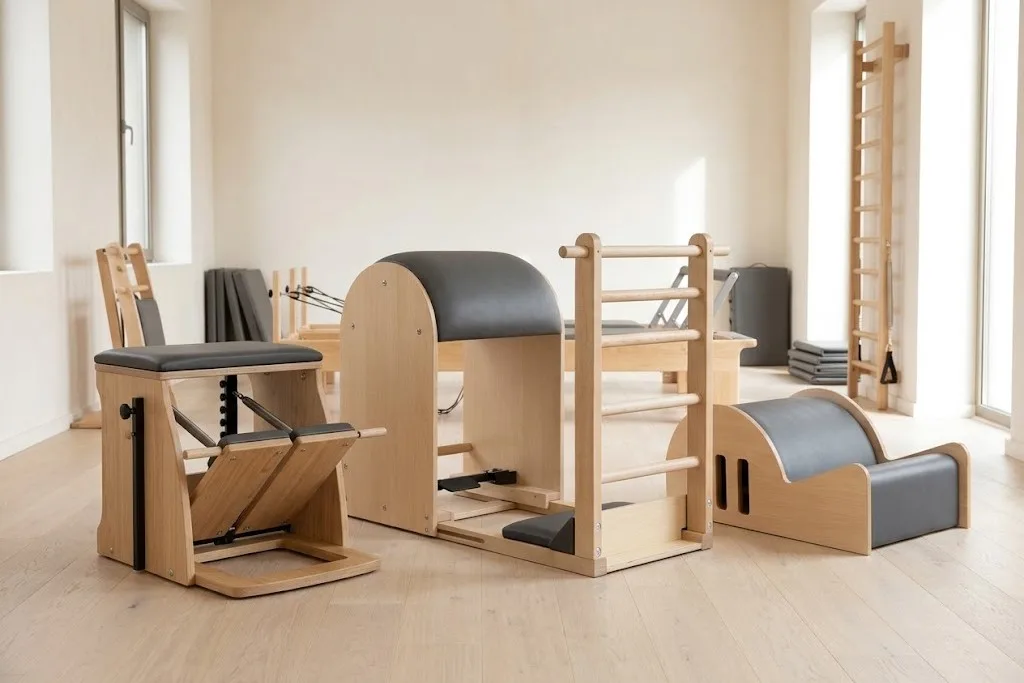
The chair, often called the Wunda Chair after Joseph Pilates’ original, is a compact box with a padded seat and a spring-loaded pedal. The seat offers little support, which makes it one of the most demanding pieces of apparatus. It can be used standing, seated or lying on the front or back, and is linked to strength, balance and foot control as well as injury rehabilitation.
Some chairs have a split pedal, so each leg or arm can work independently. As an example, the Round Fit Studio Pro Pilates Chair is 75 cm long, 65 cm wide and 59 cm high, in solid ash. It has four springs and split pedals with five positions each, plus height-adjustable handles.
Best for: strength and balance work, standing exercises, sports conditioning, and small-group circuits.
The ladder barrel
The ladder barrel combines a padded, curved barrel with a short wooden ladder, joined by a sliding base. Joseph Pilates’ original design is said to have used an empty beer keg. The barrel encourages the spine into extension and flexion, and can also be used for abdominal and oblique work.
The sliding base adjusts the distance between ladder and barrel to suit the client’s height. The Round Fit Studio Pro Ladder Barrel, for instance, is 135 cm long, 65 cm wide and 97 cm high, in laminated and solid ash, with five fixed rungs, one movable rung and a sliding base.
Best for: stretching, spinal extension and side bending, and private sessions. It takes floor space, so it is usually found in private rooms or at the side of a reformer room.
The spine corrector
The spine corrector, sometimes called a step barrel, is a smaller curved unit with a low step. It has a less dramatic curve than the barrel, which limits the range of movement. That makes it suitable for beginners, people with injuries and pregnant clients. It is used mainly to assist spinal movement and abdominal work.
Spine correctors are light enough to move and store. The Round Fit Studio Pro Spine Corrector measures 92 cm long, 35 cm wide and 37 cm high, with four band points and a strap for the step platform.
Best for: mat classes, beginners, clinical work and small rooms.
The arc
An arc is a lighter, lower curve, often used on the mat or on a reformer carriage. It gives support under the spine for gentle extension and core work. Because it is light and stacks well, it is popular in mat classes and in hotels or clinics where space is limited.
Best for: mat classes, gentle spinal work and portable use.
How much space they need
Small apparatus does not mean no space. Studio design guides commonly suggest allowing roughly 50 to 70 square feet (about 4.6 to 6.5 m²) for a Cadillac or Wunda Chair, including working space. Barrels and spine correctors need less, but they still need room around them for the client to move and the instructor to assist.
Three practical points:
- Chairs need space in front and to the sides for standing work.
- Ladder barrels need space at both ends, because clients reach and lean well beyond the frame.
- Spine correctors and arcs need a mat-sized area and somewhere to go when not in use.
Fitting small apparatus into the timetable
Small apparatus can make a studio more productive:
- Circuit classes. A small group rotates around chairs, barrels and reformers.
- Private and duet sessions. A chair and a barrel in a small room give a lot of variety without a full Cadillac.
- Add-ons to reformer classes. Spine correctors and arcs can be used on or beside the reformer.
- Mat classes. Arcs and spine correctors add support and challenge to floor work.
Storage and the room
Small apparatus is only useful if it is easy to get out and put away. Plan where each piece lives:
- Chairs and ladder barrels usually stay in place, so give them a permanent spot.
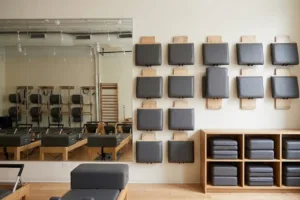
- Spine correctors and arcs can be stacked on low shelving or a wall rack.
- Keep walkways clear. The UK Health and Safety Executive notes that most trips are caused by obstructions in walkways.
Matching the rest of the studio
Small apparatus is very visible. Matching its timber, finish and upholstery to the reformers makes the studio feel designed as one. Round Fit can build every piece in the same species and finish, with upholstery to the same specification.
See the full range in our Pilates collection, or ask us for a proposal.