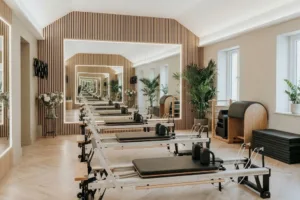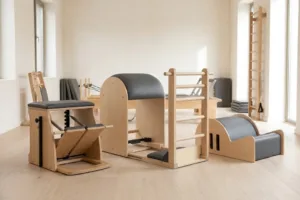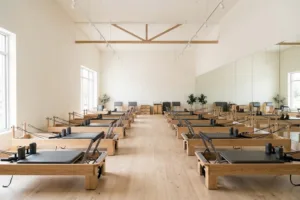
Every reformer comes with a family of accessories. Sitting boxes, jump boards and platform extenders all extend what the machine can do. They also take up space. In a room of ten or twelve reformers, accessories quickly outnumber machines, and without a plan they end up on the floor.
This article explains why accessory storage matters, how much space to plan, and how to lay it out so a class can be set up and reset in minutes.
Why it matters
Loose accessories cause three problems.
Trips. The UK Health and Safety Executive notes that most trips are caused by obstructions in walkways, and that walkways must be kept clear. A sitting box left at the foot of a reformer sits exactly where people step on and off.
Damage. Boxes and boards that are stacked loosely or leaned against walls get knocked, scratched and dropped. Upholstered faces get scuffed.
Time. If clients have to search for a box or a board, setup takes longer and classes start late. Turnaround between back-to-back classes suffers.
A clear, designed place for each accessory solves all three.
Know what you are storing
Start with a simple inventory. For each reformer, count:
- Sitting box. The sitting box is a standard reformer accessory. It is used for seated and lying exercises on top of the carriage.
- Jump board. It fits at the footbar end and turns the reformer into a low-impact jumping surface.
- Platform extender. It extends the standing area at the end of the frame.
- Straps, loops and small props. Smaller, but numerous.
Then measure each item. Accessories are usually sized to the reformer they belong to. On Round Fit equipment, the sitting box and jump board are made to fit the specific reformer, in solid hardwood with an upholstered face. Your storage should be sized to the real items, not to a general guess.
Where to put it
The best location is close to the machines that use it, along a wall that does not interrupt circulation.
- Along the nearest wall. Keep storage on the wall closest to the reformer rows, so clients walk the shortest distance.
- Away from the door route. Clients arriving and leaving should not cross the storage area.
- Spread out, not in one corner. In a large room, two or three storage points avoid a queue at the start of class.
Studio designers often recommend wall-mounted shelves and racks for props, and benches or cabinets with hidden compartments for towels, mats and small equipment. Both approaches keep the floor clear.
How to store each item
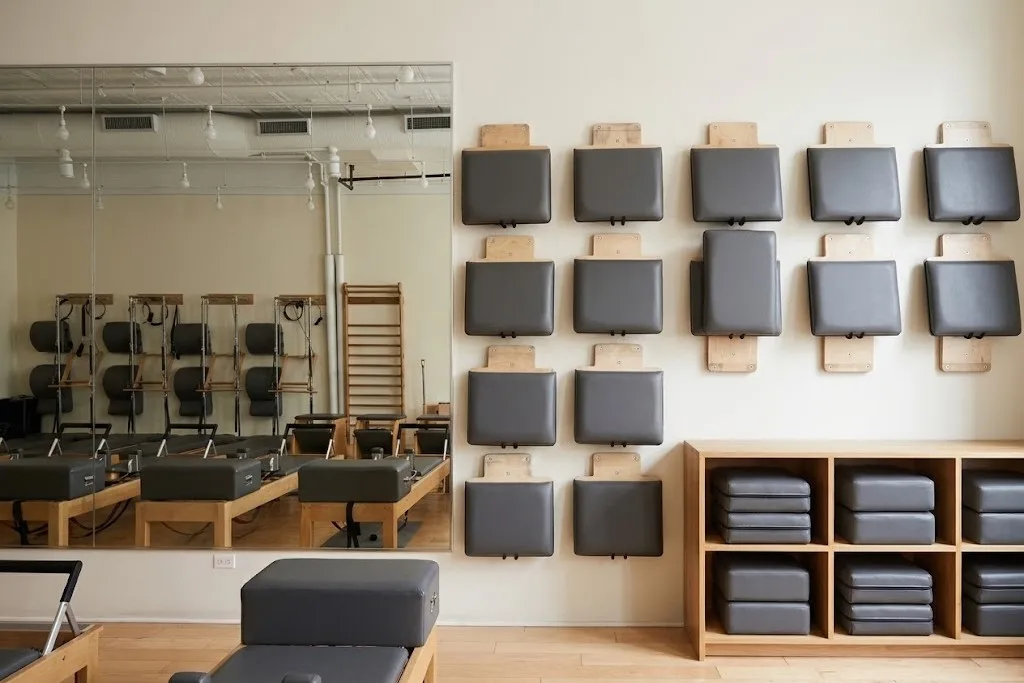
Jump boards and platforms: wall racks. These are flat and fairly large. They store best vertically in a wall-mounted rack, with a slot or bracket for each board. Vertical storage takes very little floor space and lets clients see at a glance whether a board is available.
Sitting boxes: low shelving or cubbies. Boxes are heavier and bulkier. They are best kept on low, open shelving or in cubbies at a comfortable height, so clients can lift them without bending to the floor or reaching overhead. Upholstered faces should face outwards or upwards, so they are not scraped on the shelf.
Straps and small props: hooks or rails. A rail system with hooks keeps straps untangled and lets them dry between uses.
Labelling and resets
A simple system makes resets fast:
- Give each item a fixed position.
- Label or number positions to match machines, if accessories belong to specific reformers.
- Train staff and instructors to reset the room the same way after every class.
This is especially useful for chains, where every site should run the same way.
Material and finish
Storage is part of the room. Built in the same timber and finish as the reformers, it looks deliberate rather than added. Solid hardwood and plywood stand up to the knocks of daily use. A matt lacquer finish copes with daily cleaning.
A quick planning checklist
- Count every accessory per reformer.
- Measure each item.
- Choose a wall close to the machines and away from the door route.
- Plan vertical racks for boards and low shelves for boxes.
- Add hooks or rails for straps and props.
- Label positions.
- Match timber and finish to the equipment.
See storage options in our Studio Interiors collection, or share your layout with us.