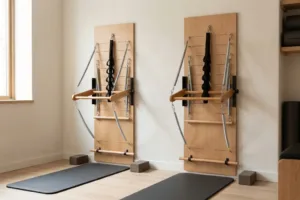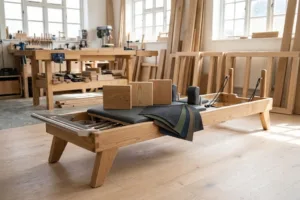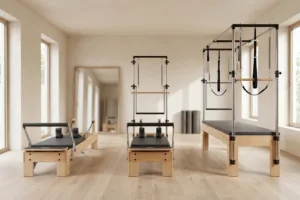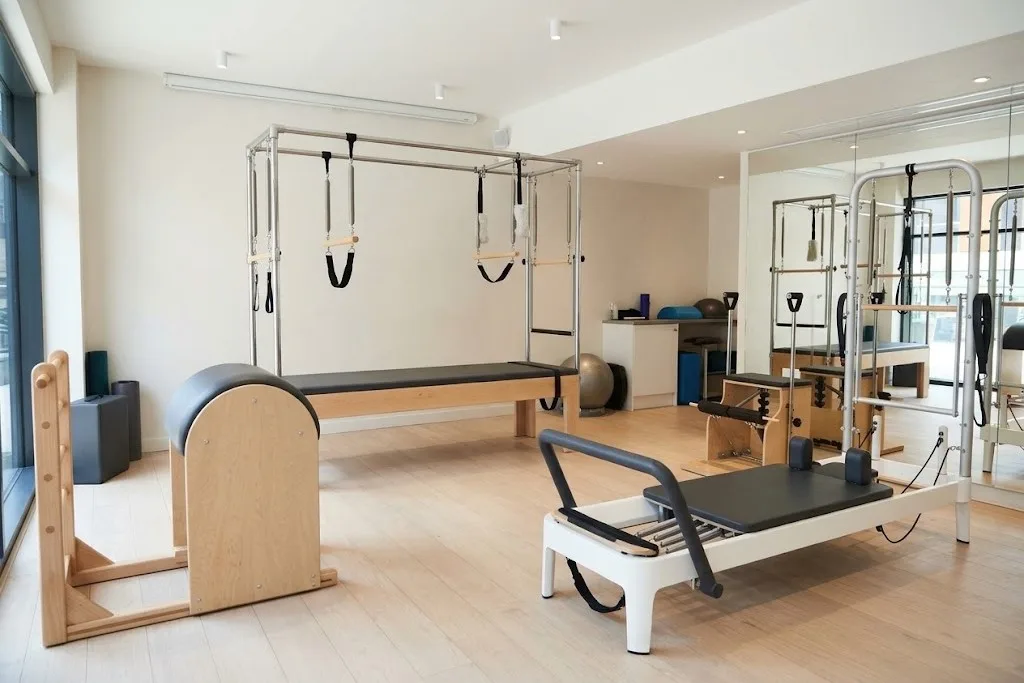
Many physiotherapists use Pilates-based exercise in their work. The apparatus can support a client through movements they cannot yet do alone, then add load gradually as they recover. But a clinic is not a group studio. Sessions are usually one-to-one. The practitioner needs room to move around the client. Hygiene standards are higher. And the equipment has to serve the clinician’s method, not the other way round.
This article looks at what the evidence says, which apparatus suits clinical work, and what to consider when equipping a treatment room.
What the evidence says
It is worth being clear about the evidence, because clinics are rightly careful about claims.
A Cochrane review by Yamato and colleagues, published in 2015 and summarised in American Family Physician, looked at ten randomised trials with 478 adults with chronic low back pain. Compared with minimal or no intervention, Pilates reduced pain in the short and intermediate term, with differences the reviewers judged clinically noticeable. It also improved disability, though the differences were only marginally clinically significant. Compared with other forms of exercise, the evidence did not show Pilates to be better. Most of the evidence was of low to moderate quality. Adverse effects were uncommon and mostly mild muscle pain.
In the UK, NICE guideline NG59 on low back pain and sciatica recommends considering a group exercise programme, whether biomechanical, aerobic, mind–body or a combination, within the NHS.
The practical reading is that Pilates is one reasonable form of exercise therapy among several. The choice of exercise, and the programme, belong to a qualified clinician. Equipment should make that clinician’s work easier and safer.
The Cadillac
The Cadillac, or trapeze table, is often the centrepiece of a clinical Pilates room. Many clinicians regard it as the most versatile and supportive apparatus, used to aid rehabilitation and improve stability and balance. The high, wide surface is easier to get onto than a mat on the floor.
That matters for many clinical clients. Getting down to the floor and back up can be difficult or painful. A raised table removes that barrier. Springs on the frame can assist a movement rather than resist it, which allows early, supported work.
Consider: a Cadillac is large and fixed. It needs space on all sides so the clinician can work from either side, at the head or at the foot.
The reformer
The reformer can be used lying, side-lying, kneeling, standing or on all fours, to mobilise the spine, assist movement, build strength and increase range of movement. It can be adapted for rehabilitation under professional guidance.
For clinics, the key feature is adjustable spring load. Small changes in spring settings allow gradual progression from session to session.
Consider: carriage height. Standard reformers are low. Some clients find a higher frame easier to get onto. A bespoke reformer can be built at a different height for clinical access.
Small apparatus
Small apparatus suits treatment rooms where space is limited:
- Spine corrector. It has a gentler curve than a barrel, which limits range of movement, and suits beginners, people with injuries and pregnant clients.
- Chair. Used seated, standing or lying, and linked to strength, balance and foot control as well as injury rehabilitation.
- Arc and wedge. Light, portable supports for gentle spinal work on a plinth or mat.
Room layout for one-to-one work
A clinical room is planned around the practitioner as much as the client.
- Space around the apparatus. The clinician should be able to stand on either side, at the head and at the foot.
- Clear transfer space. Room to help a client on and off, including space for a walking aid or wheelchair.
- Storage off the floor. Small apparatus, straps and props on shelves or wall racks, so the floor stays clear. The UK Health and Safety Executive notes that most trips are caused by obstructions in walkways.
- Privacy. Clinical sessions often need screening or a closed room.
Hygiene and upholstery
Clinics clean more often and often use stronger disinfectants than studios. Upholstery has to cope.
A comparison published by the Chemical Fabrics and Film Association notes that PVC is not subject to hydrolysis to any significant degree and rates good to excellent for use with disinfectants. Polyurethane rates lower, and the same source reports early failures when PU was cleaned with quaternary ammonium cleaners. Whichever cover is chosen, check the manufacturer’s guidance against the clinic’s actual products.
Public health guidance from the US Centers for Disease Control and Prevention makes the distinction between cleaning, which removes dirt and germs, and disinfecting, which kills germs. Disinfectants should be used according to their label, including the time the surface must stay wet.
Design details help too:
- Fewer seams on contact surfaces.
- Removable pads that can be replaced quickly.
- Smooth, sealed timber with a closed lacquer finish.
- No gaps where dirt can collect.
Working with the clinician
The physiotherapist who will use the equipment should be involved from the start. They know their methods, their clients and their room. Useful questions:
- Which conditions and client groups do you treat most?
- Which exercises do you rely on, and which apparatus do they need?
- What heights suit your clients’ transfers?
- Which cleaning and disinfection products do you use?
- How much space do you need around each piece?
Equipment should then be specified to serve that method. Round Fit can adapt height, size and upholstery to clinical needs, and every piece is tested before it leaves the workshop.
See how we approach rehab and physiotherapy, or get in touch with us.