A reformer on its own supports a large repertoire. Add the right accessories and that repertoire grows considerably. A sitting box opens up seated and prone work. A jump board turns the machine into a low-impact cardio and plyometric station. A platform extender gives more room for standing work.
The mistake many new studios make is to order reformers first and accessories later. Then a class plan calls for twelve sitting boxes and the studio has six. This article explains what each accessory does, how many to order and what to check.
The sitting box
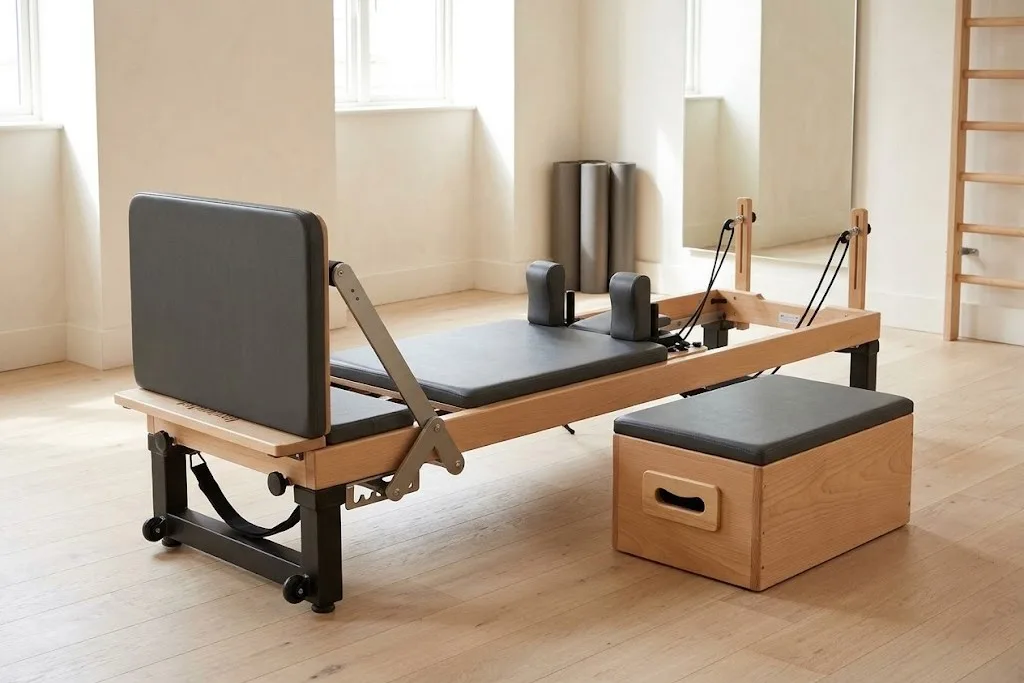
The sitting box is the most widely used reformer accessory. It is a standard part of the reformer, used for exercises in seated and lying positions on top of the carriage. It raises the client above the springs and ropes, so arm work, rowing series and prone exercises become possible.
The box is placed on the carriage, either lengthways or across it, depending on the exercise. It must sit securely without sliding, and the upholstered top must be firm enough to support the body without bottoming out.
How many: most studios order one per reformer, because group classes usually use the box at the same time on every machine.
The jump board
A jump board fixes at the footbar end of the reformer, replacing the footbar as the working surface. The client lies on the carriage and jumps against the board, with spring resistance controlling the load. Because the client is lying down, impact is much lower than jumping while standing.
Jump board classes have become a popular format in their own right. If your timetable includes them, every reformer in the room will need one.
How many: one per reformer if you run jump board classes; otherwise a few for private sessions.
The platform extender
A platform extender fills the gap at the end of the frame and creates a larger, stable standing surface. It supports standing exercises and transitions where clients step between the carriage and the frame.
How many: depends on your repertoire. Some studios use them on every machine; others keep a few for specific classes.
Straps, loops and handles
Ropes, straps and loops connect the client to the carriage through the pulleys. Double loops for hands and feet are standard. Adjustable straps change the length of the line for different body sizes and exercises.
These are working parts. Experienced equipment technicians note that some fuzziness from movement is usually normal, but any sign of thinning needs to be addressed and frayed stitching should be fixed, because it can affect strap integrity. Order spares, so a worn strap can be replaced without taking a machine out of service.
Matching accessories to the reformer
Accessories should be made for the reformer they are used on. A box that is slightly too wide or a jump board that does not seat properly is a safety risk.
On Round Fit equipment, the sitting box and jump board are made to fit the specific reformer, in solid hardwood with an upholstered face. The standard Studio Pro Reformer includes double loops, adjustable straps, shoulder rests, a jump board, a padded platform and a sitting box with a padded top.
Matching the look
Accessories are very visible. A room where every reformer is in pale ash but the boxes are in a different timber looks unplanned. Order accessories in the same timber, finish and upholstery as the reformers. If you add accessories later, keep a record of the specification so they match.
Planning for storage
Accessories need a place to live. Loose boxes and boards on the floor are trip hazards. The UK Health and Safety Executive notes that most trips are caused by obstructions in walkways.
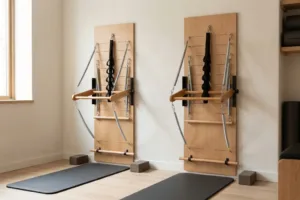
Plan wall racks for jump boards and platforms, and low shelves or cubbies for sitting boxes, at the same time as you plan the reformers.
Order to your class plan
The best way to decide quantities is to start from the timetable:
- List the class formats you will run in the first year.
- For each, note which accessories every client needs at the same time.
- Take the largest number for each accessory.
- Add a small number of spares for wear and private sessions.
Accessories are supplied as part of a project, so it is worth including them in the first order rather than adding them piecemeal.
You can explore accessory options in our Reformer configurator, or ask our team.