Many boutique studios sell a small range of products: grip socks, water bottles, mats, apparel, perhaps a few wellness products. Retail adds revenue, and branded products carry the studio’s name out into the world. It also gives clients something to browse while they wait for a class.
Badly planned retail does the opposite. Stock piles up on the reception desk, boxes sit on the floor and the entrance feels cluttered. The answer is shelving planned as part of the interior, not added afterwards.
Plan retail with reception
In most studios, retail sits next to reception. That works well for several reasons.
- Staff can see it. Products near the desk are less likely to go missing, and staff can answer questions and take payment without leaving their post.
- Clients see it while they wait. Check-in and the few minutes before class are natural browsing time.
- One payment point. The card terminal at the desk serves both bookings and sales.
Position the shelving so it is visible from the desk but does not narrow the route into the studio or changing rooms. The Health and Safety Executive notes that most trips at work are caused by obstructions in walkways. Clients stopping to browse should not block those arriving for class.
Shelves that change with the range
Retail ranges change. A seasonal colour of grip socks arrives, a new bottle replaces the old one, apparel comes and goes. Fixed shelving soon stops fitting the products.
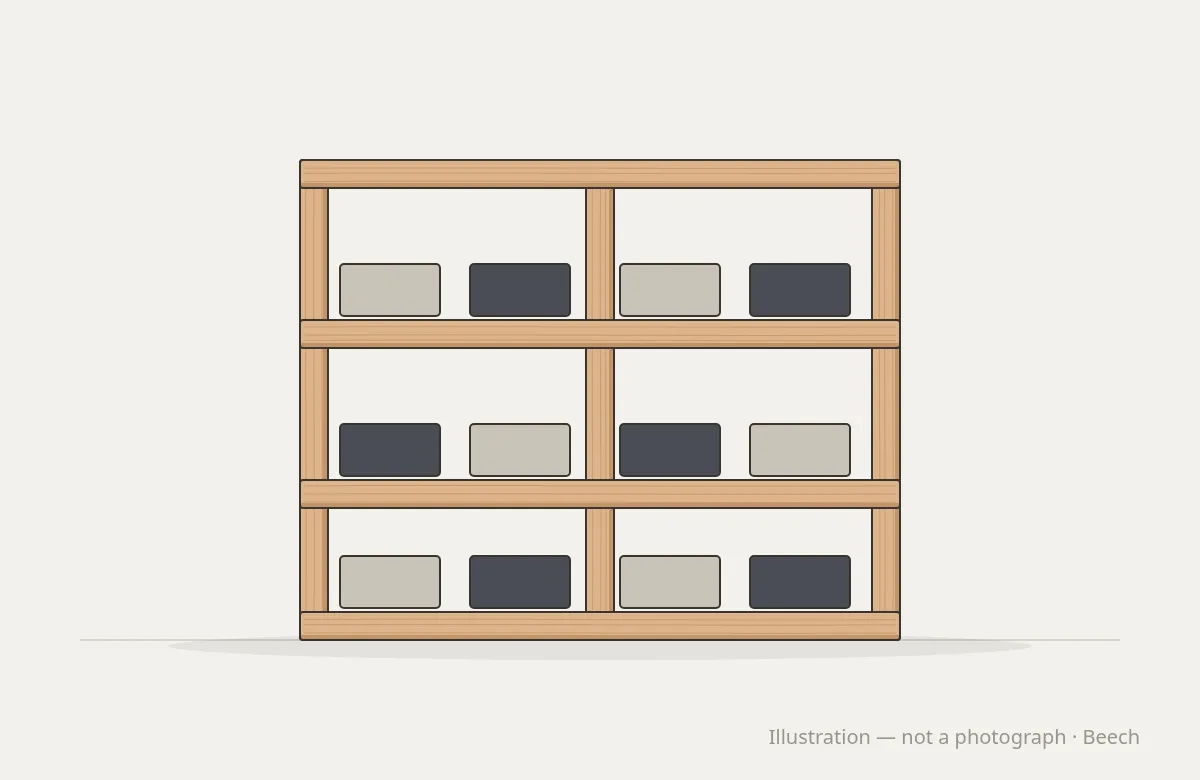
Adjustable shelves solve this. Shelves that can be moved up or down let the unit adapt to tall bottles one season and folded apparel the next.
A typical Round Fit Studio Space Retail Shelving unit is 100 × 35 × 200 cm (W × D × H), with adjustable shelves, and can be matched to the reception desk.
What goes where
Different products need different displays.
- Small items such as grip socks, hair ties and snacks suit shallow shelves at eye level, where they are easy to see and pick up.
- Bottles and cups suit mid-height shelves with enough height above them to lift one out easily.
- Folded apparel suits deeper shelves at waist to chest height.
- Hanging apparel needs a rail. A short hanging rail beside the shelves shows garments properly and saves folding.
- Mats and larger items suit lower shelves or a separate rack.
- Back stock belongs in closed storage, behind the desk or below the display, so the shop floor stays tidy.
The Health and Safety Executive’s manual handling risk filters show that handling is harder with arms extended or at very low or very high levels. Keep the products clients handle most between knee and shoulder height, and use the top and bottom shelves for display pieces and lighter stock.
Shelves that stay straight
A shelf that sags looks cheap and makes the whole display look tired. Timber shelves carry their load for months at a time, and that matters.
Timber under a constant load slowly deflects further over time. This is called creep. The American Wood Council, which publishes engineering standards for timber, explains that long-term deflection for seasoned timber can be expected to reach about 1.5 times the initial deflection, and about twice for unseasoned timber. A shelf that bends slightly on the first day will bend more after a season of heavy stock.
Good shelf design allows for this:
- Spans that suit the load. Shorter spans between supports, or a central support on wider units.
- Thickness that suits the material. A heavier load needs a thicker shelf.
- Edge stiffening. A solid hardwood front edge on a plywood shelf adds stiffness and protects the edge.
- Well-seasoned timber, which creeps less than timber that is still drying.
Humidity matters too. The Wood Handbook from the US Forest Products Laboratory explains that wood exchanges moisture with the surrounding air and swells and shrinks as humidity changes. Sealing every face keeps shelves stable and flat.
Labels and pricing
Leave space for simple labels or price cards on each shelf. A small channel or ledge on the front edge, or a discreet holder, keeps pricing tidy and consistent. Avoid sticking labels directly to the timber, where adhesive can mark the finish.
Materials and finish
Retail shelving is touched constantly by clients picking up and putting back products. It should be:
- Solid hardwood or quality plywood, never chipboard or MDF, which sag and chip more easily.
- Finished to resist handling and cleaning. Resistance of furniture surfaces to liquids is assessed under BS EN 12720. A matt lacquer does not show fingerprints and keeps the products, not the shelf, in focus.
- Matched to the reception desk and studio equipment, so retail reads as part of the interior rather than a shop fitting.
One unit, many sites
For a chain or franchise, retail shelving is an ideal candidate for a standard design. One unit, in one species and finish, can be repeated across every site. Staff learn one layout, merchandising is consistent and the brand looks the same from one location to the next.
See our solutions for chains & franchises, or send us your range and floor plan and discuss your project with us.