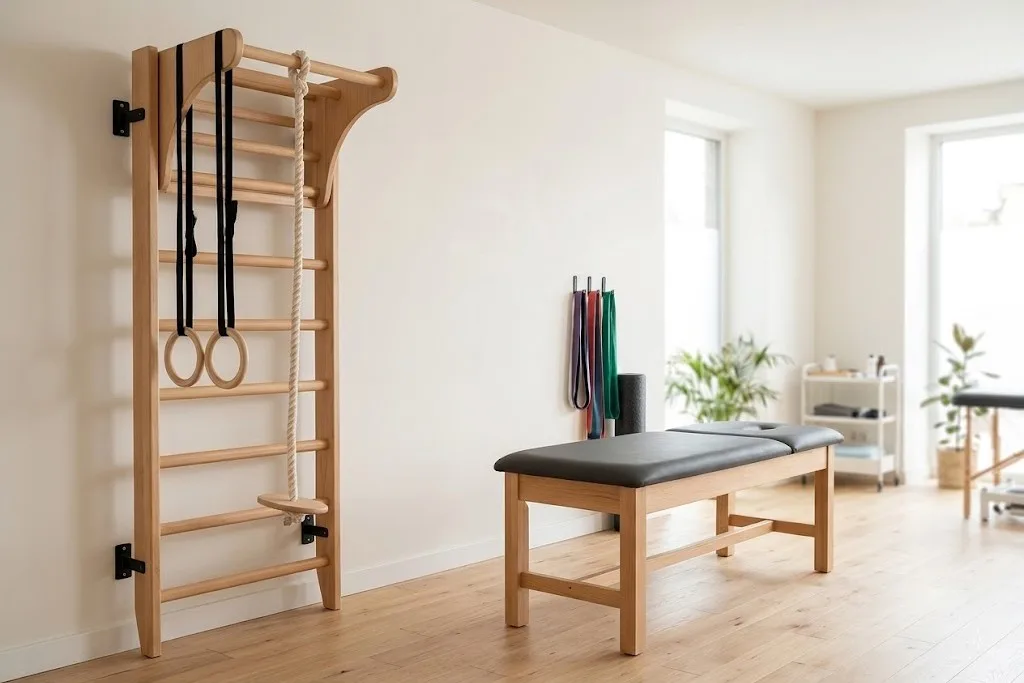
Wall bars have been part of therapeutic exercise for two centuries. They give a patient a stable, adjustable point of support for stretching, balance work, assisted standing and strengthening. In a clinic, though, they are used differently from a gym. Sessions are one-to-one, patients may have limited mobility, and the therapist needs room to assist.
This article covers the history and clinical role of wall bars, and what a clinic should consider when planning them. It is general guidance. Exercise programmes should always be set by a qualified physiotherapist.
A long therapeutic history
Wall bars are often called Swedish ladders. Their history is long. Early wooden climbing frames in Germany were developed into ladder exercises, and Per Henrik Ling used wall bars in Sweden in the early nineteenth century. Migrants took the apparatus to the United States, where wall bars became common in gyms from the late 1800s. US Army physiotherapists used wall bars in the “Therapeutic Gymnasium” from the Second World War into the early 1960s, and stall bars are still widely used in physiotherapy today.
Ling is said to have recognised their therapeutic potential while suffering from arthritis, and founded the Royal Institute for Gymnastics in Stockholm. Traditional wall bars used beech, with oval rungs around 40 mm thick and a top rung extended for hanging.
What wall bars offer a clinic
- Support at many heights. A patient can hold the rung that suits their height and ability, from low supported squats to overhead stretches.
- Graded challenge. Moving from two hands to one, or from a lower to a higher rung, changes the difficulty in small steps.
- Confidence. A fixed, solid support helps patients attempt movements they would avoid in open space.
- Versatility. Stretching, balance, step-ups, supported standing, and attachment of bands for resistance work.
These fit within broader exercise therapy. NICE guideline NG59 on low back pain, for example, recommends considering group exercise programmes, including biomechanical approaches. Wall bars are one of many tools a physiotherapist may use within such a programme.
Planning around the therapist
In a clinic, the space around the wall bars matters as much as the bars themselves.
Room to assist. The therapist should be able to stand beside and slightly behind the patient on either side.
Access. Patients using walking aids or wheelchairs need clear space to approach and position themselves, and room to turn.
Nearby equipment. A plinth, mat or chair close by allows exercises to move from standing to seated or lying without a long walk.
Clear floor. The UK Health and Safety Executive notes that most trips are caused by obstructions in walkways. In a clinic, the floor in front of the bars should always be clear.
Configuration for clinical use
Rung spacing. Clinical programmes may need different spacing from gym bars, or additional rungs at particular heights. Discuss this with the physiotherapist who will use the bars.
Width. Wider bars allow both hands at shoulder width or wider, and room for the therapist’s hands.
Height. Full-height bars give the widest range. Lower bars may suit rooms with low ceilings or programmes that do not need overhead work.
Number of bays. One bay is often enough for one-to-one work. Group rehab classes may need several, each fixed independently.
Construction and finish
- Rungs smooth along their full length, with no sharp transitions where they enter the stiles.
- Straight-grained hardwood for rungs and stiles. The Wood Database describes European ash as shock resistant, and beech as stiff and smooth in the hand.
- A matt finish that grips well, tolerates frequent cleaning and does not feel slippery.
- No sharp edges anywhere a patient might lean or fall against.
Fixing to the wall
Wall bars are only as safe as their fixings. Wall bars are covered by BS EN 12346, which sets safety requirements and test methods. In the UK, BS 8539 is the code of practice for anchors in concrete and masonry. Under it, the anchor should be selected and specified carefully, and inspected before load is applied. Stud walls usually need added structure.
Round Fit installs through local distribution partners, who assess the wall before fitting. Every piece is tested before it leaves the workshop.
Hygiene
Rungs are touched by many patients. Clean them routinely with a product suitable for lacquered timber, and follow the label contact time for any disinfectant. A closed, sealed finish makes cleaning easier and protects the timber.
See our rehab and physiotherapy solutions. If you are planning a clinic, we would be glad to discuss it.