Kettlebells and medicine balls are staples of functional training, and they are awkward to store. Kettlebells are heavy, have handles that need clearance and flat bases that sit well on a shelf. Medicine balls roll. A shelf designed for one rarely suits the other.
This article explains how to plan storage for both, so equipment is quick to grab at the start of a class, easy to return at the end and never left rolling around the floor.
Different shapes, different needs
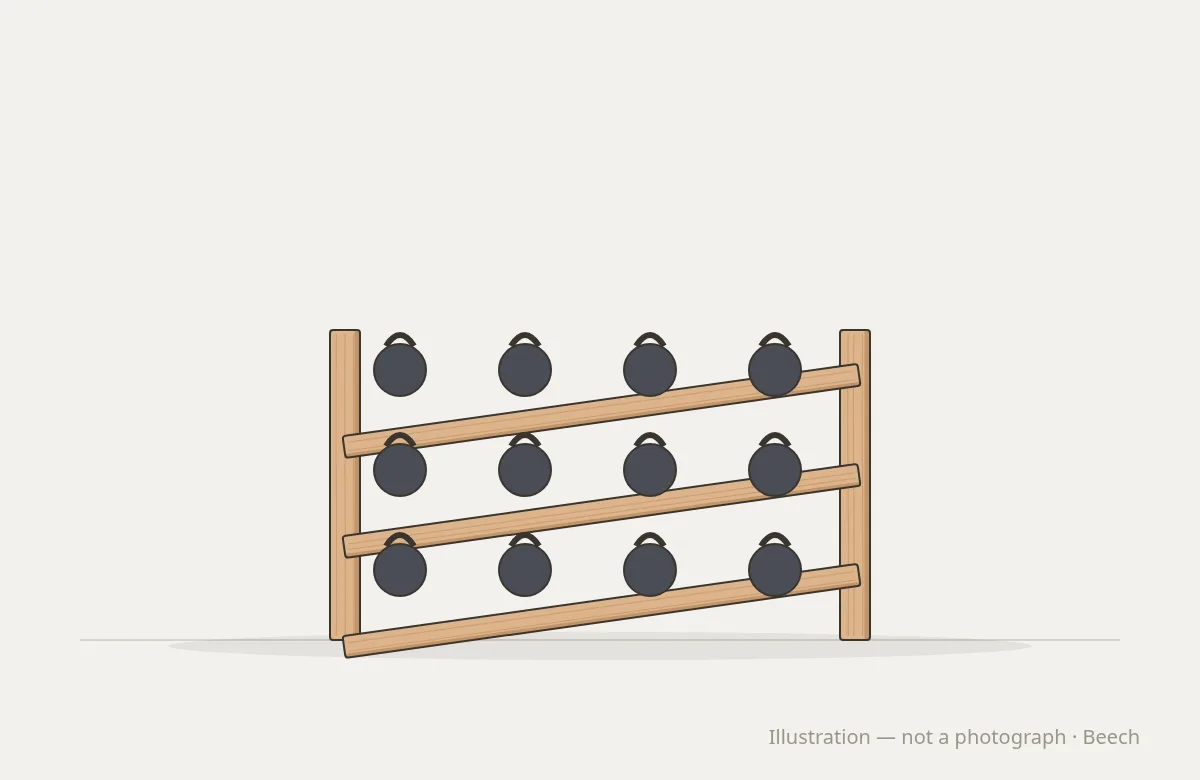
Kettlebells have a flat base and a handle on top. They sit stably on a level shelf. The challenge is reaching the handle: a shelf that is too close to the one above leaves no room for a hand.
Medicine balls are round and roll on a flat surface. They need a lip, a cradle or a slightly dished shelf to stay in place.
Slam balls and wall balls are larger and softer. They need more space per ball and often store best in a dedicated bay or tall cradle.
Plan for access, not just capacity
At the start of a class, many clients collect equipment at once. At the end, they all return it. Storage should make both quick:
- Open shelves, with nothing to open or unlock.
- One item per position, so clients can see what is missing.
- Weights in order, lightest to heaviest, in one direction.
- Enough frontage for several people to reach the rack at the same time.
Heights and handling
Kettlebells are concentrated, heavy loads. The UK Health and Safety Executive’s manual handling risk filters note that acceptable weights reduce when items are handled at high or low levels, or with arms extended. Practical rules follow:
- Heavier kettlebells on the lower-middle shelves, not on the floor and not above chest height.
- Lighter kettlebells and medicine balls higher up.
- Shallow enough shelves that clients do not reach deep into the rack.
- Clearance above each kettlebell for a hand on the handle, typically more than the handle height alone.
Keep the floor clear
The HSE notes that most trips are caused by obstructions in walkways, and that walkways must be kept clear. A medicine ball left on the floor is especially hazardous, because it rolls underfoot. Clear storage close to the training area, with a fixed place for every item, is the best defence.
Place the rack:
- Next to the floor area used for kettlebell and ball work.
- Against a wall, with clear space in front.
- Away from doors and main walkways.
Common industry guidance suggests at least 40 square feet (about 3.7 m²) per participant in HIIT and circuit training. Size the floor area to your largest class, and size the rack to the equipment that class uses at once.
Construction
Kettlebell storage carries heavy, concentrated loads and takes impacts every day.
- Materials. Solid hardwood frames with solid hardwood or plywood shelves. Plywood stays flat across a wide shelf.
- Shelf edges. A raised front lip stops medicine balls rolling off. A rounded edge protects hands and the equipment.
- Fixings. The Wood Handbook from the US Forest Products Laboratory notes that screws hold much better in dense timber, and much less well in end grain. Shelves should be supported by joints designed for the full load, not by screws alone in end grain.
- Stability. A tall rack should be fixed to the wall so it cannot tip when loaded unevenly.
- Finish. A matt lacquer protects the timber from sweat, chalk and cleaning products.
The Round Fit Studio Strength Kettlebell & Medicine Ball Rack is typically 120 cm wide, 50 cm deep and 90 cm high, in solid hardwood with open shelves sized to the kit.
Combining with other storage
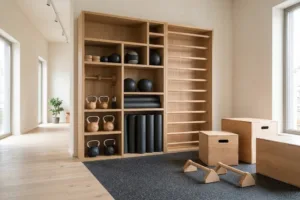
In a small studio, one storage wall often holds kettlebells, medicine balls, dumbbells, mats and small kit together. That works well if each type has its own zone:
- Dumbbells on angled tiers.
- Kettlebells on level shelves with handle clearance.
- Medicine balls in cradles or lipped shelves.
- Mats and bands on hooks or rails above.
Built in the same timber and finish, the wall reads as one piece of joinery.
Checklist
- List every kettlebell and ball, current and planned.
- Measure kettlebell heights and ball diameters.
- Plan shelves with handle clearance and lips for balls.
- Put heavier items at a comfortable lifting height.
- Place the rack next to the training floor, with clear space in front.
- Fix tall racks to the wall.
Every Round Fit piece is tested before it leaves the workshop. See storage in our Strength & Functional collection, or send us your kit list and we will plan the shelves with you.