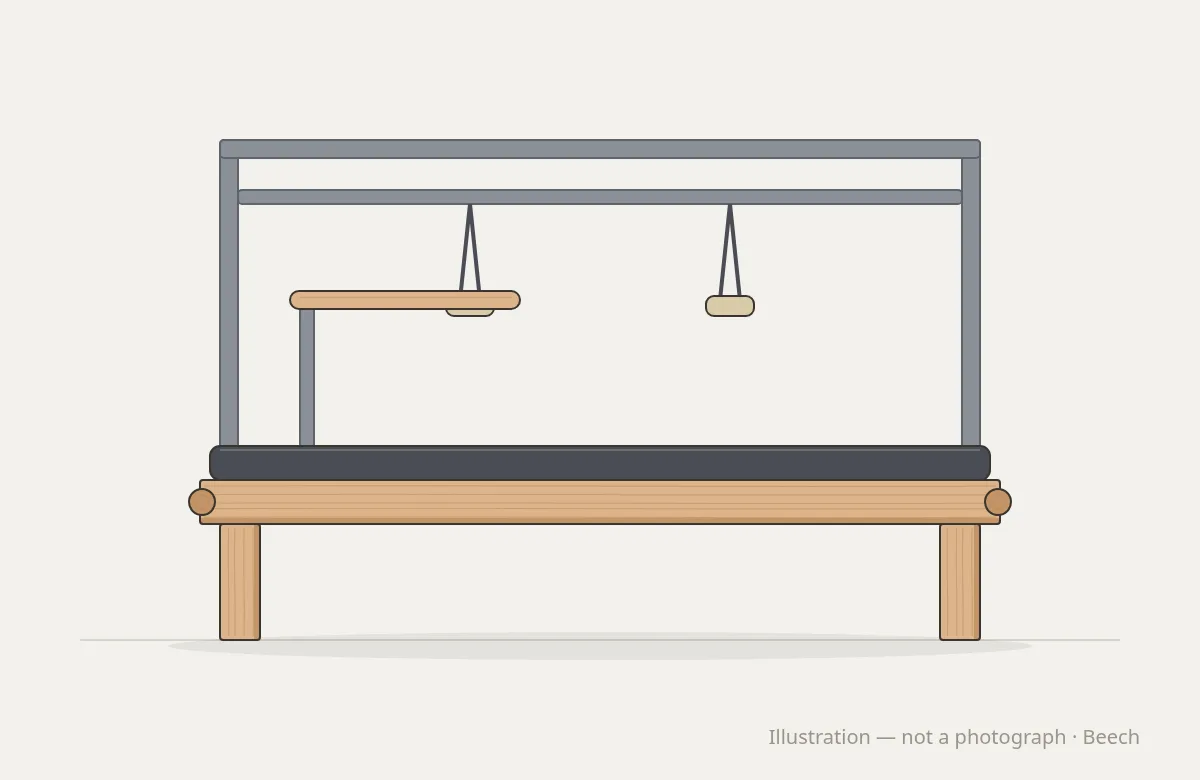
The Cadillac, also called the trapeze table, is often the centrepiece of a clinical Pilates room. It is a raised, padded table inside a four-post frame. Springs, bars and straps attach to the frame at many points, so a patient can work lying, sitting, kneeling or standing, with as much support or resistance as they need.
For a clinic, that combination is valuable. The table is stable and does not move. It is higher than a mat, so many patients find it easier to get on and off than the floor. And the springs can assist a movement as well as resist it, which helps patients who cannot yet manage an exercise on their own.
This article covers the practical points a clinic should consider before ordering one. Exercise programmes should always be set by a qualified physiotherapist or clinician.
Why clinics use Pilates apparatus
Exercise is central to the management of many musculoskeletal conditions. NICE’s guideline on low back pain and sciatica, NG59, recommends that people consider a group exercise programme, which may include biomechanical, aerobic, mind-body or combined approaches. A Cochrane review of Pilates for chronic low back pain, summarised by the American Academy of Family Physicians, found that Pilates reduced pain compared with minimal intervention in the short and intermediate term, although it was not shown to be better than other forms of exercise and most of the evidence was of low to moderate quality.
The Cadillac is well suited to individual clinical work within that kind of programme, because it can be adjusted so precisely to the patient.
What the Cadillac offers
- A fixed, stable table. Unlike a reformer, there is no moving carriage. Patients who are anxious or unsteady feel secure.
- Spring-assisted and spring-resisted work. Springs attached at different heights and positions allow gentle, supported movement or progressive strengthening.
- A push-through bar and trapeze for supported stretching, spinal mobility and upper-body work.
- Positions for every stage. Lying, side-lying, sitting, kneeling and standing work are all possible, so the same apparatus serves early and late rehabilitation.
As an example, the Round Fit Studio Pro Cadillac is 220 cm long, 74 cm wide and 215 cm high overall. Its solid beech base is 59 cm high, with a chrome-steel canopy bolted to the base at eight points. It comes with twelve colour-coded springs, two trapeze springs, a trapeze, a push-through bar and a breathing bar.
Check the room first
A Cadillac is a large, fixed piece of equipment. Before ordering, check:
Ceiling height. The frame itself is over two metres high. Allow extra height above it for overhead work, light fittings and any ceiling services.
Floor area. The table occupies roughly 2.2 × 0.75 m. The physiotherapist needs to move around all four sides: at the head, at the foot and along both sides, to position springs, guide the patient and assist transfers. In practice, plan for a clear zone around the whole frame.
Delivery route. Check the door widths, corridors and any lifts between the entrance and the treatment room. Large apparatus is often delivered in sections and assembled on site, but the parts are still long and heavy.
Access for patients. Many patients walk slowly or use aids. Keep a clear, level route from the door to the Cadillac, with space beside the table for a walking frame or wheelchair. BS 8300-2 sets out design guidance for accessible buildings, and your designer should check the layout against it. The Health and Safety Executive notes that most trips at work are caused by obstructions in walkways, so store accessories and props away from the patient route.
Getting on and off
Transfers are where many patients need the most help. The height of the table, the space beside it and the position of the frame posts all affect how easy a transfer is.
- Keep one long side of the table free of obstructions for transfers.
- Have a stable step or platform available for patients who need it.
- Consider the physiotherapist’s posture too. The Health and Safety Executive’s manual handling risk filters show that handling is harder with arms extended or at very low or very high levels. A clear space beside the table lets the therapist assist from a good position.
Upholstery and cleaning
In a clinic, the table is cleaned between every patient. The upholstery must tolerate frequent cleaning and the clinic’s disinfectants.
A comparison published by the Chemical Fabrics and Film Association notes that PVC is not subject to hydrolysis to any significant degree and rates good to excellent with disinfectants, while polyurethane rates lower and has failed early with some quaternary ammonium cleaners. Check the cover material against the clinic’s actual products, and follow the disinfectant label, including its contact time, as the US Centers for Disease Control and Prevention advises.
Round Fit upholstery is available in a base palette or any custom colour. Covers and springs are replaceable, so worn parts can be renewed without replacing the apparatus.
Inspection and care
A Cadillac has springs, bars, straps and fixings that need regular checks. The Health and Safety Executive’s guidance on inspecting work equipment recommends inspection after installation and at suitable intervals where equipment is exposed to conditions that could cause deterioration, with results recorded. For a Cadillac, that means routine checks of springs, straps, bars, canopy bolts and upholstery, and taking it out of use if anything looks wrong.
Built for clinical use
Round Fit machines its timber and makes its steel parts in-house. Every piece is tested before it leaves the workshop, and frames carry a five-year warranty. Pilates equipment is typically ready in four to six weeks.
See the Cadillac in our Pilates collection and our solutions for rehab clinics. If you are planning a clinical Pilates room, tell us about the room.