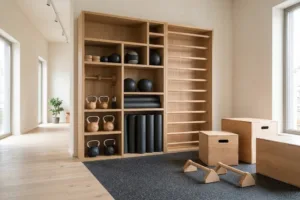
A plyo box looks like the simplest piece of equipment in the room. It is a box. But it is jumped on, stepped on and dropped onto, often by tired clients near the end of a class. It must be rigid, stable and grippy every time. And a studio usually needs several heights.
A 3-in-1 box solves the height problem with one object. This article explains how it works, what makes a commercial box safe, and how to use boxes well in a class.
Three heights in one box
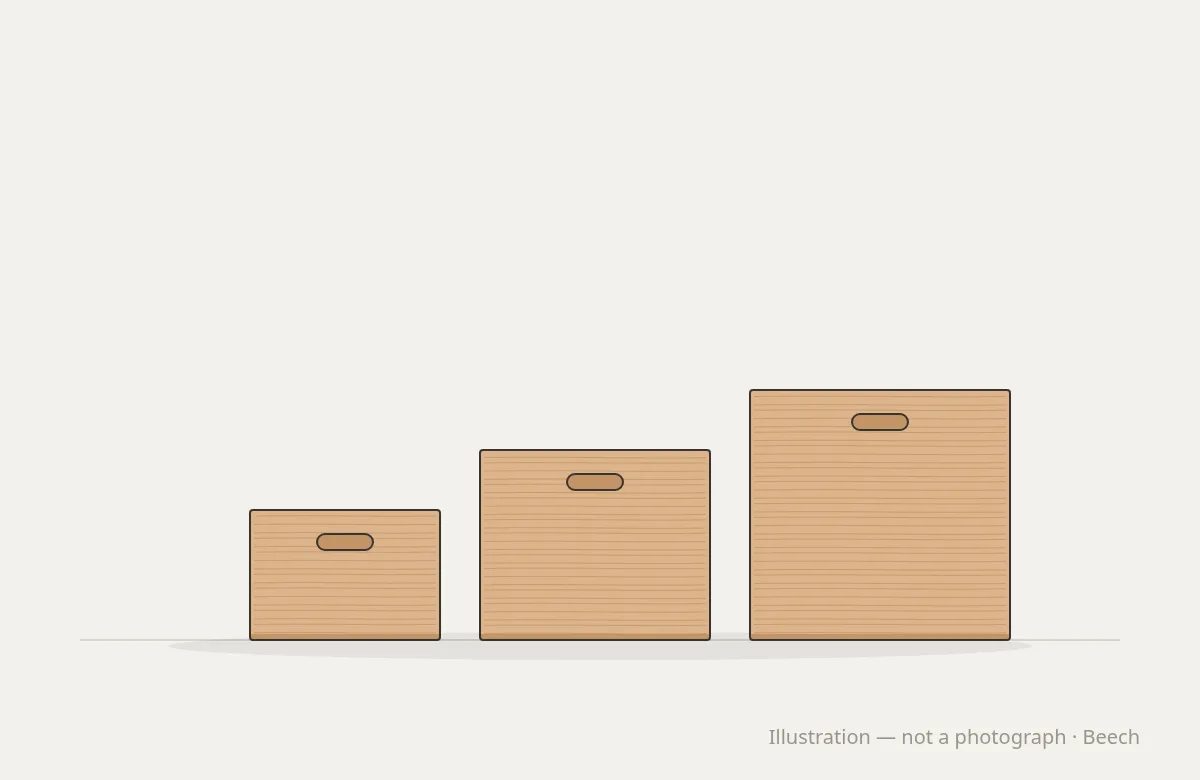
A 3-in-1 box has three different side dimensions. Turned onto a different face, it gives a different working height. The Round Fit Studio Strength Plyo Box, for example, gives 50, 60 and 75 cm (about 20, 24 and 30 inches) in one box.
For a commercial room, that has clear advantages:
- One box per station instead of three.
- Less storage and less floor taken up between classes.
- Quick changes between heights during a session.
Choosing the right height
Box height should match the client, not their ambition. Guidance from the US National Academy of Sports Medicine on the box jump says:
- Choose a height you can land on safely and with control.
- Beginners might start around 12 to 18 inches (about 30 to 45 cm) and increase height only as power and landing mechanics improve.
- A box that is too high compromises landing and raises injury risk.
For beginners, that means lower boxes or step-ups first. A 3-in-1 box with a 50 cm lowest height suits intermediate users; a studio teaching beginners may also need lower boxes or steps.
Landing and stepping down
The same NASM guidance gives landing cues that coaches will recognise:
- Land softly and symmetrically on both feet, with knees bent.
- Step down rather than jumping down, which adds impact to the joints.
- Rest fully between sets, and never perform plyometrics to failure, because fatigue degrades landing mechanics.
Equipment cannot replace good coaching. But a box that is stable, grippy and the right height makes good technique easier.
What makes a commercial box safe
Rigid joints. A box must not flex, creak or rack under a landing. Joints should be glued and mechanically fixed, with internal bracing where needed.
Stable footprint. The box should sit flat and not slide on the floor. The base edges should be in full contact with the floor on every orientation.
Rounded edges. Shins and hands will meet the edges. Rounded edges reduce injury and damage.
Grip. The top surfaces need grip that holds a shoe without being abrasive to skin.
Hand slots. Slots make the box easier to lift and turn. The HSE’s manual handling risk filters note that acceptable weights reduce when items are handled at low levels or with arms extended, so a good grip point matters.
A wipeable finish. A matt lacquer protects the timber from sweat and cleaning.
Plywood or solid hardwood
For the large flat faces, plywood is usually the better choice. Its cross-laminated veneers keep wide panels flat and resist splitting along the grain, which a solid board of the same size may not. Solid hardwood suits frames, edges and internal bracing.
Fixings need care. The Wood Handbook from the US Forest Products Laboratory notes that screws in end grain hold only about 75 per cent of their side-grain value. Box joints should not rely on screws into end grain alone.
Round Fit builds plyo boxes in plywood and solid hardwood, and does not use chipboard or MDF.
Using boxes in class
- One box per client, set to the right height for each person.
- Clear space around each box, with nothing behind the landing area.
- Boxes away from mirrors and walls, so a missed jump has room.
- Storage close to the training floor. The HSE notes that most trips are caused by obstructions in walkways.
Checklist
- Which heights do your clients need?
- Do you also need a lower option for beginners?
- Are the joints rigid and the edges rounded?
- Is the surface grippy but not abrasive?
- Are there hand slots for lifting and turning?
- Where will boxes be stored?
Every Round Fit piece is tested before it leaves the workshop. See the box in our Strength & Functional collection. Need different heights? Let us know.