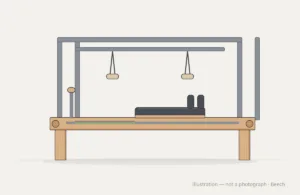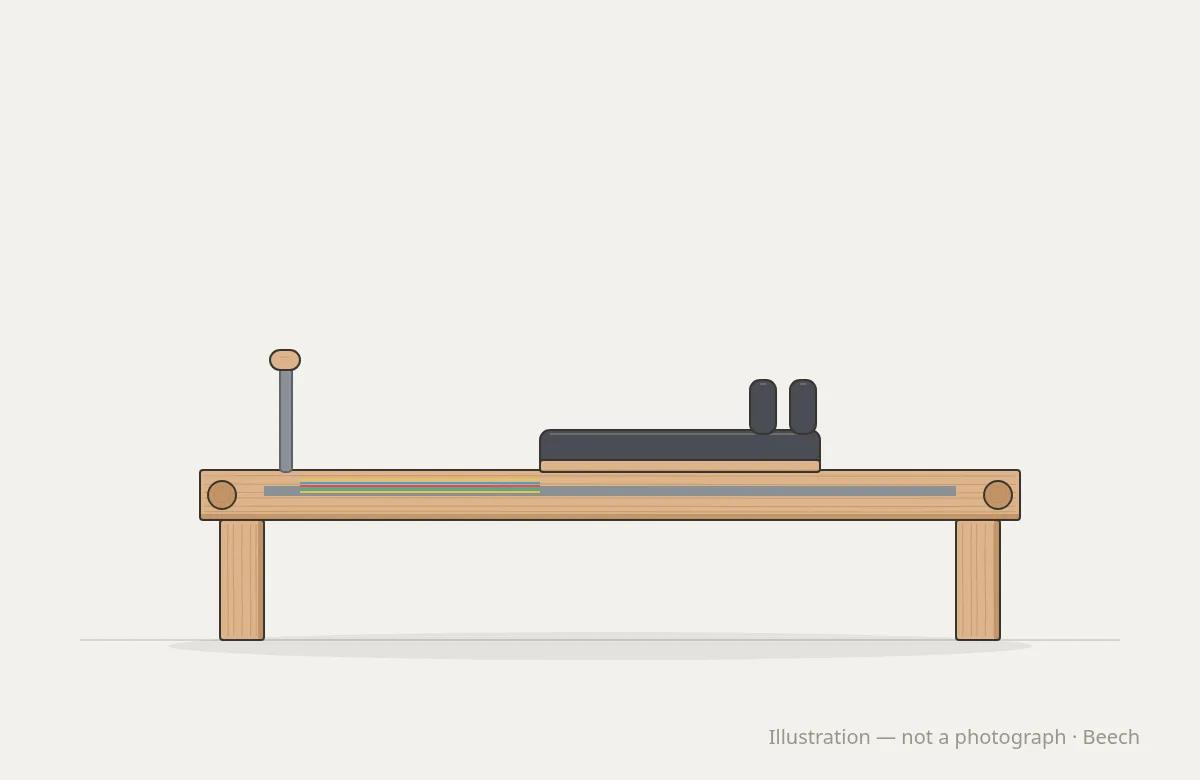
A reformer frame can last for many years. The springs and straps on it will not. They stretch, bend and rub thousands of times a week, and every one of those cycles uses up a little of their life. Studios that treat springs and straps as consumables, with a plan to inspect and replace them, avoid the sudden failures that injure clients and close machines.
This article explains why springs and straps wear, what to look for, and how to plan their replacement across a studio.
Why springs wear out
A reformer spring is an extension spring: a coil of steel wire that stores energy when it is stretched and returns it when released. Spring engineering guidance describes two separate ways in which springs lose performance.
Fatigue. Every stretch and release is a stress cycle. Over many cycles, small cracks can form and grow until the wire breaks. Engineering references note that fatigue cracks usually start at the surface of the wire, so surface damage such as scratches, nicks or corrosion shortens fatigue life. They also note that the lower the working stress, the longer the expected life of a spring.
Relaxation. Under repeated or sustained load, a spring can slowly lose some of the force it exerts. The technical literature describes this as gradual and, over a long enough period, inevitable. Heat speeds it up, and so does overloading. A relaxed spring may still look normal, but it no longer gives the resistance the instructor and client expect.
Both effects build up quietly. That is why springs need a schedule, not just a glance when something seems wrong.
What speeds up spring wear
- Over-stretching. Pulling a spring beyond its intended working range raises the stress on the wire. Make sure the carriage stops, footbar positions and spring lengths are set up as the manufacturer intended.
- Corrosion. Sweat, cleaning liquids and humid air can cause rust. Corrosion attacks the surface, which is exactly where fatigue cracks start.
- Damage to the coils. Springs dropped on hard floors, or knocked against frames, can pick up nicks that become crack starters.
- Heat. Springs stored or used next to heaters, or in direct sun, relax faster.
- Uneven use. In many studios the same springs on the same machines do most of the work. They wear faster than the rest.
What to check on springs
As part of a weekly inspection, look at each spring along its full length:
- gaps between coils that are uneven or that stay open when the spring is at rest;
- rust, pitting or flaking of any coating;
- kinks, bends or flattened coils;
- wear or deformation at the hooks and end fittings;
- any spring that feels noticeably lighter than others of the same colour or rating.
A spring with any of these signs should be taken out of use and replaced. Do not try to straighten, re-hook or repair a spring.
Why straps wear out
Straps, loops and ropes are made from textile webbing or rope, often with a padded handle or foot loop. They wear by abrasion where they run over pulleys and through fittings, and by repeated flexing at the points where they are stitched or clipped.
Check straps for:
- fraying, thinning or flattening, especially where they run over pulleys;
- broken or loose stitching at loops and joins;
- cracked, bent or sharp-edged clips and hardware;
- stiffness or hardening caused by sweat and cleaning products;
- worn or split padding on handles and loops.
Run each strap through your hands along its full length. Damage often hides on the underside, where it contacts the pulley.
Treat them as consumables
The simplest way to manage springs and straps is to plan for their replacement from the start.
- Follow the manufacturer’s replacement guidance. Ask your supplier for a recommended interval for springs and straps, based on your expected use.
- Replace springs in sets. If springs on one machine are replaced one at a time, the old and new ones will give different resistance. Changing a full set keeps the machine consistent.
- Keep a log. Record when each set was fitted, and note any spring or strap taken out of use and why. The UK Health and Safety Executive’s guidance on inspecting work equipment under PUWER recommends risk-based inspection by a competent person, with records kept at least until the next inspection.
- Hold spares. Keep a small stock of springs and straps, so a machine can be put back into use quickly. Check that spares match the specification of the originals exactly.
- Rotate machines. Where some machines see much heavier use, rotate class bookings so wear is shared.
Cleaning springs and straps
Wipe springs with a dry or barely damp cloth, then dry them. Do not soak them in liquid or spray disinfectant directly into the coils. For straps and padded loops, follow the same rules as for upholstery: mild cleaner, no solvents, and dry well. Never store damp straps in a closed box.
Standards and suppliers
EN ISO 20957-1 sets general safety requirements for stationary training equipment used in clubs, studios and similar settings. Ask your supplier for the instructions for use and maintenance when you buy, and keep them with the machine.
Round Fit makes reformers in solid hardwood, beech as standard or any species on request, and every piece is tested before it leaves the workshop. The frame carries a five-year warranty. When you order, ask us which springs and straps are fitted and how often to plan their replacement for your level of use.
Explore the Pilates collection, configure a reformer, or discuss your project with us.