Many hotels and spas would like to offer Pilates but have only a small room to give it. A dedicated studio with a row of reformers is out of the question. A quiet room of 15 or 20 square metres beside the spa or the gym is not.
That can be enough. A compact Pilates zone works well when the equipment is chosen for the space and for the kind of sessions the property will actually run. This article explains how to plan one.
Why Pilates suits hotels and spas
Wellness has become a real reason to travel. Global Wellness Institute research puts the wellness tourism market at about $830 billion in 2023 and forecasts it to pass $1.3 trillion by 2028. Pilates fits that demand well. It is low-impact, suits guests of very different fitness levels and works as a private session, a small group or a guided self-practice.
Unlike a busy studio, a hotel rarely needs ten reformers in a row. It needs one or two well-chosen pieces that can serve many guests and many types of session.
Start with the sessions
Decide how the room will be used before choosing equipment.
- Private sessions with a visiting or resident instructor: one piece of apparatus and a mat may be enough.
- Small groups of two to four guests: two or three reformers, or a reformer and a spring wall.
- Guided self-practice, where guests follow a video or printed guide: equipment must be simple and safe to use without supervision.
- Clinical or recovery sessions in a medical spa: a Cadillac or tower may be more useful than a standard reformer.
Most properties combine instructor-led sessions with some unsupervised access. Plan for both.
One footprint, many exercises
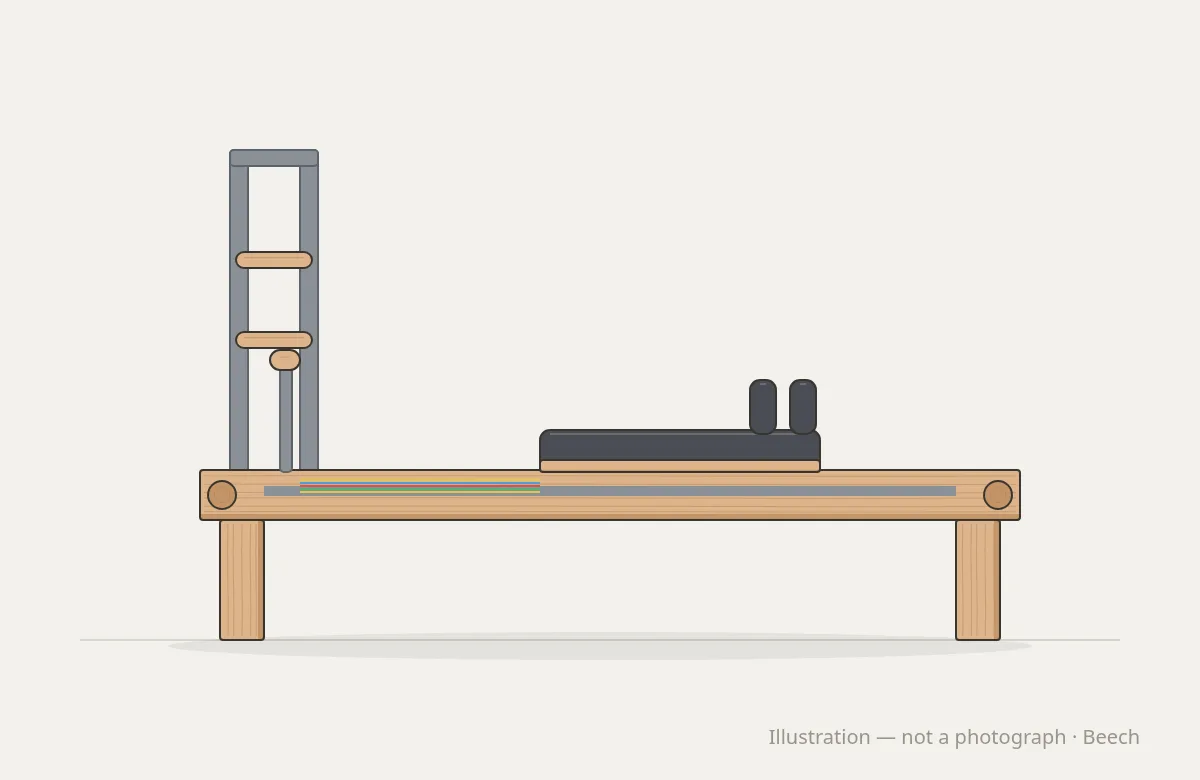
In a small room, every piece of equipment has to earn its place. A tower reformer is often the best single choice. It combines a reformer with a vertical frame at one end, so the same footprint supports both reformer work and tower exercises with springs, a push-through bar and a breathing bar.
As an example, the Round Fit Studio Pro Tower Reformer is 235 × 68.5 cm in plan and 185 cm high with the tower fitted. It has five carriage springs and ten tower springs, and the carriage can be locked to use it as a tower. A sitting box, jump board and mat converter are included, which extends the range further.
A spring wall is another option for very small rooms. It mounts flat on the wall and needs only a mat-sized space in front of it, so the floor can be used for other things between sessions.
Space around each machine
Equipment needs room around it for the guest to get on and off, for the instructor to assist and for safe circulation.
There is no single legal standard for Pilates spacing, and published guidance varies. Studio design guides commonly suggest roughly 3.7 to 4.6 m² per reformer, including clearance. In practice, plan:
- At least a metre between reformers, and more if the instructor needs to stand between them.
- Clear space at the head and foot of each machine for getting on, footwork and standing exercises.
- A clear route from the door to each machine. The Health and Safety Executive notes that most trips at work are caused by obstructions in walkways. In a small room, that usually means a sitting box or a water bottle left on the floor.
Ceiling height matters for towers and Cadillacs. Check the full height of the apparatus, and allow for raised arms, overhead light fittings and any ceiling-mounted equipment.
Storage and mirrors
A small room becomes cluttered quickly.
- Wall storage for the sitting box, jump board, mats, small balls and rings keeps the floor clear.
- Hooks or a rail for straps and loops keep them untangled.
- A mirror helps guests check their alignment, particularly in self-guided sessions. Use safety-backed glass and keep it clear of the swing of any moving parts.
Make it safe to use alone
In a hotel or spa, the room may be used without an instructor present.
- Simple instructions beside the equipment, or a QR code linking to approved videos.
- Clear rules for which exercises are suitable without supervision.
- Equipment designed for commercial use. The international safety standard for stationary training equipment, EN ISO 20957-1:2024, covers equipment used in studios, clubs, hotels and rehabilitation centres. Ask your supplier which standards their designs follow and how each piece is tested.
- A routine check of springs, ropes and upholstery, with a clear process for taking a machine out of use if something looks wrong.
A booking model
Decide early how guests will book and pay. Private sessions with an instructor, small-group classes, a free self-practice slot or a mix all affect how many machines you need and how the room is laid out. A small room with one tower reformer can be fully booked with private sessions, while a self-practice model may need a second piece of equipment.
Matching the property
A Pilates zone in a hotel or spa should feel like part of the property. Equipment in solid timber, with a matt finish and upholstery in a colour chosen for the scheme, sits naturally beside treatment rooms and lounges. Round Fit makes its Pilates equipment in solid beech as standard, or in any species on request, with upholstery in a base palette or any custom colour. Pilates equipment is typically ready in four to six weeks.
See the Pilates collection or build a machine in the Reformer configurator. Share your room plan and discuss your project with us.