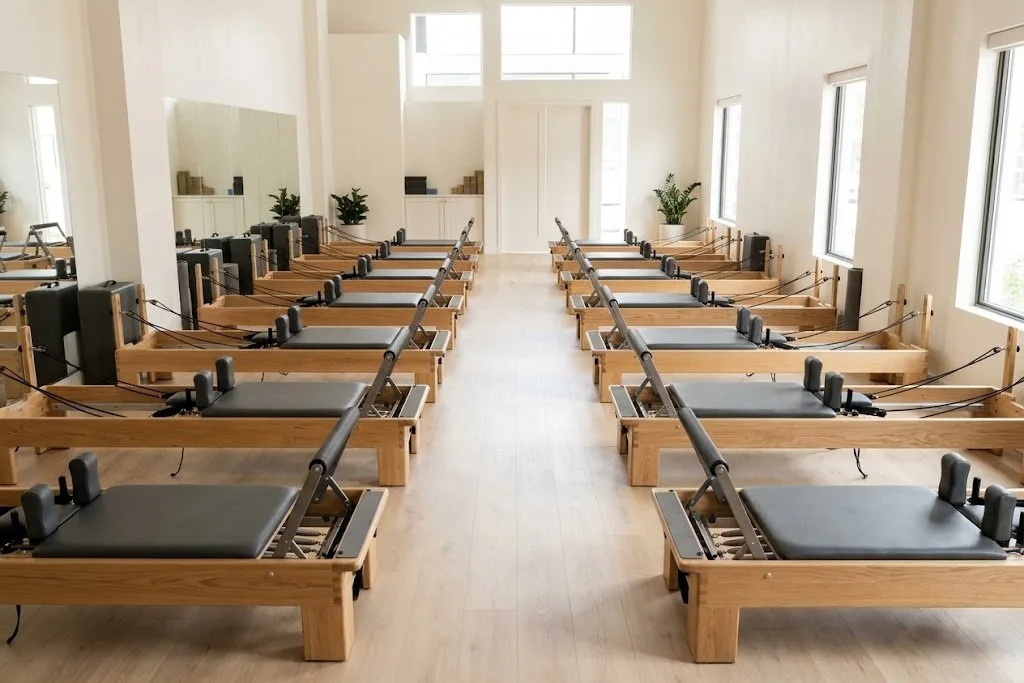
A studio chain promises its members one thing above all: every studio should feel the same. The same class, the same cues, the same quality. Equipment is a large part of that promise. When a member moves from one location to another, the reformer should look, feel and behave the same way.
Private label reformers help chains keep that promise. This article explains what private label means, how it differs from simply adding a logo, and what a chain should agree with its manufacturer before the first order.
Private label and white label
The two terms are often confused. The difference is simple:
- White label means buying a pre-made product with little or no customisation and adding your own logo. The same product is often sold by many other brands.
- Private label means working with a manufacturer to create a product exclusive to your brand, with your own specification. Exclusivity agreements typically stop the manufacturer selling the same product to other brands.
The main advantages of private label are control over specification, exclusivity and the ability to refine the product over time. The trade-offs are more upfront investment, a longer development time and the need to be confident in demand.
For a reformer, private label means the chain controls the timber, colour, upholstery, accessories and branding, and every site receives the same machine.
Lock the specification
The heart of a private label programme is a locked specification. It records every choice so that every order, at every site, is identical. It should include:
- Base model and dimensions. For example, the Round Fit Studio Pro Reformer is 235 cm long and 68.5 cm wide, with a maximum user weight of 180 kg.
- Timber species for the frame.
- Finish and colour, with an RAL or NCS reference and an approved physical master sample.
- Upholstery cover, colour, rub count and fire performance level.
- Springs and their colour coding, so instructors at every site use the same cues.
- Accessories included with each machine.
- Branding method and position.
RAL’s own guidance notes that printed colour charts are not binding and cannot reproduce every shade accurately. A physical master sample, kept by both the chain and the manufacturer, avoids slow drift in colour from one batch to the next.
Branding
Private label is more than a logo, but the logo still matters. Options include:
- Engraving into the timber.
- Inlay of a contrasting material.
- A fitted plate in metal or another material.
- Printed or stitched details on upholstery.
The right method depends on the material and on how much wear the branded area will see. Placement should be consistent across every machine and every site.
Protecting the design
If a chain develops a distinctive look for its reformers, it may want to protect it. In the UK, a registered design protects the appearance of a product, such as its shape, configuration, decoration or colour. The government’s guidance explains that a registration lasts five years and can be renewed every five years up to a maximum of 25 years. It does not protect how a product works.
UK law also provides unregistered design right, which can protect the shape of a three-dimensional design for a limited period without registration. Chains should agree with the manufacturer, in writing, who owns which design rights, and take legal advice where the design is important to the brand.
Accessory packs and spares
Each site needs the same accessories, and it needs replacements over time. Agree:
- A standard accessory pack per reformer.
- Replacement upholstery made to the locked specification.
- Springs and straps to the same specification, replaced on a schedule.
- How replacements are ordered and how quickly they arrive.
When parts match exactly, a reformer at a site that opened five years ago can be refreshed to look and feel like a new one.
Roll-out and batch production
Chains rarely open every site at once. A private label programme should allow for:
- A prototype or sample machine, approved before the first batch.
- Batch production for each opening or group of openings.
- Quality checks of each batch against the master sample.
- Delivery scheduled to each site’s fit-out window.
Every Round Fit piece is tested before it leaves the workshop. Pilates equipment is usually built in four to six weeks, depending on the project. Installation is carried out through local distribution partners.
Minimum order and terms
Private label is available from orders of €20,000. Payment is 50 per cent at the start and 50 per cent at shipment, and frames carry a five-year warranty. There is no public price list. Every programme is priced on request.
Questions to settle before the first order
- What exactly is in the locked specification?
- Who holds the master samples?
- How is branding applied, and where?
- Who owns the design, and is it protected?
- What is in the accessory pack?
- How are spare parts and replacement upholstery supplied?
- What is the schedule for prototypes and batches?
Read more on our page for chains and franchises, or contact our team.