Changing rooms shape how clients feel about a studio, club or hotel spa as much as the training floor does. They are also among the hardest rooms to keep in good order. Warm, humid air, wet floors, constant use and frequent cleaning all take their toll. Wooden lockers and benches can look excellent in these spaces for many years, provided the room is designed and looked after with moisture in mind.
This article covers how humidity affects timber in changing rooms, a care routine for lockers and benches, and the wider checks that keep the room safe and pleasant.
Why changing rooms are demanding
Showers put large amounts of water vapour into the air. Wet towels, swimwear and kit add more. When ventilation is weak, relative humidity stays high for long periods.
The Wood Handbook from the US Forest Products Laboratory shows how timber responds. At about 21 °C, wood in air at 50% relative humidity settles at around 9% moisture content. At 80% it rises to about 16%, and at 90% to around 20%. As moisture content changes, timber changes size, mostly across the grain. A finish slows this exchange, but the Handbook notes that it does not change the moisture content the wood eventually reaches.
So the most effective care for wooden lockers starts with the room: good extraction and ventilation, so humid air is removed quickly after use.
Materials that suit the space
Material choice makes a large difference in humid rooms. Solid hardwood and good-quality plywood are more tolerant of moisture and repeated fixing than chipboard and MDF, which can swell and lose their hold on screws and hinges when they get wet. Edges, cut ends and the bases of carcasses need to be fully sealed, because the Wood Handbook notes that end grain absorbs liquid water 10 to 100 times faster than other surfaces.
Raising lockers on plinths or legs, or fixing them to the wall clear of the floor, keeps them out of standing water and makes floor cleaning easier.
Daily care of lockers and benches
- Wipe surfaces with a damp cloth and a mild, pH-neutral cleaner. Dry them afterwards.
- Clean high-touch points such as handles, lock faces and bench edges. The US Centers for Disease Control and Prevention advises cleaning first, then disinfecting where needed, following the product label, including contact time.
- Do not hose or soak lockers or benches. Spray onto a cloth, not onto the timber.
- Wipe away standing water from benches and locker bases.
- Leave doors of empty lockers ajar at closing, if your security arrangements allow, so air can circulate.
NHS guidance on infection control in the built environment, HBN 00-09, recommends lockers that are easy to clean. Smooth, sealed surfaces without unnecessary ledges and grooves help.
Weekly care
- Open every locker and check inside for damp, mould, smells or items left behind.
- Check hinges, doors and catches. Doors should close squarely and not drop.
- Look at the finish on edges, bases and around handles, where wear and water damage start.
- Check benches for loose fixings and any movement.
- Check that wall-fixed units have not moved.
Locks
Many changing rooms now use electronic locks. RFID locks typically use 13.56 MHz cards or wristbands to the ISO/IEC 14443 standard, the same family of contactless technology used in many access and payment cards.
- Check batteries on a schedule. A regular check avoids lockouts.
- Keep lock faces clean and dry. Wipe them with a damp cloth, not a wet one.
- Manage master cards carefully, and keep a record of who holds them.
- Record faults and repeated problems with particular lockers.
The rest of the room
Floors
Wet floors are the main slip risk in changing rooms. The HSE’s guidance on slips stresses that contamination such as water on a floor is a major cause of slips. Use suitable slip-resistant flooring, clean up water promptly, provide mats where people step out of showers, and use warning signs while floors are wet.
Water systems
Showers and taps that are not used regularly can allow water to stagnate. HSE guidance on controlling Legionella advises identifying outlets used less than once a week and flushing them at least weekly, and keeping hot water stored at 60 °C or above and delivered at no less than 50 °C at the outlet, with cold water below 20 °C. Your water risk assessment should set out what applies to your building.
Ventilation
Check that extract fans run when they should and that grilles are clean. Weak extraction is a common cause of persistent damp in changing rooms, and it affects every timber surface in the room.
A simple schedule
| Frequency | Tasks |
|---|---|
| Daily | Wipe and dry lockers and benches, clean high-touch points, clear standing water, check floors |
| Weekly | Inspect inside lockers, check hinges and doors, check finishes and fixings, flush little-used outlets |
| Monthly | Check lock batteries and master cards, review fault log, check ventilation |
Lockers built for humid rooms
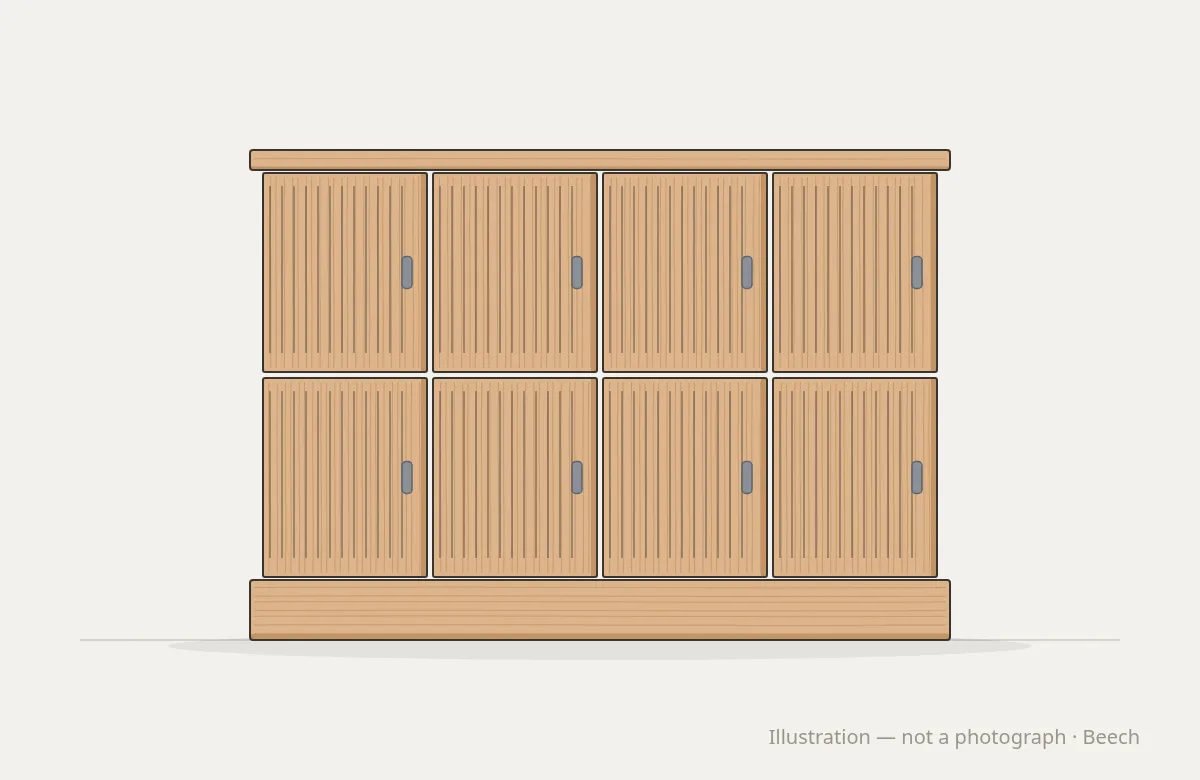
Round Fit builds lockers in solid hardwood and plywood only, never chipboard or MDF, with a matt lacquer finish. RFID is our preferred lock option, and lockers are designed around the lock you choose. A typical locker column is 30 × 50 × 180 cm (W × D × H), divided to your brief, in beech, ash or oak as standard or any species on request. Every piece is tested before it leaves the workshop, and installation is carried out through our local distribution partners.
Plan your space with the changing room configurator, explore hotel and club solutions, or discuss your project with us.