A simple rail is one of the most useful things a rehab clinic can have. Patients hold it for standing balance work, sit-to-stand practice, gait re-education, weight shifting and supported stretching. It gives confidence to patients who are unsteady and a fixed reference point for the physiotherapist.
Clinics can choose between rails fixed to the wall and freestanding barres that can be moved. Both work well, but they suit different rooms and different ways of working. This article compares them and covers height, grip and stability. Exercise programmes should always be set by a qualified physiotherapist.
Why rails matter in rehabilitation
Balance and strength training are central to falls prevention and to recovery after many injuries and operations. NICE’s 2025 guideline on falls, NG249, recommends that falls prevention exercise programmes are progressive, tailored to the person and focused on balance, coordination, strength and power. A rail lets a patient start with full support, then progress to one hand, fingertips and eventually no support at all, at the same station.
Wall barres
A wall barre is a rail fixed to the wall with brackets.
Advantages:
- Very rigid once fixed to a suitable wall. It does not move, however hard the patient leans or pulls.
- Takes no floor space. The floor in front of it stays clear for other work.
- Simple and robust, with nothing to set up or adjust.
Limitations:
- Fixed position. The patient always works along that wall. The therapist can stand only on one side.
- Needs a suitable wall. BS 8539, the British Standard for selecting, installing and testing anchors in concrete and masonry, sets out how fixings should be chosen for the actual wall and load and installed by a competent person. A stud partition usually needs extra structure.
- Projection matters. Dance safety guidance recommends that wall barres project about 15 to 20 cm from the wall, leaving room for the hand and, where needed, a leg on the rail.
Freestanding barres
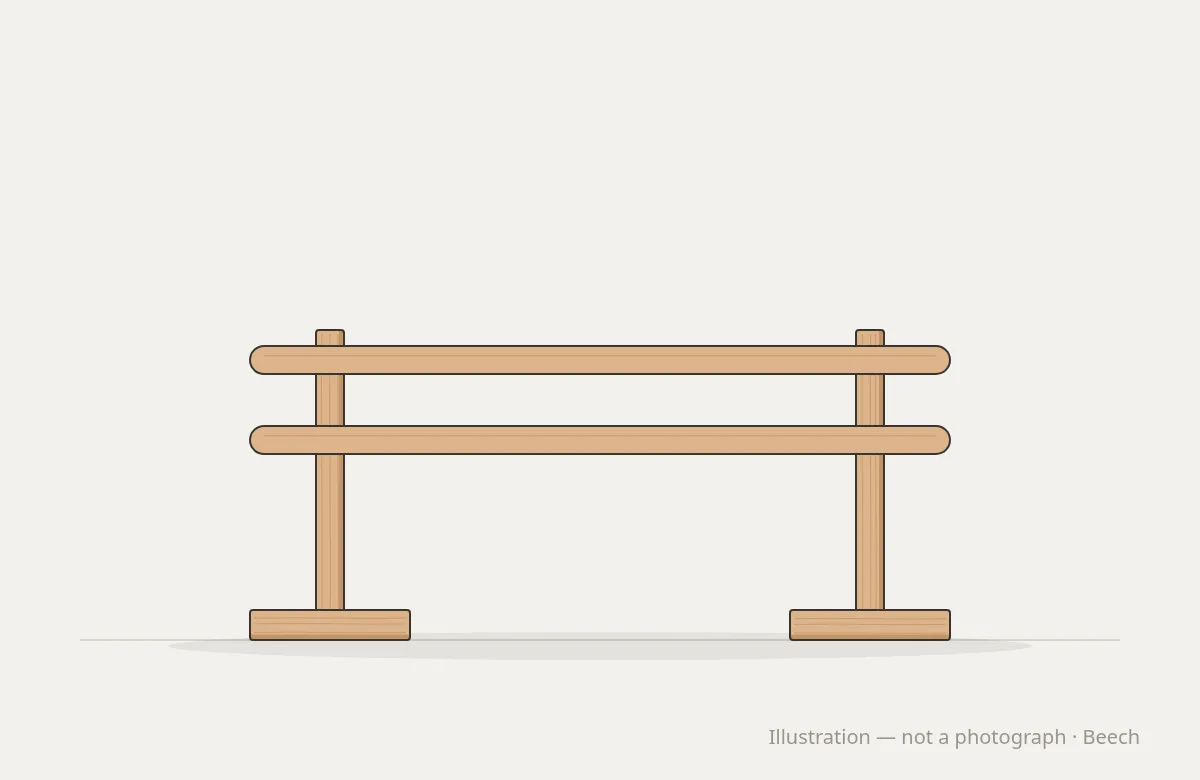
A freestanding barre stands on its own base and can be moved around the room.
Advantages:
- Flexible position. It can be placed in the middle of the room, beside a plinth or near the equipment the patient will use next.
- Access from both sides. The therapist can stand on either side of the patient, or the patient can use it from either side.
- Moves out of the way when floor space is needed for other work.
Limitations:
- Stability depends on design. A freestanding barre must have a wide, heavy base so it does not tip, rock or slide when a patient leans or pulls. Dance safety guidance notes that freestanding barres should be firmly secured. Weighted feet with non-slip pads help.
- Takes floor space while in use, and needs somewhere to be stored.
As an example, the Round Fit Studio Flow Freestanding Barre is typically 200 cm long and 110 cm high, with rails at 90 and 110 cm, on weighted hardwood feet. Heights and length can be adapted to the clinic’s brief.
Which to choose
A wall barre suits a corridor used for gait practice, a dedicated exercise area or a wall beside the treatment space, where maximum rigidity matters and the patient always works in the same direction.
A freestanding barre suits smaller clinics where one room does several jobs, treatment rooms where the rail needs to be beside a plinth, and programmes where the therapist needs to work from either side.
Many clinics use both: a wall barre for routine balance work, and a freestanding barre that can be moved where it is needed.
Height
Clinic patients vary far more than studio clients. Dance safety guidance puts barre heights between about 82 and 110 cm, set roughly at the user’s elbow height. A rail that is too high lifts the shoulders; one that is too low makes the patient stoop.
Many clinics choose a double barre, with two rails at different heights, so patients of different sizes, and children, can use the same piece. Freestanding barres can also be made at different heights for different parts of the room.
Grip
Patients with weak grip, arthritic hands or reduced sensation need a rail that is comfortable and secure.
- Diameter. Dance safety guidance suggests about 4 to 5 cm. Some patients find a slightly larger rail easier to hold.
- Profile. A smooth, round rail along its full length, with no sharp edges.
- Material and finish. Solid hardwood with a matt lacquer is pleasant to hold, gives a natural, secure grip and is simple to clean between patients.
Round Fit makes rails in beech, ash, oak or any species, with a matt lacquer for daily cleaning.
Space and safety
- Clear floor around the rail, so patients can approach with a walking aid and the therapist can stand beside them.
- Clear walkways. The Health and Safety Executive notes that most trips at work are caused by obstructions in walkways. A freestanding barre should be parked out of the patient route when not in use.
- Regular checks of brackets, fixings and feet, with the rail taken out of use if anything has worked loose.
See the barres in our Yoga and Barre collection. If you are unsure which suits your clinic, ask us.