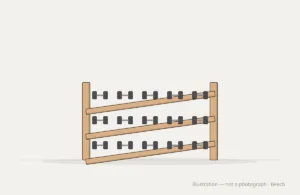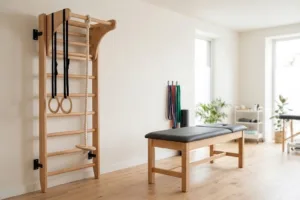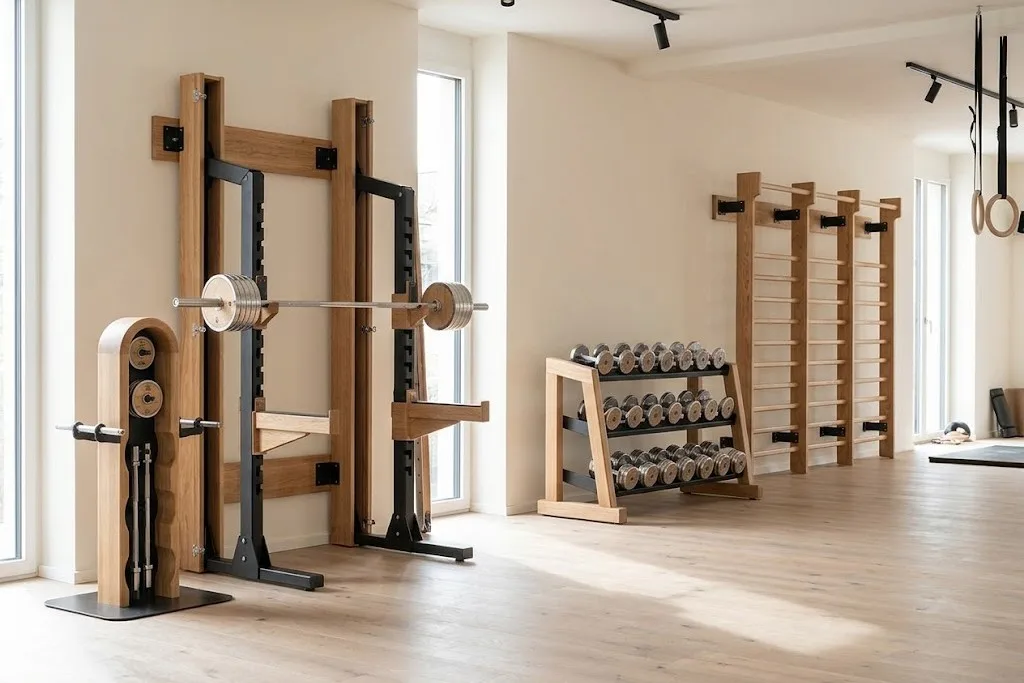
Most commercial gyms mix materials. Steel racks and frames sit next to timber benches, wall bars and reception joinery. Done well, the mix looks deliberate and each material does the job it is best at. Done badly, the room looks like a collection of unrelated purchases.
This article looks at how to combine wood and steel, both visually and technically.
Each material where it performs best
Timber and steel have different strengths:
- Timber is warm to the touch, quiet, easy to shape and repair, and stiff for its weight. It suits frames, rails, rungs, handles, benches, storage and anything people touch for long periods.
- Steel is strong in small sections and handles concentrated loads well. It suits pivots, axles, adjustment mechanisms, brackets and parts that need precise, repeatable movement.
The best equipment uses both. Wall bars with a pull-up bar, a bench with a steel adjustment mechanism, a reformer with a hardwood frame and metal rails. Round Fit makes its steel parts in-house, so timber and metal are designed together.
Joining them properly
Where timber meets steel, the joint must suit both materials. The Wood Handbook from the US Forest Products Laboratory gives useful guidance:
- Steel side plates help. Bolted joints with steel side plates have about 25 per cent higher bearing capacity parallel to the grain than joints with timber side plates.
- Edge and end distances matter. For hardwoods, the Handbook gives a tension end distance of about five bolt diameters and spacing of at least four diameters.
- Hole quality matters. Smoother, well-fitted holes give higher bearing values.
- Timber settles. Bolted joints in new timber may need retightening during the first year as the wood dries and settles.
Movement: wood moves, steel does not
Timber exchanges moisture with the air and changes size slightly as humidity changes. The Wood Handbook notes that movement across the grain is much larger than along it. Steel does not respond to humidity in the same way.
Where a long steel part is fixed rigidly across the grain of a wide timber part, the timber cannot move freely and may crack or loosen. Good detailing allows for this: slotted holes, fixings along the grain, or joints that let the timber move.
Avoiding stains and corrosion
Iron stain. A note from the US Forest Products Laboratory explains that iron stain is a blue-black discolouration caused by a reaction between wood extractives and iron in steel products. Oak is especially prone because of its tannins. Avoid bare carbon steel in contact with oak where moisture is present.
Humid areas. Near pools and spas, metal needs extra care. The International Molybdenum Association explains that chloramines from pool water treatment spread through the building and condense on surfaces as a corrosive film, and that standard 304 and 316 stainless steels should not be used for safety-critical, load-bearing parts in that atmosphere.
Coatings. Exposed steel should be coated or finished to suit the environment, and the finish should be specified as carefully as the timber finish.
Making the mix look deliberate
Good hotel gym design customises frame colours and finishes so the gym extends the building’s interior, and uses different materials and surfaces to define zones. A few principles help:
One lead material per zone. A stretching and mobility zone might be mostly timber, with steel hidden in the joints. A strength zone might lead with steel, with timber benches and storage as accents.
Repeat the timber. Use the same species and finish across benches, wall bars, storage, reception and changing rooms. Repetition makes the timber read as a deliberate choice.
Repeat the metal. Choose one metal finish, such as black, brushed steel or bronze, and use it for all visible metalwork, from rack frames to bolt heads.
Use colour to tie them together. A coloured finish on timber can pick up the colour of steel frames, or the other way round. Round Fit offers base colours and custom colours.
Working with existing equipment
Many projects add timber pieces to a room that already has steel equipment. In that case:
- Match the timber to other joinery in the building, not to the steel.
- Choose a metal finish for any new steel that matches what is already there.
- Use timber for the elements people touch and sit on, to warm up the room.
Every Round Fit piece is tested before it leaves the workshop, and frames carry a five-year warranty. See our customisation options. Tell us what you have and what you need.