Spa guests are rarely looking for a hard workout. They come to slow down. Many would welcome a gentle yoga session, a guided stretch or simply a quiet room to move in before or after a treatment. A yoga and stretching room beside the treatment rooms and pool gives them that, and it extends the spa’s offer without the noise and equipment of a gym.
This article sets out what such a room needs, how to equip it and what to consider in the particular conditions of a spa.
What the room is for
A spa movement room usually hosts:
- Small yoga classes, often gentle, restorative or yin styles.
- Guided stretching and mobility sessions, sometimes one to one.
- Breathing and relaxation sessions.
- Free use by guests between treatments.
The room should feel calm and uncluttered. Equipment is kept to what supports these sessions, and everything else is stored away.
The key equipment
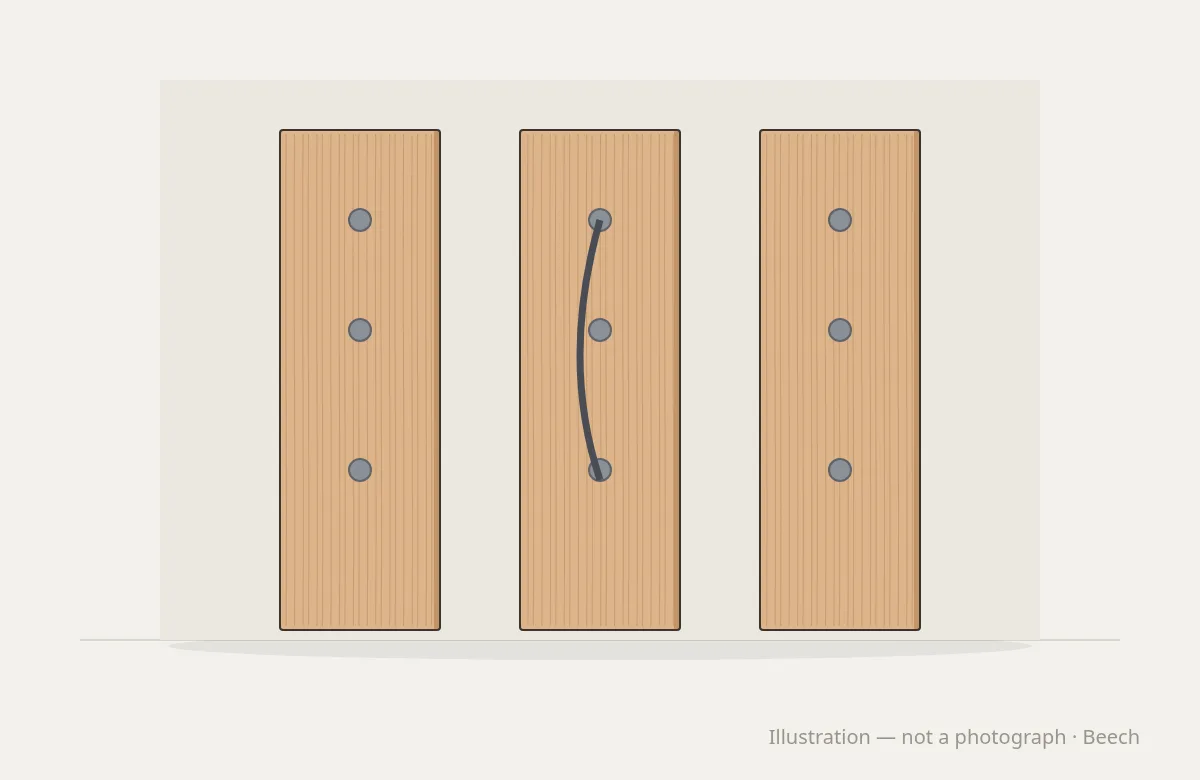
A yoga wall. Wall-mounted panels with anchor points for ropes and straps support guests in poses and stretches they could not hold alone. Rope walls are closely associated with B. K. S. Iyengar, who used knotted ropes and anchors to improve alignment for more than 70 years. In a spa, a yoga wall is ideal for supported inversions, gentle traction and assisted stretching. As an example, Round Fit’s Studio Flow Yoga Wall uses panels of 60 × 220 cm, fitted with anchor points for ropes and straps.
A barre. A wall-mounted or freestanding barre gives guests something steady to hold for balance work and standing stretches. Dance safety guidance puts barre heights between about 82 and 110 cm, roughly at elbow height, and a rail diameter of about 4 to 5 cm. A double barre serves guests of different heights.
Props. Mats, blocks, straps, bolsters and blankets make poses accessible and comfortable for guests of every ability. Restorative sessions in particular use plenty of bolsters and blankets.
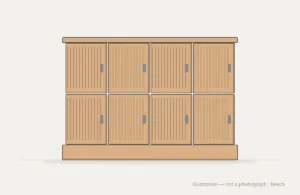
Prop storage. Open shelves or racks inside the room, so props are tidy between sessions and easy to collect.
Space
Guests in a spa expect space around them. Dance safety guidance suggests a minimum of about 6 m² of floor per person for movement classes, with 9 m² as an ideal. Gentle yoga is less mobile than dance, but guests still need room to move in and out of poses and for an instructor to walk between mats.
Keep storage inside the room rather than in a corridor, so guests do not carry props past the treatment rooms. Leave a clear area along the yoga wall, at least the length of a mat plus room to step around it.
The spa environment
Spas are warm and humid, often next to pools and steam rooms. That affects materials and fixings.
Humidity and timber. The Wood Handbook from the US Forest Products Laboratory tabulates how much moisture wood takes up from the air. At around 21 °C, wood settles at about 6 per cent moisture content at 30 per cent relative humidity, about 9 per cent at 50 per cent and about 12 per cent at 65 per cent. As moisture content rises, wood swells; as it falls, it shrinks. Equipment for a spa should be made from well-dried timber, sealed on every face and designed with joints that allow small movement.
Metal near pools. The International Molybdenum Association explains that chloramines from pool water treatment spread through the building air and condense on surfaces as a corrosive, chloride-rich film. Standard 304 and 316 stainless steels should not be used for safety-critical, load-bearing parts in that atmosphere. Fixings and brackets for a yoga wall or barre near a pool need to be specified with this in mind, and inspected regularly.
Ventilation. Dance safety guidance recommends six to ten air changes per hour for spaces used intensively. In a spa, good ventilation also stops humid air from the pool areas settling in the movement room.
Walls that carry the load
A yoga wall and a wall-mounted barre carry real loads: a guest hanging in ropes, leaning back into a strap or pulling against the barre. The wall must be able to take them.
BS 8539, the British Standard for selecting, installing and testing anchors in concrete and masonry, sets out a sound approach. The anchor should be chosen for the actual base material and load, specified clearly and installed by a competent person. Confirm the wall construction during design. Spa walls are often lined with decorative finishes or tiles, and the structure behind them must be suitable.
Light, sound and atmosphere
The atmosphere matters as much as the equipment.
- Warm, indirect lighting, dimmable for relaxation sessions.
- Quiet. The room should be sheltered from pool noise and plant rooms. Soft furnishings, timber panels and props all help absorb sound.
- Natural materials. Solid timber equipment and storage feel at home in a spa, where stone, wood and textiles are common.
- A comfortable temperature. Dance safety guidance suggests about 21 °C for movement rooms, within a range of about 20 to 26 °C. Restorative sessions often feel better at the warmer end.
Matching the spa’s joinery
Spa interiors are usually carefully designed. Equipment should belong to the scheme. Round Fit makes yoga walls, barres and prop storage in beech, ash, oak or any species, with a matt lacquer and stains to the designer’s brief, so the movement room matches the treatment rooms and lounges. Every piece is tested before it leaves the workshop.
See our Yoga & Barre collection. If you are planning a spa movement room, start a conversation with us.