Pilates fits naturally into a hotel spa or a members’ club. Guests and members who practise at home look for it when they travel or visit. It suits the calm, considered atmosphere most hotels want in their wellness areas. And it can be offered as group classes, private sessions or self-guided use.
The obstacle is usually space. Few hotels can give a whole room to a row of reformers that may stand empty for part of the day. This article sets out three practical ways to add Pilates, the equipment each needs, and how to make it fit the interior.
Why it is worth doing
Wellness has become a significant reason to travel. Research by the Global Wellness Institute shows wellness tourism growing from $830.2 billion in 2023 to more than $1.3 trillion by 2028.
Good hotel gym design starts with the guest profile. Business travellers, wellness guests, athletes and families use facilities differently. Pilates appeals strongly to wellness guests and to many club members, but the format should match how they will actually use it.
Option 1: a dedicated Pilates room
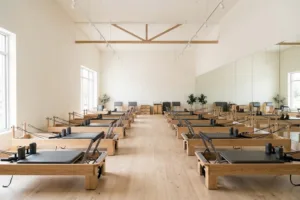
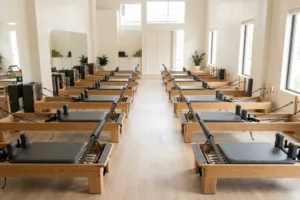
A small dedicated room with a few reformers supports scheduled group classes and private sessions.
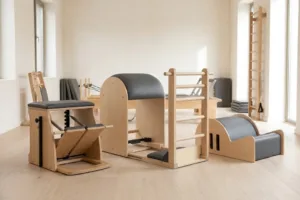
Typical equipment: – Three to six reformers, depending on room size. – One tower reformer at the front for variety and private work. – Small apparatus such as a chair and barrels.
Space: studio design guides commonly suggest roughly 40 to 50 square feet (about 3.7 to 4.6 m²) per reformer, including instructor clearance. Add circulation and storage.
Best for: clubs with regular members and hotels with a strong wellness positioning or a resident instructor.
Option 2: a shared studio
Many hotels have a studio that hosts yoga, stretching and other classes. Pilates can share it if the equipment takes little floor space or can be put away.
Typical equipment: – A row of spring walls fixed to one wall. As an example, the Round Fit Studio Pro Spring Wall is 60 cm wide and only 10 cm deep. – Portable apparatus such as step barrels, arcs and wedges for mat Pilates. – Mats and small props, stored on wall racks.
Space: the spring walls stay on the wall; the floor in front is needed only during class. Allow a similar 40 to 50 square feet per mat.
Best for: hotels and clubs that need one room to do several jobs.
Option 3: a private suite
For one-to-one sessions, a single versatile piece can do most of the work.
Typical equipment: – A Cadillac reformer, which combines a reformer and a full frame in one footprint. – One or two small apparatus.
The Cadillac has a push-through bar, arm and leg springs and a trapeze, which support everything from advanced work to supported stretching. A Cadillac reformer brings much of that range to a single piece.
Best for: luxury hotels, spas offering private sessions, and clubs with personal training.
Making it fit the interior
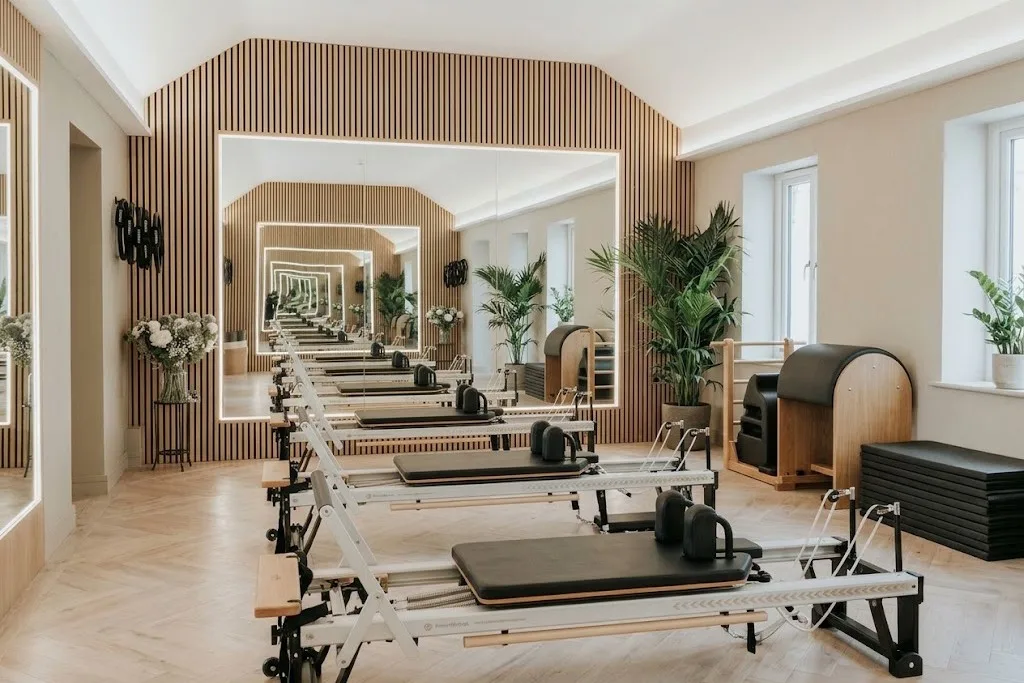
Hotel designers increasingly customise frame colours, upholstery and bespoke systems so the gym extends the hotel’s brand and interior architecture. Pilates equipment in timber does this well.
- Timber: match or deliberately contrast the nearby joinery. Beech and ash suit light schemes; oak suits darker ones.
- Upholstery: echo the spa’s soft furnishings, while choosing a cover suited to contract use.
- Storage: build racks and shelves in the same timber, so the room stays tidy and switches use quickly.
- Mirrors: frame them in the same timber as the equipment.
Round Fit works in any timber species, finish and upholstery on request.
Operational questions
Before choosing, it helps to answer:
- Who will teach? A resident instructor, visiting teachers, or self-guided use?
- How will it be booked? Scheduled classes, private bookings or open access?
- When will it be used? Peak hours matter for sizing.
- Who cleans it? Housekeeping needs clear guidance on products and methods.
- What happens when the room is not in use? A shared room needs fast changeovers.
Self-guided use on reformers needs particular care. Without an instructor, guests may set springs incorrectly. Many hotels limit reformer use to supervised sessions and offer spring walls or mat apparatus for open access.
Lead time and installation
Pilates equipment is usually built in four to six weeks, depending on the project. Installation is carried out through local distribution partners, which helps with access constraints in operating hotels.
Read more about our approach to hotels and clubs, or share your plans with us.