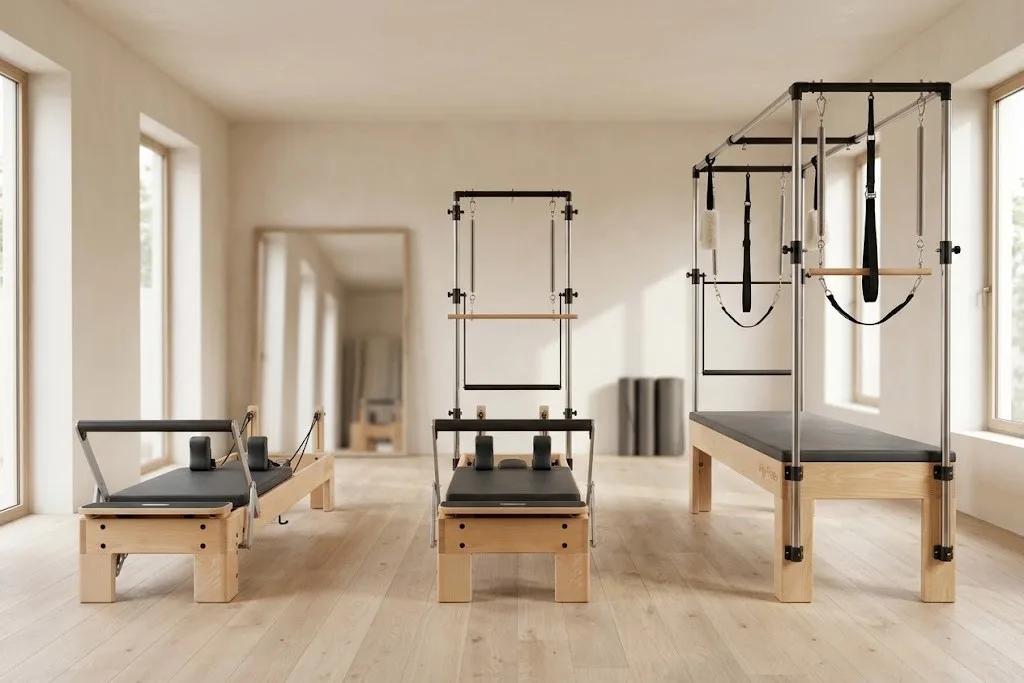
The apparatus a studio buys decides which classes it can sell. A room of reformers supports group classes. A Cadillac supports private and clinical sessions. A tower sits between the two. Choosing well means matching the apparatus to the business, not just to the room.
This article explains what each piece is, where it came from, what it is best at, and how studios typically combine them.
Where the apparatus came from
The apparatus has a long history. Joseph Pilates began developing the idea during the First World War, while interned in a camp, by attaching springs to hospital beds to help rehabilitate patients. After moving to the United States in 1926, he patented the Universal Reformer and went on to create the Cadillac, the Wunda Chair and other apparatus in his New York studio.
That background explains a lot about how the apparatus still works today. Springs provide resistance, but they also provide assistance. A spring can make an exercise harder, or it can support a client through a movement they cannot yet do alone.
The reformer
The reformer is a rectangular frame with a padded carriage that rolls along rails. Springs connect the carriage to one end. There is a footbar at that end and ropes with handles running over pulleys at the other. Changing the springs changes the load.
It can be used lying, side-lying, kneeling, standing and on all fours, to mobilise the spine, build strength and increase range of movement. It can be adapted for rehabilitation under professional guidance.
Best for: group classes, which are the commercial core of most studios. Reformers line up in rows, take a consistent footprint and are quick to reset between clients.
Consider: each reformer needs working space around it, not only its footprint. Plan the room before deciding the number.
The tower
A tower adds a vertical frame to one end of a reformer, or stands against a wall over a mat. The tower, also called a wall unit, combines elements of the reformer, the Cadillac and mat work. As an example, the Round Fit Studio Pro Tower Reformer stands 185 cm high with the tower fitted. It has five carriage springs, ten tower springs, a push-through bar and a breathing bar.
On a tower reformer, the client can move between carriage work and spring work on the frame without changing apparatus.
Best for: studios that want more variety in group classes, and smaller private rooms that need versatility without a full Cadillac.
Consider: the frame adds height. Check ceiling height and allow for overhead work.
The Cadillac reformer
A Cadillac reformer combines a reformer with a full four-post frame above it. It is, in effect, a reformer and most of a Cadillac in one footprint. The carriage can usually be secured for frame work.
Best for: private sessions and duets in limited space, where one piece of apparatus needs to do as much as possible.
Consider: it takes more height than a tower and is slower to reset. It suits private rooms better than group rows.
The Cadillac
The Cadillac, also called the trapeze table, is a raised, padded table inside a four-post frame. It has a push-through bar, arm and leg springs, a roll-down bar and a trapeze on a slider, which support everything from advanced work to supported stretching. Many clinicians regard it as the most versatile and supportive apparatus. The high, wide surface is easier to get onto than a mat on the floor, which matters for many clinical clients.
Best for: private sessions, clinical work and teacher training. Physiotherapists value the table height and the range of assisted exercises.
Consider: a Cadillac is a large, fixed piece. The Round Fit Studio Pro Cadillac, for example, is 220 cm long, 74 cm wide and 215 cm high. It needs space on all sides for the instructor to move around the client.
How studios combine them
There is no single right mix. Common patterns include:
- Group studio: a main room of reformers, sometimes with a few tower reformers at the front or back for variety.
- Group plus private: a reformer room for classes and a smaller room with a Cadillac or Cadillac reformer for private and clinical sessions.
- Clinic: a Cadillac and one or two reformers, plus small apparatus such as a chair and barrels.
- Hotel or club: a compact room with one or two tower reformers or a spring wall, sized for occasional use.
Questions that narrow the choice
- What will you sell? Group classes, privates, clinical sessions or a mix?
- How many clients per class? That sets the number of reformers.
- What is the ceiling height? It decides whether towers and Cadillacs are possible.
- Who are the instructors? Their training and method affect which apparatus they can use well.
- How will the space be cleaned and reset? Simple apparatus resets faster between classes.
Planning the room
Each piece has a different footprint and needs different working space. Plan the room around the apparatus you choose, with clear routes for clients and good sightlines for instructors.
You can see each piece in our Pilates collection, including the Studio Pro Tower Reformer, the Studio Pro Cadillac Reformer and the Studio Pro Cadillac. If you are unsure which mix suits your business, talk to our team.