Upholstery on reformers, benches, boxes and treatment tables wears faster than the frame beneath it. Sooner or later every studio has to decide whether a cover can carry on or needs replacing. Replace too early and you spend money you did not need to. Replace too late and you risk hygiene problems, damage to the board and foam underneath, and a poor impression on clients.
This article sets out the signs that upholstery is reaching the end of its life, the reasons they matter, and how to plan replacement.
Why upholstery wears
Commercial upholstery is usually a coated fabric over foam, fixed to a timber or plywood board. It wears in several ways at once.
Abrasion. Every session rubs the surface. Upholstery fabrics are commonly tested for abrasion resistance with the Martindale method, BS EN ISO 12947, in which a sample is rubbed under a set load and checked at intervals until it shows wear. Results are given as a number of rub cycles, and contract use calls for much higher figures than domestic use.
Chemical attack. Cleaning and disinfecting products, used many times a day, act on the coating. The Chemical Fabrics and Film Association reports that PVC coatings do not undergo significant hydrolysis, but that polyurethane coatings have shown early failures when cleaned repeatedly with quaternary ammonium disinfectants.
Foam fatigue. Foam is compressed with every use. Foam is tested for this kind of fatigue under standards such as EN ISO 3385, in which a sample is pounded repeatedly under load and its loss of thickness and hardness is measured. Over time, all foam softens and loses some of its height.
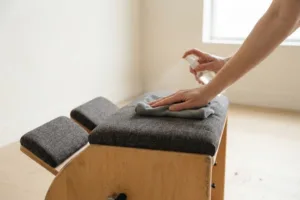
Physical damage. Sharp edges, jewellery, zips, grit from shoes and dropped equipment can cut or puncture a cover.
Signs that a cover needs replacing
Splits, cracks and tears
Any opening in the surface means the cover can no longer be cleaned properly. NHS guidance on infection control in the built environment, HBN 00-09, calls for surfaces that are smooth, impervious and easy to clean, and notes that soft furnishings should be impermeable and that damaged or soiled fabric needs replacing. A split lets sweat, liquids and cleaning products reach the foam, where they cannot be removed.
Peeling or flaking
When the top coating starts to lift or flake, the material underneath is exposed. Peeling usually spreads, and it often points to chemical or moisture damage.
Sticky or tacky surface
A cover that feels sticky, or has lost its surface texture, may be breaking down. This is a common early sign of coating failure.
Hard, cracked or brittle areas
Surfaces near heaters, in sunlight, or exposed to strong cleaning products can dry out and crack.
Foam that does not recover
Press the pad with your hand. If it stays dented, feels uneven, or you can feel the board through it, the foam has lost its support. The client will feel this too, and on some exercises it affects comfort and position.
Loose stitching and open seams
Seams are where covers fail first. Open seams let liquid in, just like a split.
Persistent staining or smell
Stains or odours that come back after cleaning suggest liquid has reached the foam.
Look underneath
When a cover is damaged, check the board below. The Wood Handbook from the US Forest Products Laboratory explains that wood takes up moisture from its surroundings and that end grain absorbs liquid much faster than other surfaces. A board that has been wet for a long time may be stained, swollen or soft. Replacing the cover without dealing with a damaged board will not last.
Repair or replace?
Small repairs can sometimes extend the life of a cover, but on commercial equipment they are rarely worth it for long:
- Patches and tape are hard to clean and usually fail at the edges.
- Re-stitching an open seam may help if the fabric around it is still sound.
- Full replacement is the right choice when there are splits, peeling, failed foam or several problems at once.
When you replace, consider replacing the foam at the same time. New covers on tired foam will look good but will not feel right.
Specifying the replacement
Use replacement as a chance to check the specification:
- Material. Ask which coating it is, and check that your cleaning and disinfecting products are approved for it.
- Abrasion resistance. Ask for the Martindale result and check it suits commercial use.
- Fire performance. Where upholstered items are used as seating in non-domestic settings, BS 7176 sets out resistance-to-ignition levels by risk. Ask your supplier what the replacement meets.
- Colour. Order all covers in a set at once if you want them to match. Covers from different batches can differ slightly.
Plan for replacement
Upholstery is a wear part. Build it into your planning:
- note the fitting date of each cover in your equipment log;
- record condition at each weekly inspection;
- budget for replacement on your busiest machines first;
- keep machines consistent within a room, so clients do not notice a difference.
How Round Fit can help
Round Fit makes Pilates and studio equipment in solid hardwood, with upholstery in a base palette or any custom colour. Every piece is tested before it leaves the workshop. If your upholstery needs replacing, tell us the piece and its condition, and we will discuss the options with you.
Read about our customisation options, or discuss your project with us.