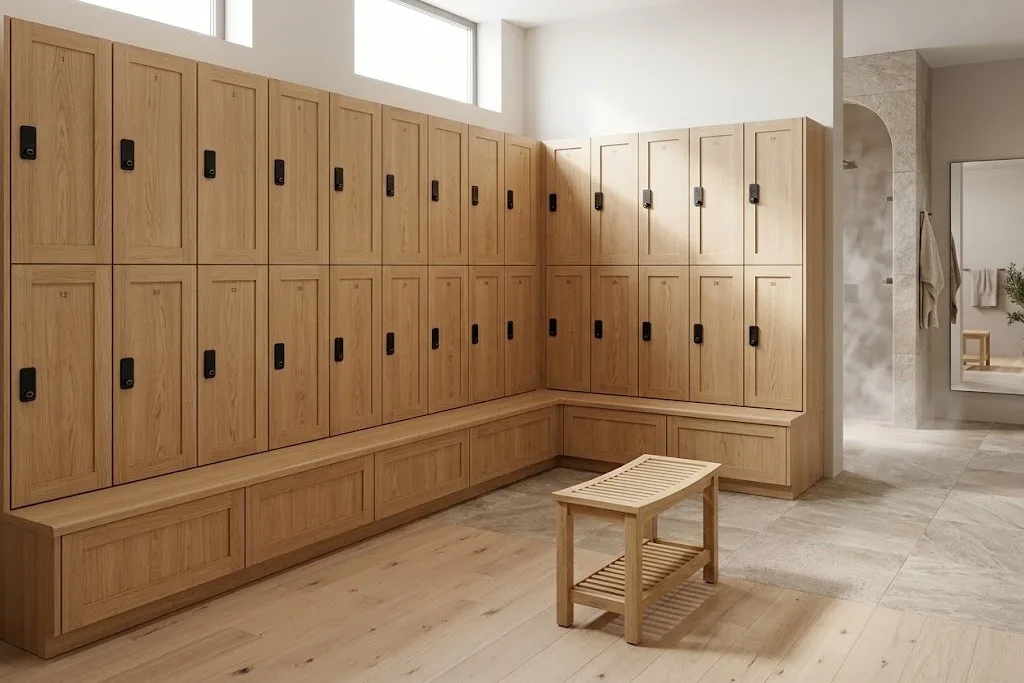
Changing rooms are hard on furniture. Steam drifts in from the showers. Wet towels go into lockers. Doors open and close hundreds of times a day. Floors are mopped every few hours. Materials that look good in a showroom can swell, peel and sag within a year in this environment.
Wooden lockers can work very well in changing rooms, and they bring warmth that metal and laminate rarely do. But the material choices have to be right. This article explains what humidity does to wood and wood-based boards, and how to specify lockers that stay square, closed and good-looking.
What humidity does to wood
Wood constantly exchanges moisture with the air around it. The US Forest Products Laboratory’s Wood Handbook tabulates the moisture content wood settles at in different conditions. At around 21 °C, wood reaches about 9 per cent moisture at 50 per cent relative humidity, which is typical of a heated studio. At 80 per cent relative humidity it rises to about 16 per cent. At 90 per cent it reaches about 20.5 per cent.
As wood takes on moisture, it swells. As it dries, it shrinks. The Handbook notes that movement across the grain is much larger than movement along it, with tangential movement roughly twice radial. A wide solid door that swells by a few millimetres will bind in its frame. A door that dries out will gap.
Changing rooms can swing between dry and very humid conditions every day. That makes stability the first requirement for locker materials.
Plywood for carcasses and doors
Plywood is built from cross-laminated veneers. Each layer restrains the movement of its neighbours, so the panel stays much more stable in width and length than solid timber. That makes it well suited to wide, flat locker parts: sides, shelves, backs and doors.
Not all plywood suits humid rooms. Guidance from LABC Warranty explains the European classes. EN 636 class 1 is for dry interiors where humidity exceeds 65 per cent only for a few weeks a year. Class 2 is for humid conditions or occasional wetting, where humidity exceeds 85 per cent only for a few weeks a year. Class 3 is for unprotected exterior use or frequent wetting. The glue bond is classified the same way under EN 314-2, and a panel cannot achieve a higher class than its bond.
For a changing room, ask which class has been used. Areas next to showers or pools call for higher classes than dry changing areas.
Solid timber for frames and edges
Solid hardwood still has an important role. Face frames, door edges, plinths and handles take knocks and hand contact. Solid timber can be shaped, rounded and repaired. It also protects plywood edges, which expose end grain in alternate layers.
Why particle boards are a risk
Many lockers are built from chipboard or MDF with a laminate face. In a dry office this can be fine. In a changing room it is a risk.
A technical bulletin from the Composite Panel Association explains why. Particleboard and MDF swell more than solid wood for the same change in humidity. And swelling caused by high humidity is permanent. When the board dries, it does not fully return to its original size.
The usual failure starts at an edge. Water from a wet towel or a mop reaches a cut edge or a screw hole. The core swells. The laminate lifts or cracks. Hinge screws lose their grip and doors drop. Once this starts, the part usually has to be replaced.
For these reasons, Round Fit builds lockers in plywood and solid timber, and does not use chipboard or MDF.
Finishing every face
A finish does not make wood waterproof. The Wood Handbook states that finishes only slow the rate at which water enters and leaves wood. It also notes that liquid water enters end grain 10 to 100 times faster than other faces.
In a locker, that means:
- Seal every face, including backs, undersides and the inside of the carcass.
- Seal all edges and drilled holes, including hinge and lock cut-outs.
- Finish both faces of doors equally, so they stay flat.
- Keep the bottom off the floor, on a plinth or legs, so mop water does not sit against it.
A hard, closed lacquer film protects surfaces during daily cleaning.
Metal parts near pools
Hinges, lock bodies, handles and fixings also need attention. In a dry changing room, standard stainless steel hardware performs well. Near indoor pools, conditions are harsher.
The International Molybdenum Association explains that chloramines from pool water treatment spread through the building air and condense on surfaces, forming a corrosive, chloride-rich film. Standard 304 and 316 stainless steels perform well in many accessible pool-area uses, but the article states they should not be used for safety-critical, load-bearing applications in that atmosphere. Areas that are regularly washed fare better than hidden areas that are not.
For lockers, the practical points are to choose hardware rated for the environment, to avoid hidden steel fixings that cannot be cleaned or inspected, and to wipe exposed metalwork as part of routine cleaning.
Ventilation inside the locker
Wet towels and kit release a lot of moisture into a closed locker. Without airflow, humidity inside can stay high for hours. Simple design measures help:
- Ventilation slots in doors or tops.
- A gap behind the locker bank so air can move.
- Shelves or bases that allow drips to drain and dry.
Room ventilation matters even more. A changing room that clears steam quickly is easier on every material in it.
Durability and daily use
In leisure changing areas, lockers and benches are often hit by bags, equipment and doors. They need robust construction, secure fixings and impact-resistant materials. Rounded edges and stable fixings help reduce damage and repairs. Changing areas should also offer accessible lockers and provision.
Locks
Locks are part of the material decision too. Keys get lost, wet and bent. Round Fit prefers RFID locks, which take keys out of the user journey and can work with membership cards or wristbands. The lock body and its cut-out still need to be sealed and protected like any other part.
A specification checklist
- Plywood class to suit the humidity of each area.
- Solid timber for frames, edges and handles.
- No chipboard or MDF.
- Finish on every face, edge and cut-out.
- Raised plinth or legs.
- Hardware rated for the environment, especially near pools.
- Internal ventilation.
- Lock type, with RFID preferred.
To plan a layout, try our changing room configurator or browse Studio Interiors. Or talk to us about your plans.