Timber has a good reputation. It is renewable, it stores carbon while it is in use, and it can be repaired. So equipment made from wood is often described as sustainable without further explanation. That is not enough. Whether a piece of timber equipment is a responsible choice depends on details: where the wood came from, how the product is built, how long it lasts and what happens at the end.
This article sets out the questions worth asking a supplier, and the rules that sit behind them in the UK and the EU.
Why broad claims are not enough
The UK Competition and Markets Authority published the Green Claims Code in 2021. It sets out six principles for environmental claims. Claims must be truthful and accurate. They must be clear and unambiguous. They must not omit or hide important information. Comparisons must be fair and meaningful. Claims must be substantiated. And the full life cycle of the product must be considered.
The Code is direct about broad words. It says terms like “green”, “sustainable” or “eco-friendly” are likely to suggest a product has a positive environmental impact, or at least no adverse one. A business using them must be able to prove it, and should explain what the term means.
For a buyer, that gives a useful test. If a supplier calls its equipment sustainable, ask what that means and what the evidence is.
Question 1: Which species, and where is it from?
This is the starting point. A supplier should be able to name the species and the country of harvest for each timber used.
There is a legal reason as well as an ethical one. In Great Britain, the UK Timber Regulation prohibits placing illegally harvested timber, or products made from it, on the market. Operators placing timber products on the market for the first time must exercise due diligence. The retained regulation, published on legislation.gov.uk, lists the products covered in its annex. That list includes wooden furniture under several 9403 headings and plywood under 4412.
In the EU, the Deforestation Regulation will replace the older timber rules. Under the current timetable, it is scheduled to apply from 30 December 2026. Operators will need adequately conclusive and verifiable information that products were produced legally in the country of production and will need to carry out risk assessment and mitigation where applicable.
For a commercial buyer, the practical question is simple. Can the supplier show where the timber came from and how its legality was checked?
Question 2: Is the timber certified, and what does the label mean?
Forest certification schemes such as FSC and PEFC provide independent checks on forest management and on the supply chain. FSC explains that its labels have specific meanings:
- FSC 100% means all the material comes from FSC-certified forests.
- FSC Recycled means the product is made from 100 per cent recycled material.
- FSC Mix means a combination of certified material, recycled material and FSC controlled wood.
FSC also notes that a company needs chain of custody certification before it can label any product. Holding a certificate does not mean all of that company’s products are certified. Only products made with certified materials can carry the label.
So ask two questions. Is the timber in this product certified? And does the supplier hold chain of custody certification, or is the claim based on the sawmill’s certificate alone? Both are legitimate positions, but they are different claims.
Question 3: What board materials are used?
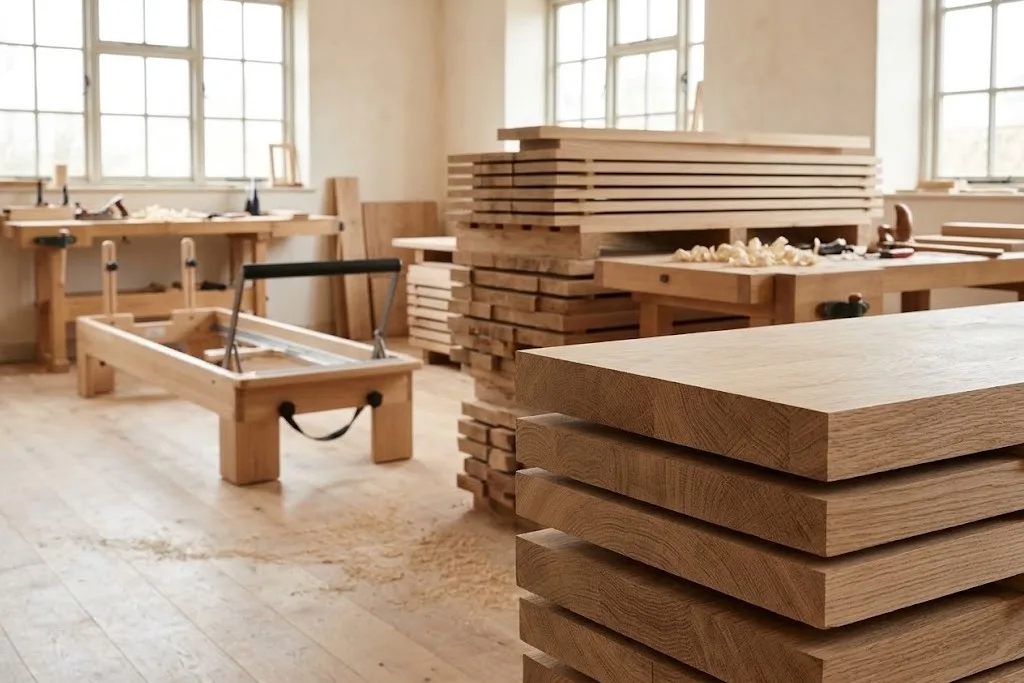
Many products described as “wood” are mostly board. Particleboard and MDF are made from wood particles or fibres bonded with resin. They have uses, but in damp or heavily used spaces they can swell permanently and lose their grip on screws. A product that fails early is not a sustainable product, however it was sourced.
Ask what each part is made from. Round Fit uses solid hardwood and plywood, and does not use chipboard or MDF.
Question 4: Can it be repaired?
The Green Claims Code asks businesses to consider the full life cycle. For equipment, the longest part of the life cycle is use. A product that lasts twice as long has, roughly, half the impact per year of service.
Useful questions:
- Can worn surfaces be sanded and refinished?
- Can upholstery be replaced on site?
- Can springs, ropes and straps be replaced to the original specification?
- Are fixings standard, so parts can be tightened or swapped?
- Is there a warranty on the frame, and for how long?
Round Fit’s frames carry a five-year warranty, and the equipment is designed so wearing parts can be replaced.
Question 5: How is it packed and delivered?
Transport and packaging are part of the life cycle too. Ask:
- Is packaging reusable or recyclable?
- Are items shipped flat or assembled?
- Is installation done locally, or does a team travel long distances?
Round Fit installs through local distribution partners, which keeps installation close to the client.
Question 6: What about offsetting and donations?
Some suppliers link sales to environmental projects. The Green Claims Code says that where businesses offset, they should be clear about whether they are reducing their own emissions or compensating for them, and should give information about the scheme.
Round Fit donates 1 per cent of every order to tree-planting projects. That is a contribution, not an offset. It does not cancel out the footprint of making and delivering equipment, and we do not present it as if it does.
A short checklist for buyers
When you compare suppliers, ask each one:
- Which species are used, and from which countries?
- How is legality checked, under the UK Timber Regulation or the EU Deforestation Regulation?
- Is the timber certified, and does the supplier hold chain of custody certification?
- Which parts are solid wood, which are plywood, and are any particle boards used?
- What can be repaired or replaced, and how?
- How is the equipment packed, delivered and installed?
- What does any environmental claim mean, and what is the evidence?
Clear answers to these questions say more than any label. To learn more about how we build, read how we work, or let us know your requirements.