Upholstery is the part of studio equipment that clients touch most. It carries body weight, sweat, skin oils and daily cleaning. It is also usually the first part to show wear. A well-built reformer frame can last many years. The pads on it may need replacing several times in that period.
That makes upholstery worth specifying carefully. This article covers the four things that matter most: the cover material, abrasion resistance, fire performance and the foam beneath. It ends with a short specification checklist.
Coated fabrics: PVC and polyurethane
Most commercial studio upholstery uses a coated fabric. A textile backing is coated with a polymer to give a smooth, wipeable, liquid-resistant surface. The two main types are PVC, often called vinyl, and polyurethane, or PU.
A comparison published by the coated fabrics industry sets out the main differences:
- Hydrolysis. PVC is not subject to hydrolysis to any significant degree. PU can slowly break down under heat and humidity, which eventually gives a flaking, brittle surface. How quickly this happens depends on the formulation, so PU products should be tested or certified.
- Disinfectants. PVC rates good to excellent for use with disinfectants. PU rates fair, and the same source reports early failures when PU was cleaned with quaternary ammonium cleaners.
- Feel. PU is often softer, more breathable and quicker to adapt to body temperature. PVC can feel firmer in cold rooms.
- Abrasion. PU rates higher for abrasion resistance in that comparison.
Neither is always better. For a busy studio with strong disinfectant routines, a well-formulated PVC is often the safer choice. For a hotel or club where touch and appearance matter more, a high-grade PU may suit. In both cases, check the manufacturer’s cleaning guidance against the products you actually use.
Abrasion: the Martindale rub count
Abrasion resistance for upholstery is usually tested by the Martindale method, under BS EN ISO 12947. In the test, a circular sample is rubbed with a wool abradant under a load of 12 kPa in a figure-of-eight motion. It is checked every 5,000 cycles until yarns break or the surface visibly changes.
Results are usually read against typical bands. General domestic use is around 15,000 to 25,000 rubs. Contract use, such as hotels, restaurants and busy offices, starts at 40,000 rubs. Severe contract use, such as transport and healthcare, starts at 100,000 rubs.
A studio reformer is used by many people every day, often for hours. It sits at the contract or severe contract end of the scale.
The Martindale test does not measure everything. It does not cover pilling, light fastness, staining, seam strength or resistance to cleaning chemicals. A high rub count is necessary, but it is not enough on its own.
Fire performance
In the UK, fire performance for upholstered furniture in commercial settings is usually specified to BS 7176. SATRA, an independent testing organisation, explains how the standard works. It sets hazard levels by the type of building and use:
- Low hazard covers places such as offices, schools and museums. Covers and fillings must resist a smouldering cigarette and a match flame, tested under BS EN 1021.
- Medium hazard covers places such as hotel bedrooms, public buildings, restaurants and public entertainment venues. It adds ignition source 5 from BS 5852, a small wooden crib. This is commonly referred to as “Crib 5”.
- High hazard covers places such as certain hospital wards and offshore installations, and adds a larger crib.
SATRA also notes that, at every level, fillings must meet the ignition resistance requirements of the Furniture and Furnishings (Fire) (Safety) Regulations 1988.
Which level applies to a studio, hotel gym or clinic is a decision for the building’s fire risk assessment. Ask your fire safety adviser before you choose covers. Then make sure the cover and the filling were tested together, as the standard requires.
The foam underneath
The cover gets most of the attention. The foam beneath decides how the pad feels on day one and on day one thousand.
Two foam properties matter:
- Hardness. SATRA explains that indentation hardness is measured under EN ISO 2439 and reflects the foam’s load-supporting characteristics. The higher the value, the firmer the foam.
- Fatigue resistance. SATRA also describes the constant load pounding test, EN ISO 3385. A 750 N load is applied repeatedly to predict how much the foam will soften and lose height in service.
For a reformer carriage, a pad needs to be firm enough to support the spine and pelvis without bottoming out. It should still be comfortable for long sessions. For a bench or a box, a firmer foam is usually right. A foam that softens quickly under repeated loading will feel tired long before the cover wears through.
Construction and replacement
How upholstery is built matters as much as what it is made from:
- Seams. Seams are where coated fabrics usually fail first, and where dirt collects. Fewer seams on contact surfaces is better.
- Edges. A sharp edge on the base board wears through the cover from inside. Edges should be rounded.
- Fixing. Pads that can be removed and refitted on site make replacement simple and quick.
- Base board. The board under the foam should be stable and screw-holding, so the pad does not loosen.
Plan for replacement from the start. Ask how pads are fixed, whether replacements can be ordered to the same specification, and how long that takes.
Colour and brand
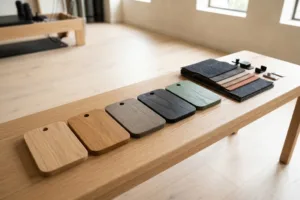
Upholstery is the easiest place to bring brand colour into a studio. It is also the most visible place for wear. Very pale colours show marks. Very dark colours can show dust and salt from sweat. Mid-tones with a little texture tend to hide everyday wear best.
A specification checklist
When you brief a maker, include:
- Cover type (PVC or PU) and the cleaning products it must tolerate.
- Minimum Martindale rub count, and which part of BS EN ISO 12947 was used.
- Fire performance level, as set by your fire risk assessment.
- Foam hardness and fatigue performance, or a sample to try.
- Seam layout, edge detail and fixing method.
- Colour, with a physical sample viewed in your room.
- How replacement pads are supplied.
Round Fit can fit any upholstery on request, in-house, alongside the timber and finish. See our customisation options, or send us your scheme.