A mirror wall changes how a studio works. In a barre class it is a teaching tool. Clients check their alignment, and the instructor can see the whole room while facing the same way as the class. In yoga, opinion is split. Some teachers use mirrors for alignment work. Others prefer students to feel the pose rather than watch it, and ask for mirrors to be covered or left out.
Either way, a mirror is a large sheet of glass in a room where people move, stretch and sometimes stumble. It needs to be planned like any other piece of equipment: where it goes, what it is made of, how it is fixed and how its edges are protected.
Where the mirror goes
In most barre studios the mirror wall sits behind the main barre run, or on the wall the class faces. The basic rule is simple. Clients should be able to see their whole body from their usual position, from feet to head.
That sets the two key heights.
- The bottom edge should be low enough to show the feet and ankles. Dance safety guidance recommends that mirrors are raised about 15 cm from the floor. That small gap keeps the glass clear of mop buckets, cleaning machines and stray feet, and stops water from sitting against the bottom edge.
- The top edge should be high enough to show a tall adult standing at the barre, with some margin for raised arms. In most rooms this means a mirror around 180 to 200 cm high, mounted from the 15 cm line.
Width depends on the class size. A mirror that covers the full length of the barre wall lets every client see themselves without crowding into the middle. Corner mirrors let you analyse movement from two directions, which some instructors value for alignment work.
Keep in mind what the mirror reflects. A mirror opposite a window can cause glare at certain times of day. A mirror opposite the entrance makes the room feel busy, as every arrival is reflected.
What the glass is made of
Mirrors in fitness spaces need safety glass. Dance safety guidance advises that mirrors should be safety-backed and installed flush with the walls.
In the UK and Europe, the impact performance of flat glass is classified under BS EN 12600. In this test, a weighted impactor is swung at the glass from set drop heights. The classes are class 3 at a 190 mm drop height, class 2 at 450 mm and class 1 at 1,200 mm. The classification also records how the glass breaks. Type B breakage means the fragments are held together, which is typical of laminated glass and of glass with a safety film applied.
For a studio, the practical options are:
- A mirror with a safety backing film. If the glass breaks, the film holds the pieces together.
- Laminated or toughened mirror glass. These are often specified in commercial projects.
Your glazing supplier or contractor should confirm the classification that suits your room and your building’s requirements. A mirror wall is not a place to save money on the glass itself.
How the mirror is fixed
Large mirrors are heavy. They are usually fixed with a combination of mechanical fixings, channels and approved adhesives, chosen to suit the wall. A mirror on a plasterboard partition needs a different approach from one on a masonry wall.
BS 8539, the British Standard for anchors in concrete and masonry, makes a point that applies here. Anchors should be chosen for the actual base material and load, installed by a competent person and, where needed, tested on site. Before a mirror wall is ordered, ask your contractor or local installation partner to assess the wall behind it.
If the barre is mounted on the same wall, plan both together. Barre brackets usually fix through or between mirror panels, and the positions need to line up with solid fixing points in the wall. Changing one after the other is installed is expensive.
Framing and edges
An unframed mirror wall can look very clean, but its edges are the most fragile part. A timber frame does three jobs.
- It protects the edges from knocks by equipment, mats and cleaning machines.
- It gives a finished line where the mirror meets the floor, the ceiling or a change of wall finish.
- It ties the mirror into the room. A frame in the same species and finish as the barre makes the wall look like one designed piece rather than glass and timber bought separately.
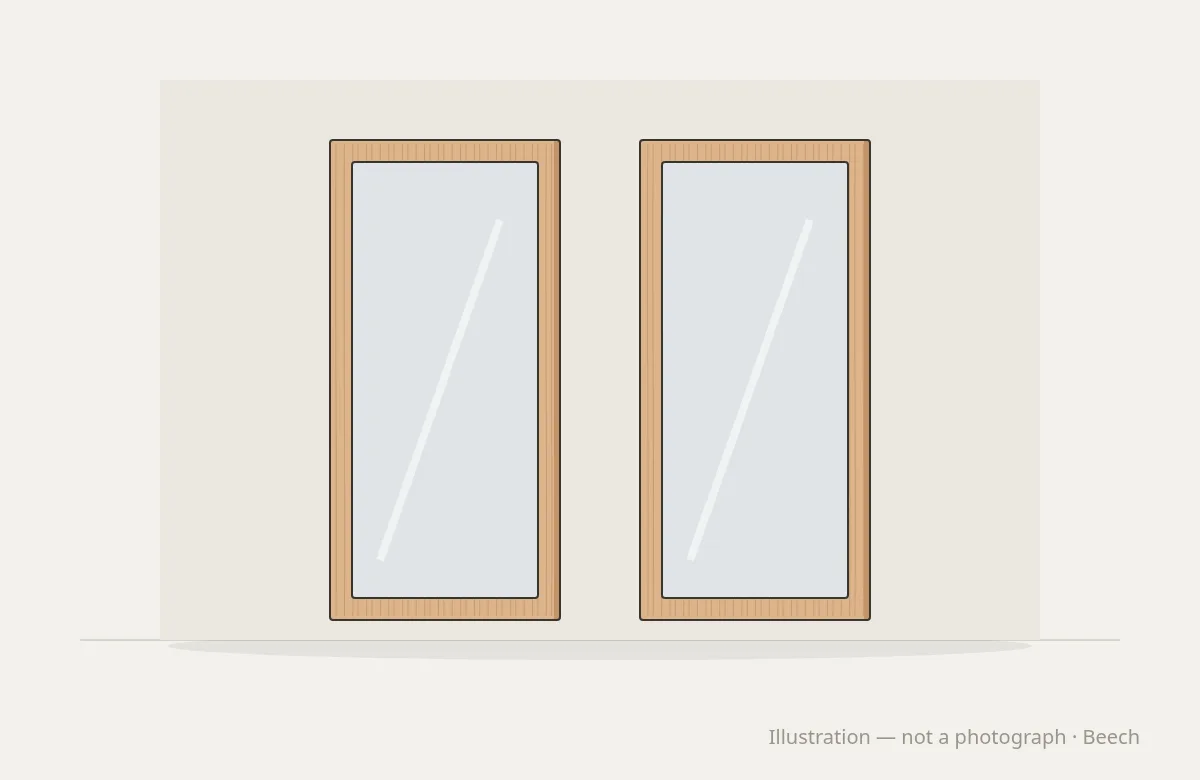
Round Fit’s Studio Space Mirror Frame is wall-mounted and made in solid hardwood, typically beech, ash or oak, with a matt lacquer that copes with daily cleaning. A typical frame is 60 × 180 cm, but frames are made to any size, and the species and finish can be matched to your barres and other furniture.
Mirrors in shared rooms
Many studios teach barre, yoga and meditation in the same room. Mirrors are welcome in one class and distracting in another.
The usual solutions are:
- Curtains on a ceiling track in front of the mirror wall. They are quick to use and soften the acoustics.
- Sliding or folding panels in timber or fabric. They are more solid and can match the barres and storage.
- Portable mirrors on castors for rooms where only some classes need them. Dance safety guidance suggests portable mirrors of about 180 × 240 cm on castors.
If you choose curtains or panels, allow space for them in the drawings. A curtain track needs a fixing at ceiling level. A sliding panel needs a clear run along the wall and somewhere to park when open.
Cleaning and care
Mirrors in studios are cleaned often. Fingerprints, sweat and spray from cleaning products show quickly. Frames and barres near the mirror get splashed with glass cleaner, so their finish needs to tolerate it. A matt lacquer is easy to wipe and does not show streaks the way a gloss finish can.
Check the mirror fixings and the frame during routine inspections. Look for loose sections, chipped edges and any movement at the barre brackets. A cracked mirror should be taped and reported straight away, and the area kept clear until it is replaced.
A short planning list
- Bottom edge around 15 cm above the floor, with the top high enough for a tall adult with raised arms.
- Safety-backed, laminated or toughened glass, confirmed with your glazing supplier.
- Fixings chosen for the actual wall, with barre brackets planned alongside the mirror.
- A hardwood frame that protects the edges and matches the barres.
- A plan for covering the mirrors if yoga or meditation uses the same room.
See our Studio Interiors collection for frames, barres and storage made to match. If you have a wall to fit out, tell us the dimensions and we will help.