A private label Pilates reformer carries your brand rather than the maker’s. For a chain or franchise, it means every studio has the same machine, built to the same specification, in the brand’s own colours and with its own name on the frame. Clients recognise it, instructors know it and the brand owns the experience from the front door to the footbar.
This article explains how a private label reformer project works in practice: what can be specified, how the process runs from brief to delivery and what to agree before production starts.
Private label, not white label
The two terms are often confused. A white label product is an existing product with your logo added, and the same product may be sold under many other brands. A private label product is made to your specification and supplied only to your brand. It gives more control over the design and more exclusivity, in return for a larger commitment and a longer development time.
Round Fit offers private label for chains and franchises from an order value of €20,000.
What you can specify
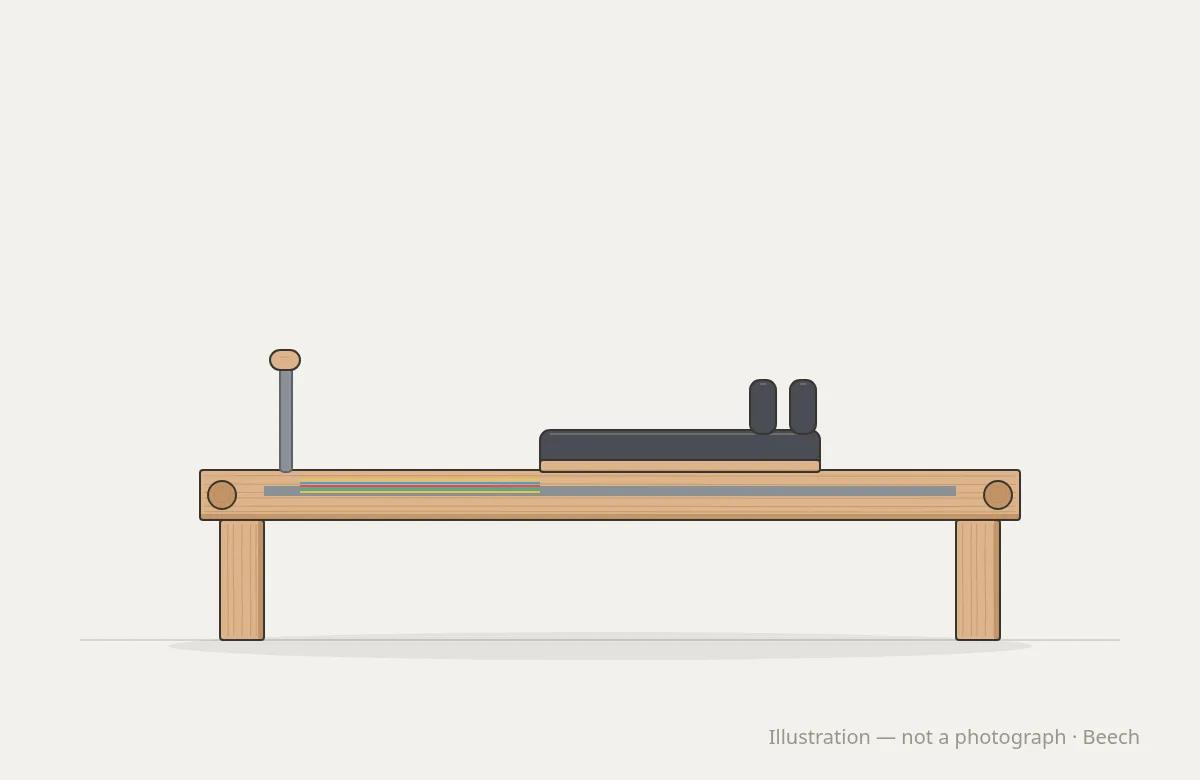
A private label reformer starts from a tested base design. As a reference, the Round Fit Studio Pro Reformer is 235 cm long and 68.5 cm wide, with a solid hardwood frame, anodised aluminium rails, a carriage on eight polyurethane wheels and a maximum user weight of 180 kg. The structural and safety basics stay those of the tested design. The international safety standard for stationary training equipment, EN ISO 20957-1:2024, sets general safety requirements for equipment used in studios, clubs, hotels and rehabilitation centres.
Around that base, you can specify:
- Timber species. Beech, ash, oak or any other species, to suit the brand’s interiors.
- Finish and colour. A natural matt lacquer, a stain or a colour matched to the brand. Recognised colour references, such as an RAL Classic code like RAL 1028 or a Natural Colour System code like S 1050-Y90R, give the maker a precise target.
- Upholstery colour, from a base palette or matched to any custom colour.
- Branding. Your logo on the frame, the footbar area or another agreed position, applied in a way that suits the material, such as engraving or inlay.
- Accessories. The standard set supplied with every machine, for example sitting boxes, jump boards or platform extenders, so every studio has the same kit.
How the process runs
1. Brief. You share the brand guidelines, colour references, the number of studios and machines, and the roll-out timetable. If you already have a reformer you like, or one you do not, say what you want to keep or change.
2. Drawings and samples. The maker prepares drawings showing dimensions, materials, colours and branding positions, and makes physical samples of timber, finish and upholstery. Approve colours on the actual timber, under the lighting of a real studio. The same stain looks different on beech, ash and oak.
3. Prototype or first-off sample. For a new specification, a first machine is built and reviewed before batch production. This is the moment to check the look, the feel and the branding, and to make changes cheaply.
4. Sign-off. The approved drawings, samples and prototype become the reference specification. Keep a written record, including photographs of the approved sample.
5. Production. Machines are built in batches to the approved specification. Pilates equipment is typically ready in four to six weeks from approval, depending on the order. Payment is typically 50 per cent at the start and 50 per cent at shipment.
6. Testing, delivery and installation. Every machine is tested before it leaves the workshop. Installation is arranged through local distribution partners.
Protecting the design
If a chain develops a distinctive look for its reformers, it may want to protect it. In the UK, a registered design protects the appearance of a product, such as its shape, configuration, decoration or colour. The UK government’s guidance explains that a registration lasts five years and can be renewed every five years up to a maximum of 25 years. It does not protect how a product works.
Agree with the maker, in writing, who owns which design rights, and take legal advice where the design is important to the brand.
Keeping every site the same
The value of private label comes from consistency. Once the specification is approved:
- Use one reference specification for every order, with a version number.
- Record any permitted variations, for example a shorter frame for a small site.
- Order repeat batches against the same reference, so a studio that opens next year matches one that opened this year.
- Keep spare parts that wear, such as ropes, springs and upholstery covers, to the same specification.
Timber changes colour slowly with light, so machines made a year apart may look slightly different at first. That usually evens out as the newer pieces age.
Built in one workshop
Round Fit builds its reformers in its own workshop in Ukraine, where it machines the timber and makes its steel parts. Producing the timber and metal parts to one specification in one place makes it easier to keep every batch consistent.
See our solutions for chains and franchises. For a branded quote, contact our project team.