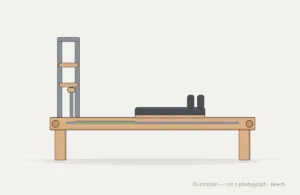
Not every clinic has room for a reformer or a Cadillac. Even those that do often find that small apparatus earns its place just as well. An arc, a spine corrector, a step barrel or a wedge can add variety and support to a treatment room without taking up much floor space. They can be moved to the plinth, the mat or the reformer, and stored away when not in use.
This article looks at what each piece offers, how to judge them for clinical use and how to fit them into the room. Exercise programmes should always be set by a qualified physiotherapist.
Why small apparatus suits clinics
Exercise is central to rehabilitation for many conditions. NICE’s guideline on low back pain and sciatica, NG59, recommends that people consider a group exercise programme, which may include biomechanical, aerobic, mind-body or combined approaches. Small Pilates apparatus supports that kind of work in individual and small-group sessions.
The pieces share a simple principle. They give the spine and limbs a shaped surface to work over: support for gentle extension, a curve for mobility, an incline for strengthening. They do not use springs, so they are simple to set up and easy to understand for patients.
The main pieces
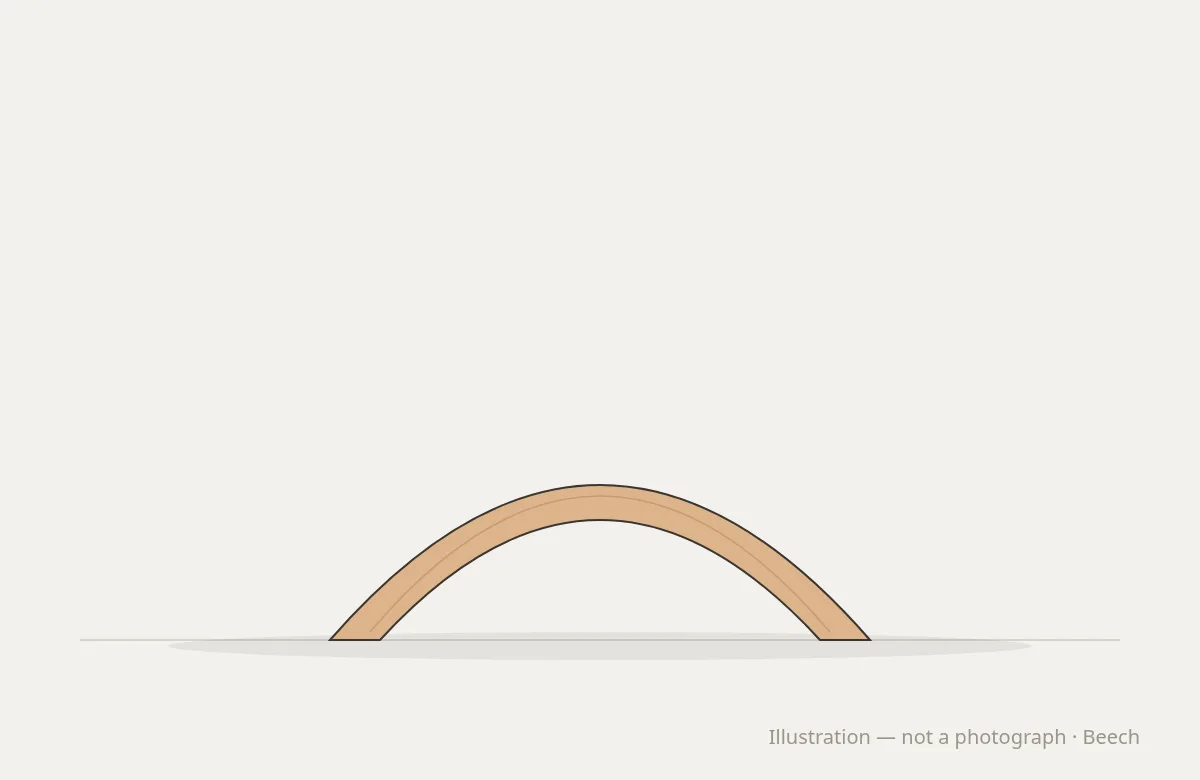
The arc. A light, low curve, used on the mat or on a reformer carriage. It supports the spine for gentle extension and core work. Because it is light and stacks well, it suits clinics where space is limited. The Round Fit Studio Pro Arc is 62 cm long, lightweight and has a non-slip surface.
The spine corrector. A curved unit with a low step, larger than an arc. It has a gentler curve than a full barrel, which limits the range of movement and suits early-stage work. The Round Fit Studio Pro Spine Corrector is 92 cm long, 35 cm wide and up to 37 cm high, with a high-density core, four band attachment points and a strap to secure it to a step platform.
The step barrel. A half-round barrel with a built-in step, used for spinal extension and flexion, and for abdominal work. The Round Fit Studio Pro Step Barrel is 82 cm long, 44 cm wide and 33 cm high, and weighs 9 kg. It has side handles, a carry handle and attachment points for resistance bands.
The wedge. An incline that supports the body at an angle, for gentle extension, inclined work and positioning. The Round Fit Studio Pro Big Wedge is 97 cm long and 60 cm wide, rising from 5 to 36 cm.
Judging pieces for clinical use
Weight. Small apparatus is moved many times a day, between the floor, the plinth and the reformer. Staff should be able to lift and carry each piece comfortably. The Health and Safety Executive’s manual handling risk filters show that the weight a person can handle safely falls when the load is held away from the body or lifted from low or high levels. Handles help, and so does storing pieces at a sensible height.
Stability. A piece that slides or rocks under a patient undermines confidence and safety. Look for a stable base and a non-slip surface underneath. On a reformer carriage, a strap or fixing that secures the piece is useful.
Upholstery. Contact surfaces should be easy to wipe between patients. NHS England’s Health Building Note 00-09 on infection control recommends soft furnishings that are compatible with detergents and disinfectants and covered in an impermeable material, preferably seam-free or heat-sealed. A comparison published by the Chemical Fabrics and Film Association notes that PVC rates good to excellent with disinfectants, while polyurethane rates lower. Check the cover against the clinic’s products.
Construction. Solid hardwood or plywood bodies with sealed finishes last longer and clean better than painted or composite ones.
Fitting them into the room
Small apparatus works alongside a plinth, a mat area or a reformer. Plan for both use and storage.
- A working area with enough space around the mat or plinth for the patient to move and the therapist to assist.
- A set storage place for each piece, so it is always in the same place and missing items are noticed.
- Storage off the floor, at a height that avoids repeated bending. HBN 00-09 recommends that stored items are kept off the floor, which also makes the floor quicker to clean.
- Clear walkways. The Health and Safety Executive notes that most trips at work are caused by obstructions in walkways. A barrel left on the floor is exactly that, particularly for patients with limited mobility.
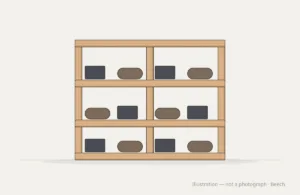
Open shelves or racks work well for small apparatus. Air can circulate, so pieces dry after cleaning, and it is easy to see what is where.
A starting set
For a clinic adding small apparatus for the first time, a sensible set might be:
- One or two arcs, for mat and carriage work.
- A spine corrector, for early-stage spinal work.
- A step barrel, for progression.
- A wedge, for positioning and inclined work.
- Mats, blocks and bands to go with them.
The set can grow as the clinic’s programme develops.
Built to order
Round Fit makes small Pilates apparatus in solid hardwood, with any species, finish and upholstery colour available. Pilates equipment is typically ready in four to six weeks. Every piece is tested before it leaves the workshop.
See the small apparatus in our Pilates collection. If you are planning a clinic treatment room, start a conversation with us.