Yoga uses more small equipment than most people expect. A busy studio might have dozens of mats, blocks, straps, bolsters and blankets, plus chairs and wall ropes. Without a plan, props pile up in corners, get mixed up and make a calm room feel cluttered. With a plan, students collect what they need in seconds and the room resets quickly between classes.
This article explains how to plan prop storage that is quick to use, easy to keep tidy and good for the props themselves.
Know what you are storing
Props have a long history. A cloth strap appears in Indian sculptures around 2,000 years old, and B. K. S. Iyengar’s 1966 book Light on Yoga set out a systematic approach requiring belts, bricks and ropes. Today’s studios commonly use:
- Mats for grip and comfort.
- Blocks to bring the floor closer or raise the pelvis.
- Straps to extend reach in forward bends.
- Bolsters to support the body in restorative and Yin practice.
- Blankets for padding and support.
- Chairs for supported poses and chair yoga.
Count each type for the largest class you run, and add spares.
Give every prop type its own place
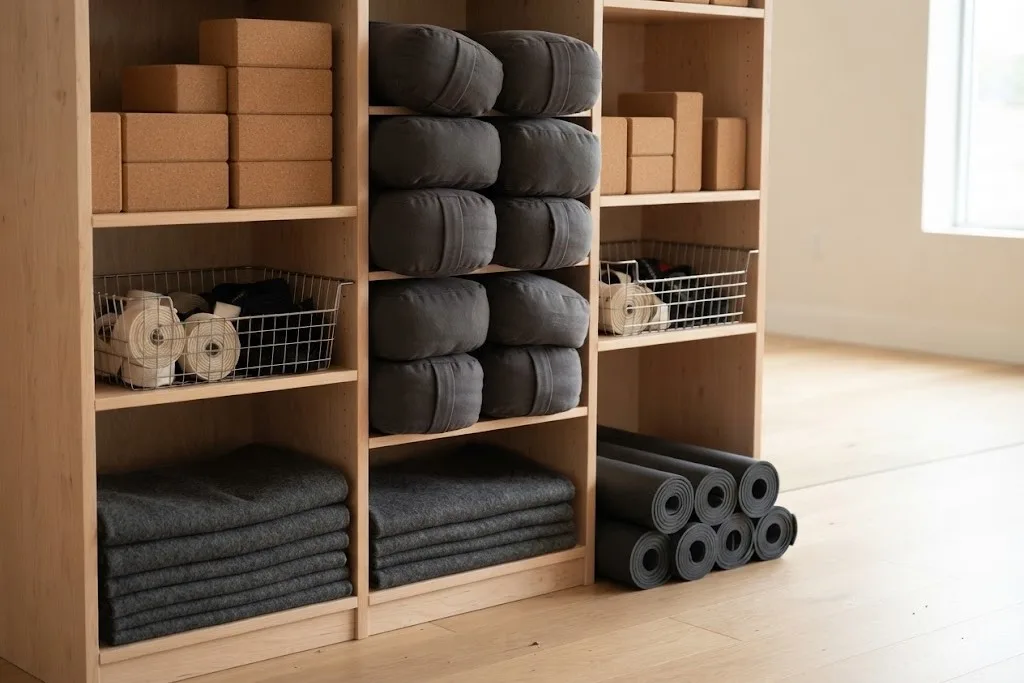
The simplest system is one section per prop type, sized for the full class set:
- Blocks on shelves, stacked to a stable height.
- Straps on hooks or rails, hung loosely so they dry and do not tangle.
- Bolsters on deep, low shelves or in cubbies.
- Blankets folded on shelves, with air around them.
- Mats rolled and stored vertically in a rack, or hung.
- Chairs stacked or lined up in a dedicated bay.
When each item has a fixed place, students can see at a glance what is available, and staff can see what is missing.
Heights and handling
Bolsters, stacks of blankets and chairs are bulky. The UK Health and Safety Executive’s manual handling risk filters note that acceptable weights reduce when items are handled at high or low levels, or with arms extended. In practice:
- Heavier and bulkier props low to middle, not on the floor and not overhead.
- Lighter props higher up, such as straps and blocks.
- Shallow shelves so students do not reach deep into the unit.
Open shelving for speed
Closed cupboards look tidy but slow everything down. Students have to open doors, find props and close doors again. Open shelving lets a class of twenty collect props quickly and return them without queues.
As an example, the Round Fit Studio Flow Prop Storage unit is typically 120 cm wide, 40 cm deep and 180 cm high, with open shelves, in solid hardwood or plywood with a matt lacquer.
Air and hygiene
Props are in close contact with skin. Mats, straps and blankets absorb sweat. Stored tightly in a closed space, they stay damp and can develop odours.
- Allow air around mats, blankets and bolsters.
- Hang straps so they dry.
- Clean mats after use, and let them dry before rolling.
- Ventilate the room. Dance safety guidance recommends six to ten air changes per hour when spaces are used intensively. Good room ventilation helps props dry.
Open timber shelving lets air circulate around props better than closed plastic bins.
Where to put it
- Near the entrance to the studio, so students collect props on the way in and return them on the way out.
- Away from the teaching wall, so the teacher’s space stays clear.
- Out of the main walkway. The HSE notes that most trips are caused by obstructions in walkways.
- Away from wall ropes, so students using the wall are not disturbed.
Keeping it tidy
- Label sections.
- Make returning props part of the end of every class.
- Check and reorganise once a day.
- Replace worn props promptly.
Matching the studio
Prop storage is often one of the largest pieces of furniture in a yoga room. Built in the same timber and finish as the floor or the yoga wall, it becomes part of the room’s calm.
See prop storage in our Yoga & Barre collection. Send us your prop list and we will plan storage around it.