Dumbbells left on the floor are one of the most common hazards in a gym. They are easy to trip over, they roll, and they make a room look untidy. A well-planned rack keeps weights visible, sorted and easy to return. It also protects the dumbbells, the floor and the people using them.
This article explains how to plan a dumbbell rack for a commercial studio, hotel gym or club, and what to look for in its construction.
Why storage is a safety question
The UK Health and Safety Executive notes that most trips are caused by obstructions in walkways, and that walkways must be kept clear. In a gym, loose weights are the most frequent obstruction. A rack that is easy to use, and close to where weights are used, is the best way to keep them off the floor.
Storage also affects how weights are lifted. The HSE’s manual handling risk filters note that acceptable weights reduce when items are handled at high or low levels, or with arms extended. A rack that puts heavy dumbbells at floor level, or at the back of a deep shelf, makes every lift harder than it needs to be.
Step 1: count the weights
Start with a list:
- Every pair you have now, by weight.
- Every pair you plan to add in the next few years.
- The size of the largest dumbbell head, because diameter varies by style and weight.
Size the rack for the full list, with some spare space. A rack that is full on day one quickly overflows.
Step 2: decide the layout
Order. Arrange weights in one direction, lightest to heaviest. Clients learn the order and return weights to the right place.
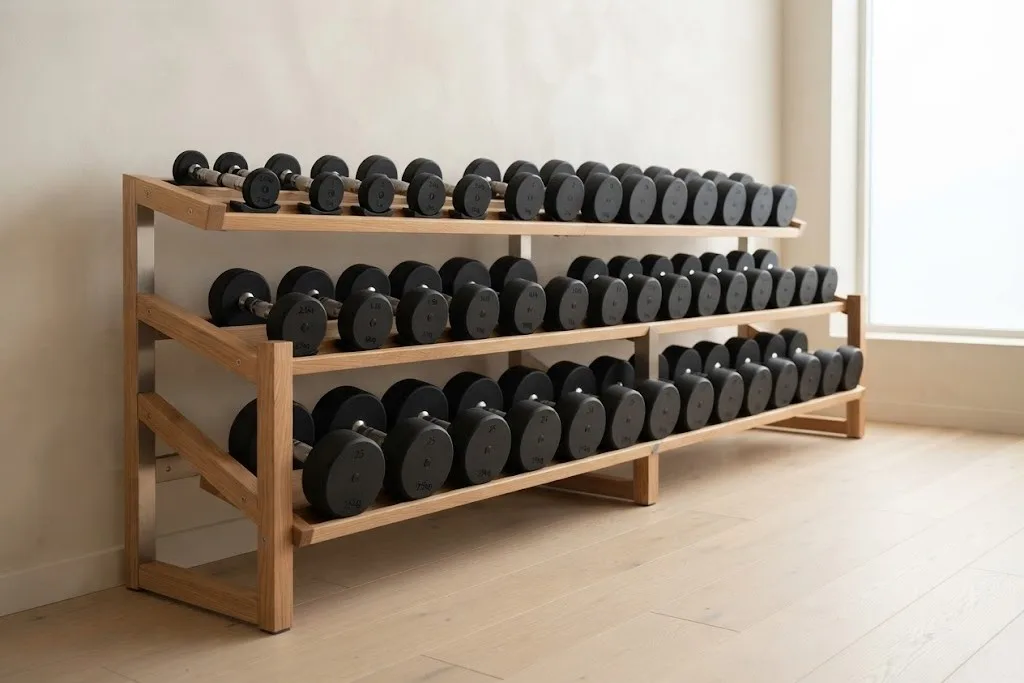
Height. Put the heaviest pairs at a comfortable lifting height, roughly between knee and chest, and lighter pairs above or below. Avoid putting the heaviest weights on the lowest tier.
Angle. Angled tiers present the handles towards the user and stop dumbbells rolling backwards. The Round Fit Studio Strength Dumbbell Rack, for example, uses angled tiers and is typically 140 cm wide, 60 cm deep and 85 cm high, sized to the dumbbell set.
Depth. Tiers should be deep enough to hold the largest head securely, but not so deep that users have to reach.
Step 3: place it in the room
- Near where weights are used, so clients do not carry them across the room.
- Against a wall, with the area in front kept clear.
- With space in front for several people to pick up and return weights at once. Common industry guidance suggests allowing about 60 to 70 square feet (about 5.6 to 6.5 m²) per machine in strength areas, including free weights and benches.
- Away from doors and main walkways.
Step 4: build it to last
A dumbbell rack carries a heavy, concentrated, static load, and it is hit by dumbbells many times a day.
Materials. Solid hardwood and plywood both work well. Plywood stays flat across wide tiers; solid hardwood takes knocks on edges and frames. Round Fit does not use chipboard or MDF. The Wood Handbook warns that screws in particleboard strip their threads if overtightened, which is a poor basis for a rack that is loaded and knocked every day.
Joints and fixings. The Wood Handbook from the US Forest Products Laboratory notes that screws hold much better in dense timber, with withdrawal resistance rising with the square of specific gravity, and less well in end grain. Load-bearing joints should be designed for the full weight of the set, with a margin.
Finish. A matt lacquer protects the timber from sweat and cleaning products and hides small marks.
Protection. Contact surfaces can be lined, so metal heads do not wear through the finish.
Matching the room
In a boutique studio or hotel gym, the rack is a large, visible object. Built in the same timber and finish as the other equipment, it becomes part of the interior rather than an industrial fixture. Round Fit builds racks in any species on request.
Checklist
- List every pair, current and planned, with head sizes.
- Order weights in one direction.
- Put the heaviest pairs at a comfortable height.
- Use angled tiers sized to the largest heads.
- Place the rack near the training area, with clear space in front.
- Specify solid hardwood or plywood, designed for the full load.
- Match timber and finish to the room.
Every Round Fit piece is tested before it leaves the workshop. For hotel and club gyms, see our approach to hotel and club gyms. Share your weight list and we will size a rack around it.