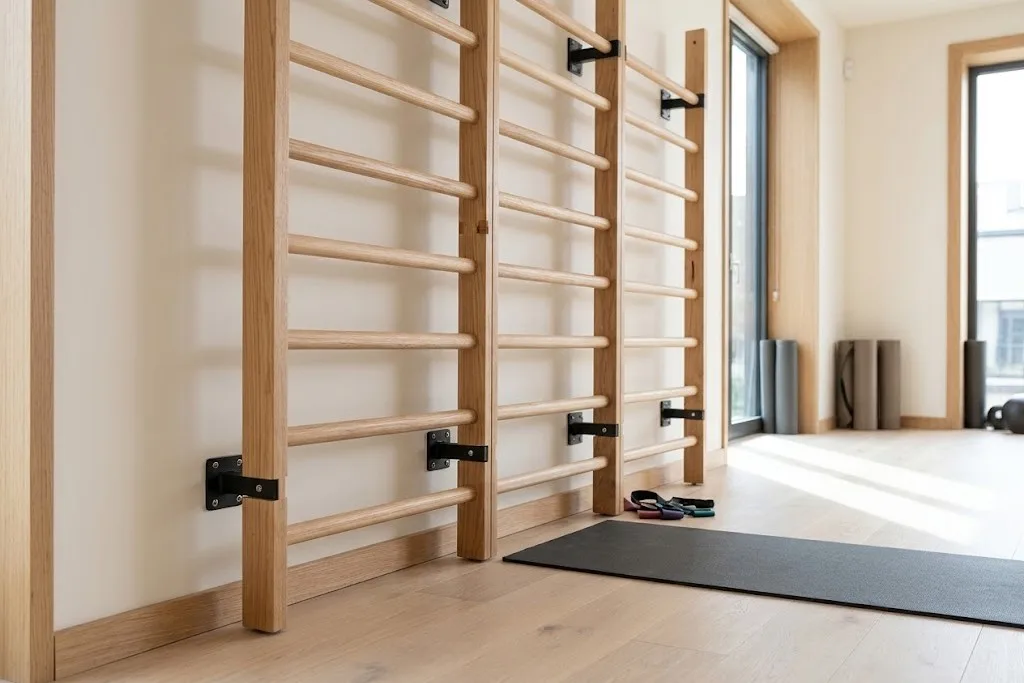
Wall bars sold for home use and wall bars built for commercial rooms can look almost identical in a photograph. In use they are very different. A home set may see a few sessions a week. A set in a studio, club or clinic may be climbed, hung from and stretched on by dozens of people every day, for years.
This article is a practical checklist. It covers what to check when comparing wall bars for a commercial space, what to check at installation, and what to check during use.
Before you buy: the design
Is there a standard behind it? Wall bars are covered in Europe by EN 12346, published in the UK as BS EN 12346:1999, “Gymnastic equipment. Wall bars, lattice ladders and climbing frames. Safety requirements and test methods”. BSI lists it as current, with subjects including loading, mechanical and torsion testing, dimensional tolerances, marking and instructions for use. Ask whether the design follows it and how it has been tested.
What are the rungs made of? Rungs should be solid, straight-grained hardwood. The Wood Database describes European ash as having fairly good strength for its weight and as shock resistant, which is why it is traditional for sports equipment and handles. European beech is stiffer still and smooth in the hand. Look for straight grain with no knots near the ends of rungs.
How do the rungs meet the stiles? The joint between rung and stile takes bending and twisting loads every time someone pulls or steps. It should be a tight, glued and fully seated joint, not a shallow hole.
What are the stiles made of? Stiles carry the rungs and transfer loads to the wall. They should be solid hardwood of generous section. Particle boards such as chipboard and MDF have no place here.
What finish is used? A matt lacquer protects the timber and stands up to daily cleaning, while giving a natural, non-slippery grip.
Before you buy: the configuration
Check the configuration against how the bars will be used:
- Single or multiple bays, each independently fixed.
- Pull-up bar, if required, designed for the extra leverage it puts on the fixings.
- Rung spacing that suits the programme. Rehab rooms may need different spacing from training rooms.
- Height that suits the ceiling and the users.
The Round Fit range includes single and double wall bars, wall bars with a pull-up bar, and modular wall bars, all in solid hardwood and made to brief.
At installation: the wall and fixings
What is the wall made of? Solid concrete or masonry is the best base. Hollow block and stud walls usually need added structure.
How are the anchors chosen and installed? In the UK, BS 8539 is the code of practice for anchors in concrete and masonry. Its approach is that the specifier should assess the anchor’s suitability and specify it clearly, that any substitution should follow the same selection process, and that each anchor should be inspected before load is applied.
How are the fixings set into the timber? The Wood Handbook from the US Forest Products Laboratory notes that screws hold much better in dense timber, with withdrawal resistance rising with the square of specific gravity, and that screws in end grain hold only about 75 per cent of their side-grain value. Fixings should go into side grain of the stiles.
Is there enough clear space? Leave clear floor space in front and to the sides, with nothing projecting from the wall nearby.
Round Fit installs through local distribution partners, who assess the wall before fitting.
During use: routine checks
Even well-installed bars need checking. The Wood Handbook explains that fixings in wood exposed to repeated wetting and drying can lose much of their holding power, and that bolted joints may need retightening as timber settles in its first year.
A simple routine:
Weekly – Grip and twist each rung. It should not turn or move in the stile. – Look for cracks at the rung ends and around fixings. – Check the floor in front for anything left lying around.
Monthly – Push and pull each bay firmly. There should be no movement at the wall. – Inspect the finish on the most-used rungs. – Check any pull-up bar and its brackets.
Every three months – Check and retighten all accessible fixings. – Record the inspection.
Take a bay out of use if a rung turns, a crack appears, or the bay moves at the wall. Do not use it until it has been inspected and repaired.
Signs of quality at a glance
When you see a set of wall bars, a few things tell you a lot:
- Rungs with straight, continuous grain.
- Tight, clean rung joints with no gaps.
- Stiles of generous section in solid hardwood.
- An even, matt finish, including on rung ends.
- Clear installation instructions that ask about your wall type.
Every Round Fit piece is tested before it leaves the workshop, and frames carry a five-year warranty.
See the range in our Strength & Functional collection, or let us help you specify the right wall bars.