A standard reformer suits many studios. But some rooms, brands and teaching methods need something different. A bespoke reformer lets a studio choose the timber, the colour, the upholstery and the accessories, and adapt the machine to the space and the method.
This article explains what can usefully be specified on a bespoke reformer for a UK studio, what should stay fixed, and which checks matter before ordering.
Start from a proven base
Bespoke does not mean starting from a blank sheet. The safest approach is to begin with a proven base design and change what matters for your studio.
As a reference point, the Round Fit Studio Pro Reformer is 235 cm long, 68.5 cm wide and 40 cm high, with a carriage of 93 by 61.5 cm. It has a solid hardwood frame, anodised aluminium rails, a carriage on eight polyurethane wheels, five springs (two light, two medium and one heavy) and a maximum user weight of 180 kg. Shape and size can be adapted to the space and the method.
The international safety standard for stationary training equipment, EN ISO 20957-1:2024, covers equipment in studios, clubs, hotels and rehabilitation centres as well as domestic equipment, and sets general safety requirements and test methods. Whatever is customised, the structural and safety basics should stay those of a tested design.
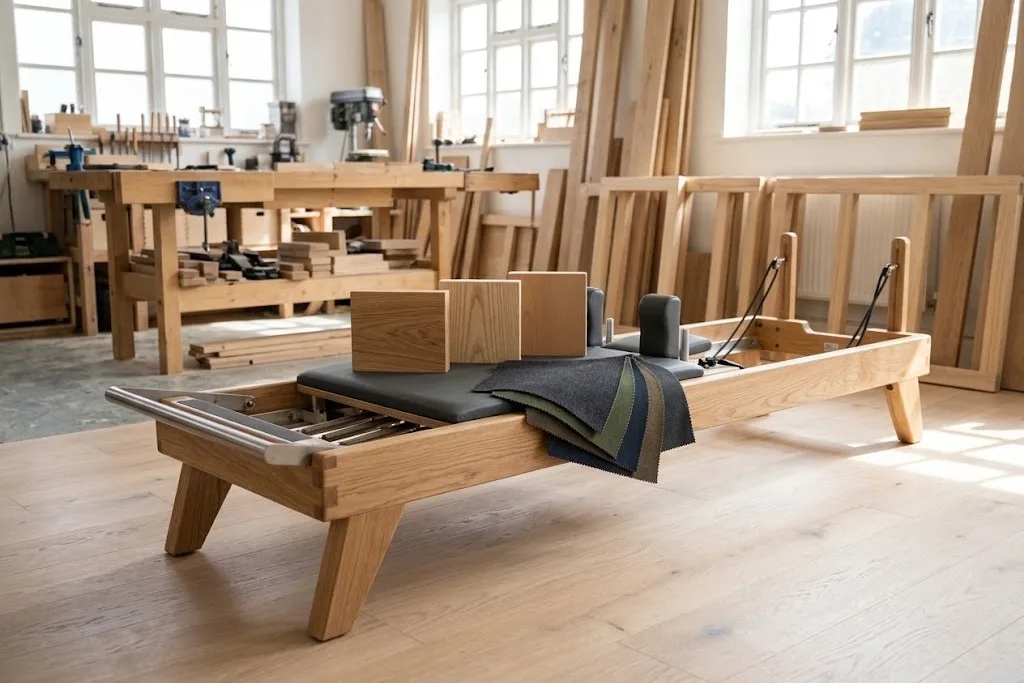
Timber species
The frame is the most visible part of the reformer. Common choices are:
- Beech. Fine, even grain and a pale, warm tone. Of these three, it is the stiffest: The Wood Database lists an elastic modulus of 14.31 GPa.
- Ash. Pale with a livelier grain, and known for shock resistance.
- Oak. Strong figure and a heavier, more traditional look.
Round Fit works with any timber species on request. The choice should suit the room’s interior and its humidity. Species that move more with humidity need more careful detailing in rooms with large seasonal swings.
Finish and colour
The finish protects the frame and sets its final tone. Options include:
- Clear matt lacquer, to show the natural timber.
- Tinted lacquer, to warm, cool or deepen the timber while keeping the grain visible.
- Coloured finishes, to match a brand colour by RAL or NCS reference.
Ask for a physical sample on the chosen species, with the chosen finish, before approving.
Upholstery
Upholstery is where many studios bring in brand colour. It is also the part that wears first. Three technical points should sit alongside the colour choice:
Cover material. A comparison published by the Chemical Fabrics and Film Association notes that PVC is not subject to hydrolysis to any significant degree, while polyurethane can break down slowly in heat and humidity. PVC also rates better with disinfectants. Choose a cover that tolerates your cleaning products.
Abrasion resistance. Martindale results of 40,000 rubs and above are generally treated as contract grade, and 100,000 rubs and above as severe contract. A busy studio reformer sits at the upper end.
Fire performance. In the UK, contract upholstery is commonly specified to BS 7176. SATRA explains that the standard sets hazard levels by building use, with medium hazard adding a crib ignition test. Your fire risk assessment should confirm which level applies.
Accessories
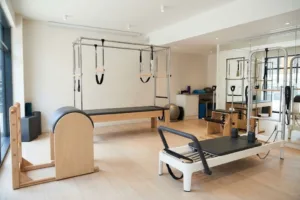
Accessories extend what the reformer can do. The standard Studio Pro Reformer includes double loops, adjustable straps, shoulder rests, a jump board, a padded platform and a sitting box with a padded top. Other options can be added to suit the method.
Specify accessories at the same time as the reformer, so they match in timber, finish and upholstery. Plan storage for them too.
Branding
A reformer can carry a studio’s identity. Options include engraving, inlay, a fitted plate or printed details, chosen to suit the material. For chains, private label is available, with the specification locked across every site.
Size and adaptation
Bespoke sizing can help in some situations:
- A slightly shorter frame for a tight room.
- A different height for clinical access.
- Changes to suit a particular teaching method.
Any change to size or geometry affects how the reformer works. It should be agreed with the instructors who will teach on it, and tested before batch production.
What should stay fixed
Some things should not be compromised for appearance:
- Structural sections and joints sized for commercial loads.
- Spring specification and spring fixings.
- Rail and wheel quality, which affect smoothness and noise.
- Safety features such as footbar locking.
Every Round Fit piece is tested before it leaves the workshop, and frames carry a five-year warranty.
Lead time, payment and installation
Pilates equipment is usually built in four to six weeks, depending on the project. Payment is 50 per cent at the start and 50 per cent at shipment. Installation is carried out through local distribution partners. There is no public price list. Every project is priced on request.
A specification checklist
- Base model and any changes to size or geometry.
- Timber species.
- Finish and colour reference, with an approved sample.
- Upholstery cover, colour, rub count and fire performance level.
- Accessories, in matching materials.
- Branding method and position.
- Number of units and delivery schedule.
Explore options in our Reformer configurator, or send us your requirements.