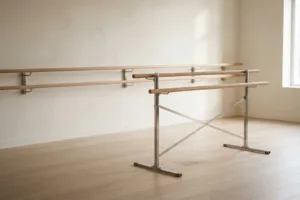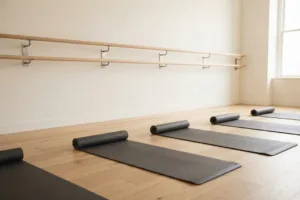
Barres and yoga equipment were designed for studios, but they are just as useful in a clinic. A barre gives a patient something steady to hold while they work on balance. A strap lets someone reach a stretch they cannot yet manage alone. A block brings the floor closer. A fixed point on the wall supports assisted stretching.
This article looks at how clinics use this equipment, and what to consider when choosing and placing it. It is general planning guidance. Which exercises suit which patient is always a decision for a qualified physiotherapist or clinician.
Why clinics use studio equipment
Exercise is at the centre of a great deal of rehabilitation. NICE guidance reflects this. Its guideline on low back pain and sciatica, NG59, recommends that people with low back pain consider a group exercise programme, which may include biomechanical, aerobic, mind-body or combined approaches. A Cochrane review of Pilates for chronic low back pain, summarised by the American Academy of Family Physicians, found that Pilates reduced pain compared with minimal intervention in the short and intermediate term, although it was not shown to be better than other forms of exercise and most of the evidence was of low to moderate quality.
Falls prevention is another strong example. NICE’s 2025 guideline on falls, NG249, recommends that falls prevention exercise programmes are delivered by appropriately trained professionals, are progressive and tailored to the person, and focus on balance, coordination, strength and power. Balance work needs support that the patient can trust. A well-fixed barre provides exactly that.
Barres for balance and support
A barre in a clinic is used differently from a barre in a studio. Patients may hold it with both hands for standing balance work, use it to steady themselves through sit-to-stand practice, or rest a leg on it for a supported stretch. Some will put real weight through it, especially early in rehabilitation.
Height. Patients vary much more than studio clients. Dance safety guidance puts barre heights between about 82 and 110 cm, set roughly at elbow height for the user. A clinic serving adults of all sizes, older patients and sometimes children benefits from two rails at different heights, or from barres at different heights in different parts of the room. A rail that is too high lifts the shoulders. A rail that is too low makes the patient stoop.
Diameter. A rail of about 4 to 5 cm suits most hands. Patients with weak grip or arthritic hands may find a slightly larger, smooth rail easier to hold.
Stability. A wall barre must be fixed to a wall that can carry the load, using anchors chosen for the base material. BS 8539 is the British Standard for selecting, installing and testing anchors in concrete and masonry. On a stud partition, extra structure is usually needed. A freestanding barre must have a wide, heavy base that does not tip or slide when a patient leans or pulls.
Wall or freestanding in a clinic
Both have a place.
- Wall barres give the firmest support. They suit a dedicated exercise area, a corridor used for gait practice, or a wall beside the treatment space.
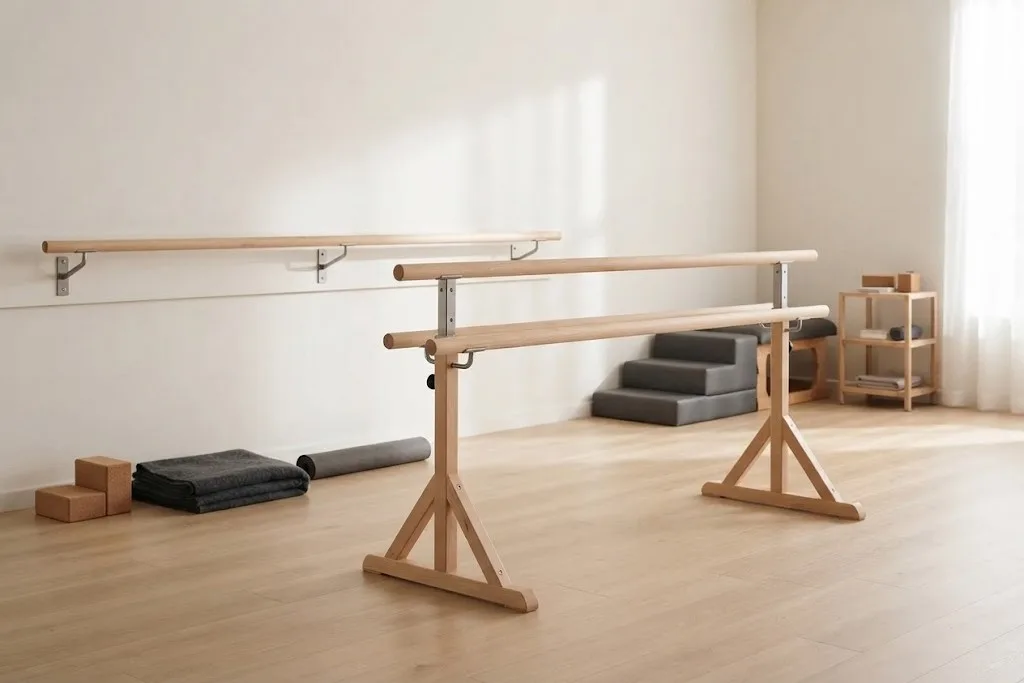
- Freestanding barres can be moved next to a plinth, into a treatment room or out of the way when floor space is needed. They suit smaller clinics where one room does several jobs.
As an example, Round Fit’s Studio Flow Freestanding Barre is typically 200 cm long and 110 cm high, with rails at 90 and 110 cm, on weighted hardwood feet. Rail heights can be set to the clinic’s brief.
Yoga props in rehabilitation
Small props make a large difference in a clinic.
- Straps extend a patient’s reach, so they can hold a stretch without straining.
- Blocks bring the floor closer for patients with limited range, and support positions on the plinth or mat.
- Bolsters and wedges support the spine and limbs in rest or supported positions.
- Wall-mounted anchor points or yoga wall panels give fixed points for strap and rope work, where the patient can use the wall for support.
Props are in close contact with skin, and clinics have higher hygiene expectations than most studios. Choose props that can be cleaned properly, and keep enough spares that a used item can be set aside for cleaning.
Hygiene and cleaning
The US Centers for Disease Control and Prevention distinguishes cleaning, which removes dirt and germs from surfaces, from disinfecting, which kills germs. Disinfectants should be used according to the label, including the contact time the surface must stay wet.
For timber equipment, this means:
- A sealed, non-porous finish that tolerates the clinic’s cleaning products.
- No open grain, cracks or rough patches where dirt can collect.
- Rails and frames that are easy to wipe in one movement.
Round Fit barres and storage are made in solid hardwood with a matt lacquer for daily cleaning. Check any cleaning product against the finish before adopting it.
Storage that supports the routine
Props on the floor are a trip hazard for patients with limited mobility or balance. They are also harder to keep clean. Good clinic storage:
- Keeps props off the floor, on open shelves where air can circulate.
- Separates clean props from used ones awaiting cleaning.
- Keeps commonly used items between knee and shoulder height, so patients and staff do not bend or reach awkwardly.
- Sits outside the main walking routes, which must stay clear.
Access and space
Many patients use walking aids or wheelchairs. Allow enough space beside barres and plinths for a patient to approach, turn and be assisted. BS 8300-2 and Approved Document M set out the accessibility requirements for buildings in England, and your architect or designer should check the layout against them. A barre should never be fixed where it narrows an accessible route.
A short planning list
- Agree with your clinical team how the barres and props will be used.
- Choose barre heights, or two rails, to suit the patients you see.
- Fix wall barres to walls that can take the load, with anchors chosen for the base.
- Use freestanding barres with a wide, heavy base where flexibility matters.
- Choose finishes that tolerate your cleaning and disinfection products.
- Keep props off the floor, separated into clean and used.
- Keep routes clear and accessible.
See our rehab and physiotherapy solutions for barres, wall bars and Pilates equipment for clinics. Let us know what you need, and we will help you plan the room.