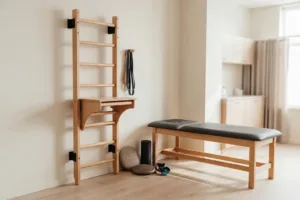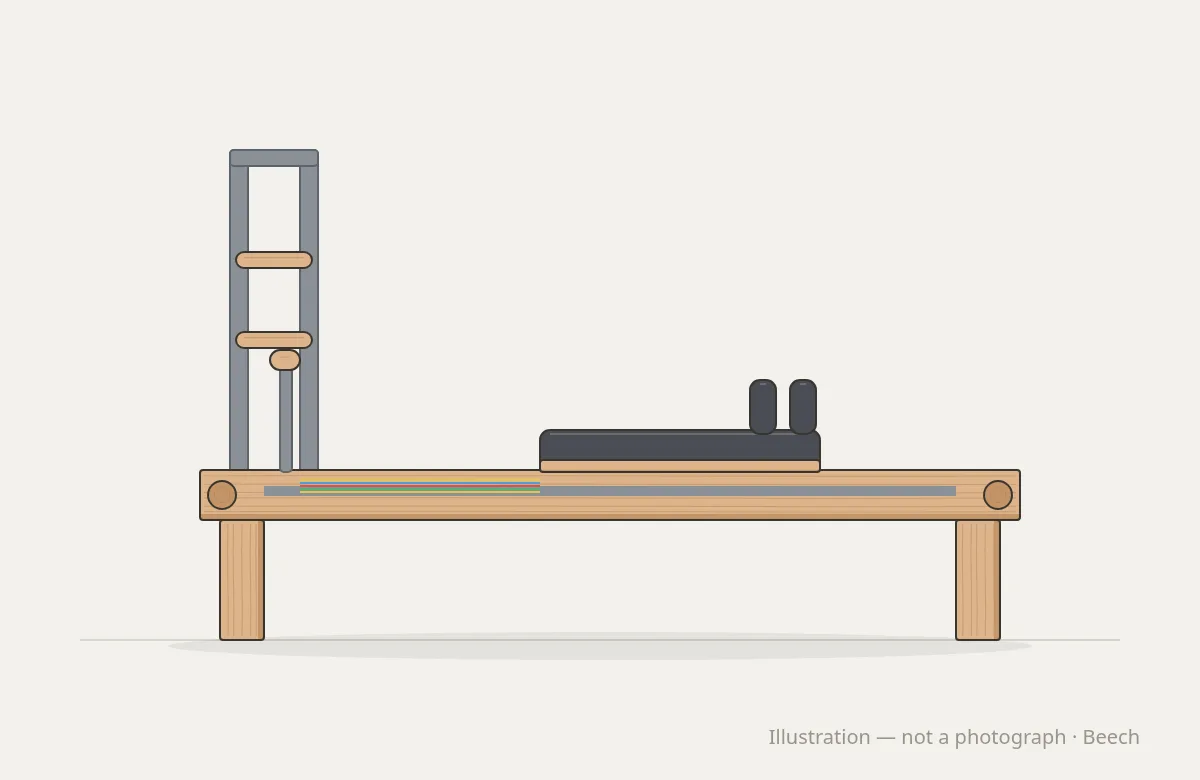
Many physiotherapy and rehab clinics would like Pilates apparatus but work in treatment rooms of modest size. A Cadillac may be too large, and a reformer alone may not offer enough. A tower reformer is often the answer. It combines a reformer carriage with a vertical frame at one end, so the clinician can use springs and bars from the mat or from the carriage, in roughly the footprint of a standard reformer.
This article explains what a tower reformer offers a clinic and how to plan a smaller room around one. Exercise programmes should always be set by a qualified physiotherapist or clinician.
What a tower reformer is
A standard reformer has a sliding carriage on rails, attached to springs at one end, with a footbar and ropes. The tower adds a vertical frame at the head or foot end, with its own springs, a push-through bar and a breathing bar.
That gives the clinician two kinds of work in one piece:
- Reformer work on the moving carriage, with spring resistance or assistance.
- Tower work with the carriage locked, using springs and bars from the frame, much as on a Cadillac.
As an example, the Round Fit Studio Pro Tower Reformer is 235 × 68.5 cm in plan and 40 cm high at the frame, rising to 185 cm with the tower fitted. It has five carriage springs and ten tower springs, colour-coded by tension, an adjustable footbar with four positions, a push-through bar and a breathing bar. The carriage can be locked to use the machine as a tower, and a sitting box, jump board and mat converter are included.
Why it suits clinics
Pilates-based exercise is widely used in rehabilitation. NICE’s guideline on low back pain and sciatica, NG59, recommends that people consider a group exercise programme, which may include biomechanical, aerobic, mind-body or combined approaches. For individual work in a clinic, apparatus lets the physiotherapist control the load and support very precisely.
The tower reformer is particularly useful because:
- Springs can assist as well as resist, helping patients through movements they cannot yet do alone.
- The locked carriage gives a stable surface for tower work, which suits patients who are not ready for a moving carriage.
- One machine covers a wide range, from early, supported work to more demanding exercise.
Check the ceiling
The footprint is close to a reformer’s, but the tower adds height. Measure the ceiling and look for obstructions: light fittings, ducts, sprinkler heads, ceiling-mounted hoists. Allow room above the tower for the push-through bar to move and for the patient’s raised arms during standing work.
Leave room beside the machine
In a clinic, space beside the machine matters as much as space at the ends.
- For the therapist. The physiotherapist needs to stand beside the patient to guide, cue and assist. Leave clear space along at least one long side, ideally both.
- For transfers. Patients may need help getting on and off. Guidance from the US Department of Justice on accessible examination rooms gives a useful reference: a clear floor space of at least 30 by 48 inches, about 760 by 1,220 mm, beside the table, and enough turning space for a wheelchair, such as a 60-inch, about 1,525 mm, circle.
- For the therapist’s posture. The Health and Safety Executive’s manual handling risk filters show that handling is harder with arms extended or at very low or very high levels. Space beside the machine lets the therapist assist from a good position rather than reaching across.
A reformer frame is low. Some patients find it easier to get on and off with a step or with the help of a platform extender, which turns the end of the reformer into a level, upholstered surface for standing and mat-style work.
Which way should it face?
Think about what the patient sees. A patient lying on the carriage looks at the ceiling and the tower; a patient sitting or kneeling looks at the wall or window in front of them.
- Avoid facing a window with strong glare or a view into a busy corridor. Patients find it harder to relax and concentrate.
- Consider privacy. A treatment room with a glazed door or a window at ground level may need blinds or a screen.
- If the clinic uses a mirror for feedback, place it where the patient can see it from the main working positions.
Upholstery and cleaning
The machine is cleaned between patients. Upholstery must tolerate frequent cleaning and the clinic’s disinfectants. A comparison published by the Chemical Fabrics and Film Association notes that PVC is not subject to hydrolysis to any significant degree and rates well with disinfectants, while polyurethane rates lower and has failed early with some quaternary ammonium cleaners. Check the cover material against the clinic’s products before ordering.
Round Fit frames are available in beech, ash, oak or another species, with a matt, liquid-resistant finish and upholstery in a standard or custom colour.
Inspection
A tower reformer has springs, ropes, straps and a moving carriage. The Health and Safety Executive’s guidance on inspecting work equipment recommends inspection after installation and at suitable intervals where equipment is exposed to conditions that could cause deterioration, with results recorded. Build checks of springs, ropes, the carriage and the tower fixings into the clinic’s routine.
Every Round Fit machine is built and inspected in our own workshop and tested before it leaves. Pilates equipment is typically ready in four to six weeks.
Configure a machine in the Reformer configurator, or send us your floor plan and we will check how a tower reformer fits your treatment room.