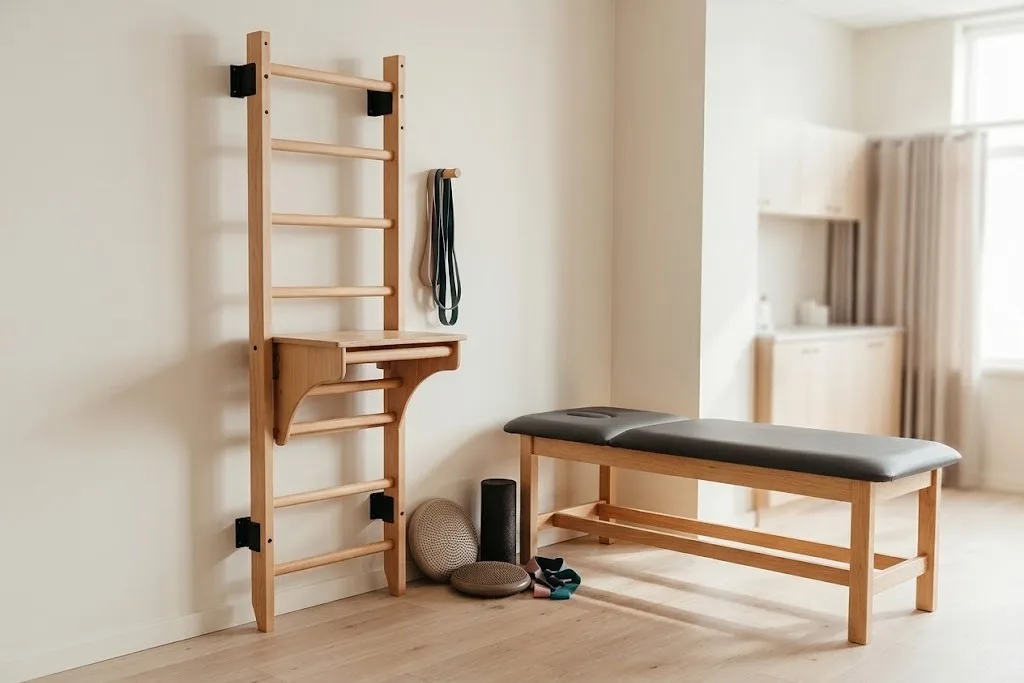
Wall bars are one of the most versatile pieces of equipment a physiotherapy clinic can own. Patients use them to hold on during balance work, to pull and hang for stretching, to step and climb for strength, and as a fixed point for bands and straps. They take almost no floor space and last for decades if they are made and fixed well.
This is a practical specification guide. It sets out what a clinic should settle before ordering wall bars for a treatment room or gym. The exercises themselves are always for a qualified physiotherapist to prescribe; the equipment’s job is to be a stable, well-finished frame for them.
Why wall bars suit rehabilitation
Much of rehabilitation is about strength, balance and confidence. NICE’s 2025 guideline on falls, NG249, recommends that falls prevention exercise programmes are delivered by appropriately trained professionals, are progressive and tailored to the individual, and focus on balance, coordination, strength and power. Wall bars support exactly that kind of programme. A patient can hold the bars with both hands for standing balance work, progress to one hand, then to fingertip support, all at the same station.
1. Width: single or double
Wall bars come in bays, or sections. Decide how many patients will use them at the same time.
- A single bay suits a treatment room where one patient works with one physiotherapist.
- A double or multiple bay suits a rehab gym or class, where two or more patients may work side by side.
- Space beside the bars matters as much as the width. The physiotherapist needs room to stand beside the patient, and a patient using a walking aid or wheelchair needs space to approach and turn.
2. Height and ceiling
Check the ceiling height and any obstructions, such as lights, ducts or sprinkler heads. Full-height bars give the most range, including hanging and stretching from the top rungs. In a room with a low ceiling, shorter bars or a different arrangement may be needed.
3. Rungs
The rungs are the part patients touch, so they deserve care.
- Solid hardwood. Beech has long been the traditional choice for wall bars. The Wood Database lists European beech at an average dried weight of about 710 kg/m³ and a Janka hardness of about 6,460 N, which makes it dense, hard-wearing and stiff. Ash and oak are also suitable.
- A smooth, rounded profile, comfortable for patients with weak grip or painful hands.
- Consistent spacing, so patients and physiotherapists can count rungs and repeat positions from session to session.
- No splinters or rough patches anywhere along the length.
4. The standard and the joints
Wall bars are covered by BS EN 12346, which sets safety requirements and test methods for wall bars, lattice ladders and climbing frames. Ask your supplier whether their design follows it and what testing has been done.
The joints between rungs and uprights carry the load every time a patient pulls or hangs. The Wood Handbook from the US Forest Products Laboratory explains that the holding power of a fastener depends strongly on the density of the timber and on whether it is driven into side grain or end grain. Dense hardwood and well-designed joints give a frame that stays tight under daily clinical use. Round Fit tests every piece before it leaves the workshop, and frames carry a five-year warranty.
5. Fixing to the wall
Wall bars are only as safe as their fixing. Patients may put their full weight through them, sometimes suddenly.
BS 8539, the British Standard for selecting, installing and testing anchors in concrete and masonry, sets out the approach: choose the anchor for the actual base material and load, specify it clearly and have it installed by a competent person, with inspection before load is applied. A stud partition usually needs added structure behind the bars.
Confirm the wall construction during design. Installation of Round Fit equipment is arranged through local distribution partners, who assess the wall before wall-mounted pieces are fixed.
6. Accessories
Consider what else the bars should support:
- A pull-up bar at the top, for hanging and upper-body work where appropriate.
- Modular sections, so the installation can grow as the clinic does.
- Fixing points for bands and straps, if the physiotherapists use them often.
7. Finish and hygiene
Clinic equipment is cleaned between patients. The finish must tolerate frequent cleaning and the clinic’s disinfectants without becoming sticky or slippery. A matt lacquer gives a natural, secure grip and wipes clean easily. Check any disinfectant against the finish before adopting it.
8. Inspection
Wall bars in a clinic should be part of a routine inspection regime. The Health and Safety Executive’s guidance on inspecting work equipment says that where safety depends on installation, equipment should be inspected after installation and before first use, and at suitable intervals where it is exposed to conditions that could cause deterioration. Results should be recorded.
For wall bars, that means regular checks of the fixings, the joints and the rung surfaces, and taking the bars out of use if anything has worked loose.
A specification checklist
- Number of bays and space beside them.
- Height, checked against the ceiling.
- Rung species, profile and spacing.
- Design following BS EN 12346, with testing confirmed.
- Wall construction confirmed and fixings chosen under BS 8539.
- Accessories such as a pull-up bar or band points.
- A matt finish compatible with the clinic’s cleaning.
- An inspection routine with records.
Round Fit makes wall bars in beech, ash or oak, and never in chipboard or MDF. Set out your installation in the wall bars configurator, or get in touch with our team to discuss your clinic.