Mats and foam rollers are the most used pieces of kit in many studios. Every client in a yoga, barre or mat Pilates class needs a mat. Many reach for a roller before or after class. In a busy timetable, dozens of mats go in and out of storage several times a day.
Good storage makes that easy. Clients find a clean, dry mat in seconds, the room resets quickly and the kit lasts longer. Poor storage leaves mats damp and tangled, rollers on the floor and a queue at the corner where everything is piled.
Why air matters
Mats absorb sweat and moisture from cleaning. If they are rolled tightly and pushed into a closed cupboard while damp, they dry slowly and can start to smell.
Advice on mat care is consistent on this point. Mats should be air-dried in a shaded, well-ventilated place, out of direct sunlight, and rolled only once they are fully dry. Different materials need different care. PVC mats should not be soaked. TPE is more sensitive to sunlight. Natural rubber can be sensitive to oils, so oil-based cleaners should be avoided.
For storage, this points to a few principles.
- Open racks rather than closed cupboards, so air can reach every mat.
- Space between mats, so a mat put away after wiping is not pressed against the next one.
- A spot away from direct sun and heaters, which can dry out and degrade some mat materials.
- Enough capacity that mats are not forced in tightly.
Racks for mats
There are three common ways to store mats.
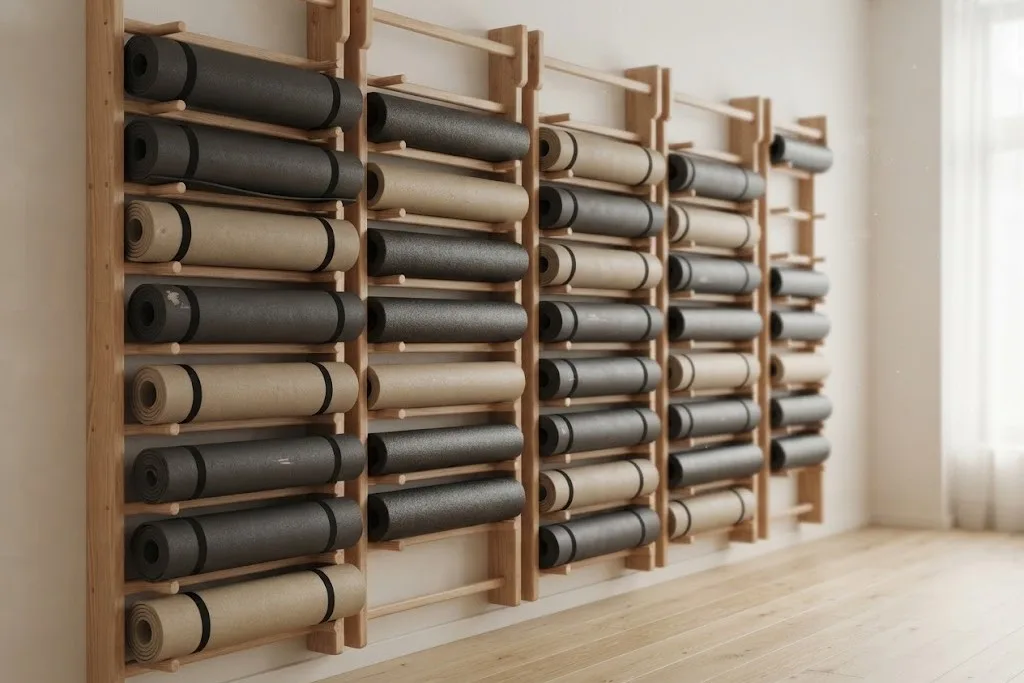
- Vertical rolled storage. Rolled mats stand upright in pigeonholes or a slotted rack. This is compact and easy to grab from. Each mat gets its own space, and the open front lets air in.
- Hanging storage. Mats hang from rails or hooks, usually flat or folded. Air reaches both sides, so this is good for drying. It needs more wall length.
- Flat shelves. Mats lie flat in stacks. This suits thicker mats that do not roll well, but stacks become heavy and the bottom mat is hard to reach.
In most studios, a vertical rack with individual slots works best for everyday mats. Consider a separate hanging rail near the cleaning station for mats that have just been wiped and need to dry.
Rollers take more room than you think
Foam rollers are light but bulky, and they roll. Left on an open shelf they slide off. Stacked in a basket, they jam together.
Good roller storage gives each roller a defined place, with:
- Cradles or deep shelves with a lip, so rollers cannot roll off.
- Vertical tubes or slots for standing rollers on end.
- A size that matches your rollers. Rollers vary in length and diameter. Measure the ones you use before ordering storage.
Clients often pick up a mat and a roller together. Store them side by side, so one trip to the rack is enough.
Height and reach
A rack that is too tall or too deep makes clients stretch or bend awkwardly. The Health and Safety Executive’s manual handling risk filters show that the weight a person can handle comfortably drops when the load is held with arms extended, or at very low or very high levels.
Mats and rollers are light, but in a busy changeover they are lifted many times. Keep the most used items between knee and shoulder height. Use the top shelves for spares and the bottom for heavier or less used kit, such as blocks or bolsters. Leave clear floor space in front of the rack so two or three people can collect equipment at once.
Capacity and placement
Size storage against your busiest class, not your average one. Then add spares for clients who forget their own, for kit taken out of use for cleaning and for growth.
Placement matters as much as capacity. The rack should be on the route into the room, so clients collect their mat on the way in and return it on the way out without crossing the teaching area. Good studio design relies on clear walkways between equipment and planned storage, so the floor stays open and safe.
Avoid placing mat storage where clients arriving for the next class will meet clients leaving the last one. A rack beside the door, with the flow running one way, keeps the changeover calm.
Cleaning the storage
Racks need cleaning too. Sweat and dust collect on shelves and in slots. The Centers for Disease Control and Prevention’s guidance on cleaning facilities distinguishes cleaning, which removes dirt and germs from surfaces, from disinfecting, which kills germs and should follow the product’s label and contact time.
A smooth, sealed surface makes both easier. Round Fit’s Studio Space Mat & Roller Rack is made in solid hardwood or plywood with a matt lacquer that stands up to daily cleaning. A typical rack is 80 × 50 × 180 cm and can be freestanding or wall-mounted, sized to your mats and rollers.
A short checklist
- Count mats and rollers for your largest class, plus spares.
- Measure your mats rolled and your rollers end to end.
- Choose open, ventilated storage with a slot for each mat.
- Keep frequently used items between knee and shoulder height.
- Place the rack on the route in and out, away from the teaching area.
- Plan a drying spot for freshly cleaned mats.
See the Studio Interiors collection for racks and storage in solid wood. Send us your class sizes and room plan, and we will suggest a layout.