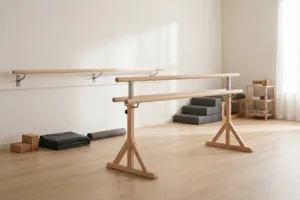
Every barre studio faces the same early decision. Fix the barres to the wall, or use freestanding barres that can move? Both work well. They suit different rooms, different timetables and different walls. This article sets out the strengths and limits of each, and when a mix makes sense.
The two types
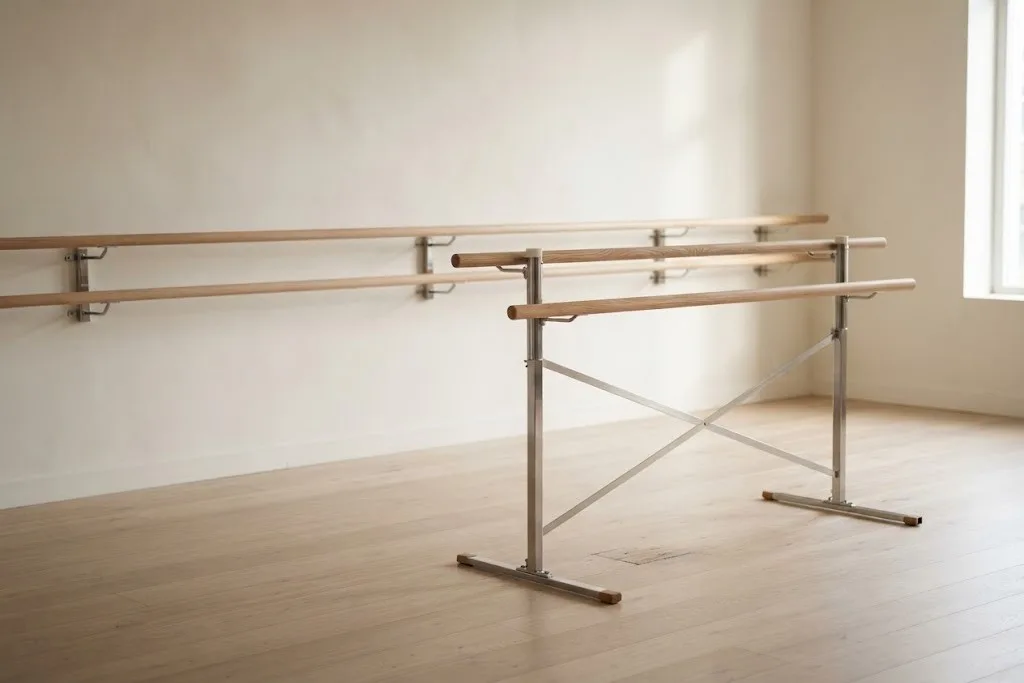
The difference is simple. A permanent barre is a handrail mounted to and supported by a wall. A portable barre is a handrail on a rigid or adjustable freestanding structure. Either can have one rail or two at different heights.
Wall barres
Strengths – Very stable. Fixed into the wall, a good wall barre does not move, however hard a client leans or presses. – No floor footprint. The floor in front stays clear when the barre is not in use. – Long, continuous runs. A wall barre can run the full length of a wall, giving many places in one line. – Neat. Fixed barres look like part of the architecture.
Limits – Fixed layout. Every barre class happens along the walls. The centre of the room cannot be used for barre work. – Depends on the wall. The wall must carry the loads. Stud partitions usually need added structure. – Hard to change. Moving or changing height means new holes and repairs.
Fixing. In the UK, BS 8539 is the code of practice for selecting, installing and testing anchors in concrete and masonry. Under it, anchors should be specified carefully and inspected before load is applied. Brackets need to be close enough that the rail does not flex.
Projection. Dance safety guidance recommends that wall-mounted barres project about 15 to 20 cm from the wall, giving room for the hand and for a leg on the barre.
Freestanding barres
Strengths – Flexible layout. Barres can be placed in rows, in the centre, or in a circle, and moved for different classes. – Multi-use rooms. They can be cleared away so the room can host yoga, Pilates mat or other classes. – No wall work. Useful where walls are glazed, unsuitable for fixings, or rented space where drilling is restricted.
Limits – Floor footprint. Each barre takes floor space, during and between classes. – Storage. The room needs somewhere to put them when not in use. – Stability depends on design. Freestanding barres should be firmly secured. A good freestanding barre has a heavy, wide base so it does not tip or slide when a client leans. – Handling. Barres are moved often. The UK Health and Safety Executive’s manual handling risk filters note that acceptable weights reduce when items are handled at low levels or with arms extended. Design the barre so two people can lift and move it comfortably.
As an example, the Round Fit Studio Flow Freestanding Barre is typically 200 cm long and 110 cm high, with rails at 90 and 110 cm, on weighted hardwood feet.
Which suits which room
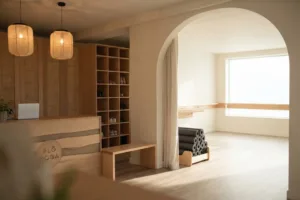
A dedicated barre studio usually suits wall barres. The room is used for barre all day, the walls can be designed for it, and stability matters most.
A multi-use studio usually suits freestanding barres, or a mix. The room must clear quickly for other classes.
A hotel or club studio often suits freestanding barres, because the room hosts many activities and walls may be finished with features that should not be drilled.
A clinic may use either. Wall barres give the most stable support; freestanding barres can be positioned next to a plinth.
A mix often works best
Many studios combine both:
- Wall barres along one or two walls for the main class.
- A few freestanding barres for extra places or centre work.
- The same rail heights on both, so instructors’ cues work everywhere.
Inspection and care
Both types need simple, regular checks. On wall barres, look at the brackets and fixings for any movement, and listen for creaks when a client leans on the rail. On freestanding barres, check that the feet are level, the base is stable and any adjustable parts are fully locked. On both, run a hand along the rail to feel for rough patches or splinters, and check that the finish is still smooth. Record the checks, so problems are found early and repairs are planned rather than urgent.
Matching timber and finish
Wall and freestanding barres in the same timber and finish look like one system. A matt lacquer protects the rail from daily cleaning and gives a natural grip. Round Fit makes both types in beech, ash, oak or any species on request.
See both in our Yoga & Barre collection. Not sure which suits your room? Ask us.