In a commercial studio, the finish on wooden equipment is wiped more often than almost any surface in a home. Hands, sweat, water bottles and disinfectant all reach it every day. The finish has to protect the timber, stay good-looking and survive that routine for years.
A matt lacquer is a strong choice for this job. This article explains what a lacquer does, why a low sheen suits studios, how finishes are tested, and how to clean them without shortening their life.
What a finish actually does
It is worth being precise about what a finish can and cannot do. The US Forest Products Laboratory’s Wood Handbook states that finishes cannot change the moisture content that wood eventually reaches. They only slow down the rate at which water enters and leaves.
That slowing is valuable. It means a splash of water or a film of sweat stays on the surface long enough to be wiped away, instead of soaking into the fibres. It also evens out the timber’s response to daily changes in humidity, which reduces movement and the risk of small cracks at joints.
The Handbook also notes that liquid water enters end grain 10 to 100 times faster than through other faces. A finish that covers faces well but leaves end grain thin will not protect the piece properly. On equipment, end grain sits at the feet of frames, the ends of rails and the edges of handles. These are exactly the places that meet wet floors and wet hands.
Film-forming lacquers
There are two broad families of wood finish. Penetrating finishes, such as oils, soak into the surface and leave no real film. Film-forming finishes, such as lacquers and varnishes, build a continuous layer on top.
For commercial equipment, a film is usually the better choice. It keeps liquids and cleaning products out of the wood, and it can be wiped many times a day.
Two-component polyurethane lacquers are widely used on heavily used furniture. They cure in two stages: first by solvent evaporation, then by a chemical reaction between the resin and a polyisocyanate hardener. The cured film offers high mechanical resistance and good chemical resistance. These lacquers are commonly used on kitchen, bathroom and office furniture and on table tops, which face similar daily abuse.
The Wood Handbook adds one caution about films. They can crack or flake if the wood beneath moves a lot, and they need careful preparation before refinishing. This is another reason to seal every face evenly and to keep the timber at a stable moisture content.
Why matt suits a studio
Sheen is measured in gloss units with a gloss meter. The scale runs from near zero for a fully matt surface to 100 for a polished black glass reference. International standard ISO 2813 sets out the method. Surfaces are measured at 60 degrees, with 85 degrees used for low-gloss surfaces below about 10 gloss units and 20 degrees for high gloss.
For studio equipment, a low sheen has practical advantages:
- It hides fine scratches. Light scattering on a matt surface makes small marks much less visible.
- It hides fingerprints and smears. These show clearly on gloss and need constant buffing.
- It avoids glare. Studios are often brightly lit, with mirrors. Reflections from gloss surfaces can be uncomfortable when lying on a reformer and looking up.
- It keeps the timber looking like timber. A matt film lets the grain read naturally, rather than looking plastic.
Matt does have a trade-off. Some matt surfaces can polish slightly in areas of heavy contact, such as handles. Over years, those areas may become a little shinier than the rest. That is normal wear and can be evened out when the piece is refinished.
How finishes are tested
Furniture finishes are tested in standard ways. The most relevant for studios is BS EN 12720, which sets a method for assessing the resistance of rigid furniture surfaces to cold liquids. Test liquids and contact times are agreed in the requirement specification or between buyer and supplier. The surface is then assessed for marks and damage.
When you choose a finish, it is reasonable to ask:
- Which test liquids were used, and for how long?
- Were common studio cleaners and disinfectants among them?
- What was the result after recovery time?
A supplier who has tested the finish against the products you actually use is giving you useful information. One who simply says “wipe-clean” is not.
Cleaning without damage
A good lacquer tolerates daily cleaning. It still lasts longer when cleaning is done sensibly.
Public health guidance makes a useful distinction. The US Centers for Disease Control and Prevention explains that cleaning removes dirt and germs from surfaces, while disinfecting kills germs. Frequently touched surfaces should be cleaned routinely, and disinfectants should be used according to their label, including the contact time the surface must stay wet. Alcohol-based products should contain at least 70 per cent alcohol.
For lacquered wood, that translates into a simple routine:
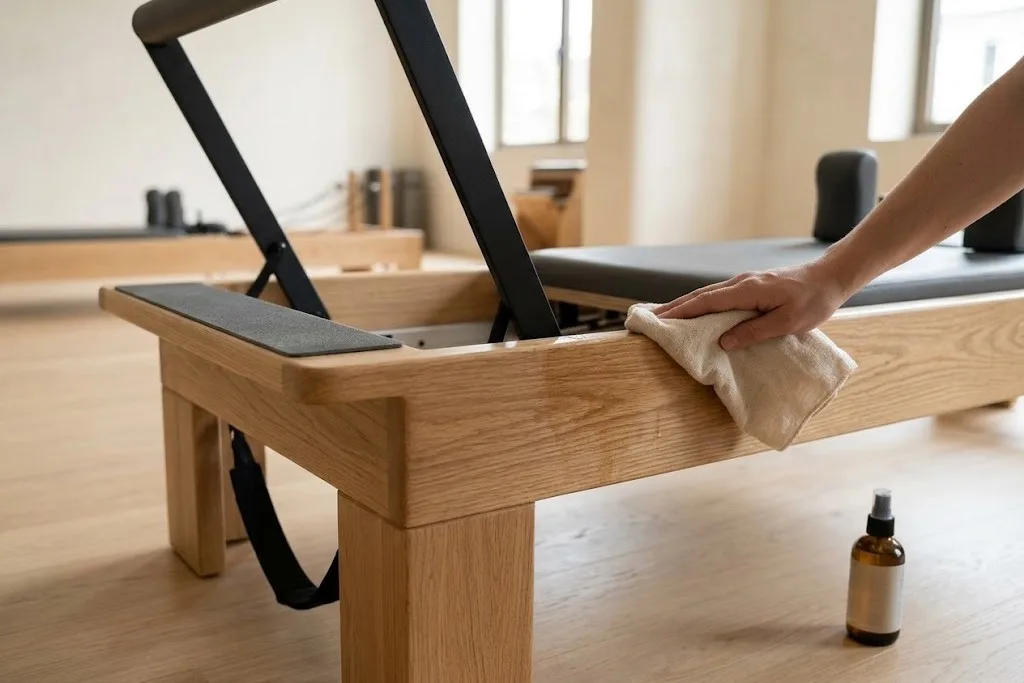
- Wipe with a damp cloth and a mild, pH-neutral cleaner after sessions or at the end of the day.
- Disinfect when needed, using a product suitable for coated surfaces. Follow the label contact time, then wipe off any residue.
- Do not flood joints. Use a damp cloth, not a spray that runs into joints and end grain.
- Dry surfaces in humid rooms. Do not leave standing water on frames or feet.
- Avoid abrasive pads and harsh solvents. They cut the film and dull the sheen unevenly.
- Check upholstery separately. Upholstered parts have their own cleaning requirements.
When to refinish
Even a good film wears in time. Signs that a piece needs attention:
- The surface feels rough or dry instead of smooth.
- Water no longer beads, but darkens the wood.
- Edges and handles show bare timber.
Small areas can often be repaired locally. Larger areas are best sanded and refinished. Because the base is solid hardwood, this can be done several times over the life of the equipment.
Round Fit offers any finish on request. Our customisation page explains the options. If you are choosing finishes for a project, start a conversation with us.