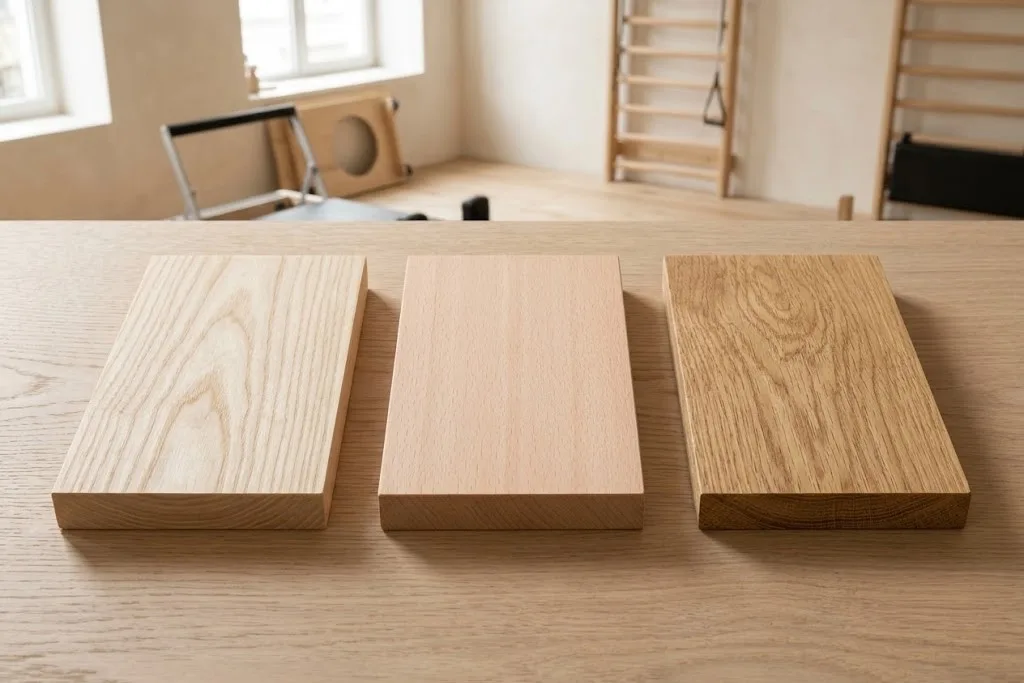
Most studio owners choose a timber by eye. That is reasonable. The species sets the colour, the grain and the overall mood of the room more than any other single decision. But beech, ash and oak also behave differently in use. They differ in hardness, in how much they move with humidity, and in how they react to metal and light.
This guide compares the three species most often used for commercial studio equipment. All three are suitable when properly specified. The aim is to help you choose the one that fits your room and your use.
The numbers side by side
The figures below come from The Wood Database. They are averages for small, clear test pieces at around 12 per cent moisture content. Real boards vary, so treat them as a guide to how the species compare, not as design values.
| Property | European beech | European ash | European oak (sessile) |
|---|---|---|---|
| Average dried density | 710 kg/m³ | 680 kg/m³ | 710 kg/m³ |
| Janka hardness | 6,460 N | 6,580 N | 4,990 N |
| Elastic modulus (stiffness) | 14.31 GPa | 12.31 GPa | 10.47 GPa |
| Modulus of rupture (bending strength) | 110.1 MPa | 103.6 MPa | 97.1 MPa |
| Tangential shrinkage, green to dry | 11.7% | 9.6% | 9.7% |
| Volumetric shrinkage, green to dry | 17.9% | 15.3% | 14.2% |
A few points stand out. Beech is the stiffest of the three. Ash is the hardest by a small margin and is known for shock resistance. Oak is a little softer and less stiff, but it moves less than beech when humidity changes. The Wood Database lists sessile oak as nearly identical to English oak, and both are sold as European oak.
Beech: even, pale and precise
Beech has a fine, even texture and a pale, warm colour. The grain is quiet, so the shape of a piece reads clearly. That suits equipment with clean lines, such as reformers, chairs and barres.
Beech machines, glues and finishes well. It also steam-bends well, which is useful for curved parts. Its main drawback is movement. The Wood Database describes it as a timber that moves considerably in service. In a room where humidity swings widely, beech parts need careful grain selection and joint design.
Good fit: Pilates apparatus, barres, accessories, and rooms with a calm, light palette.
Ash: light, lively and tough
Ash is pale, with a stronger and more open grain than beech. It gives a bright, slightly more energetic look. The Wood Database notes its good strength for its weight and its shock resistance. That is why it has a long history in tool handles and sports goods.
There is one supply issue to know about. Ash dieback, caused by the fungus Hymenoscyphus fraxineus, was confirmed in the UK in 2012 and is now recorded in every county. Forest Research notes that a shortage of ash could push industries that rely on it towards other materials. European ash remains available, but it is sensible to confirm supply and lead time early for a large project.
Good fit: Wall bars, rails, functional equipment, and Scandinavian-style interiors.
Oak: figure, depth and a heavier look
Oak has a pronounced figure, with visible rays when quartersawn. It reads as more traditional and slightly heavier, and it suits darker or richer schemes. The Wood Database rates sessile oak as having very good decay resistance and notes that it accepts stain and finishes very well.
Oak has a chemical habit worth planning for. It is rich in tannins. A note from the US Forest Products Laboratory explains that iron stain is a blue-black discolouration caused by a reaction between wood extractives and iron in steel products. Oak is one of the species most prone to it. In practice, that means avoiding bare iron or carbon steel in contact with oak where moisture is present, and choosing suitable fixings and coatings.
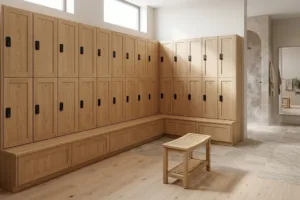
Good fit: Hotels and members’ clubs, lobbies and spas with darker joinery, and statement pieces.
Movement matters more than hardness
People often ask which species is hardest. For studio equipment, movement is usually the more important question.
The Wood Handbook explains that wood exchanges moisture with the air until it reaches equilibrium. At around 21 °C, timber settles at about 6 per cent moisture in dry winter air at 30 per cent relative humidity, and about 12 per cent at 65 per cent. As the moisture content changes, the timber shrinks or swells. Tangential movement is roughly twice radial movement.
So a species with high shrinkage, such as beech, needs more care in a room with big seasonal swings. That is not a reason to avoid it. It is a reason to tell your maker about the room. Is it heated and air-conditioned? Is it next to a pool or a steam room? Is it a basement with high humidity in summer?
Colour changes with light
All three species change colour over time. The Wood Handbook notes that visible light, not only ultraviolet, changes the colour of wood indoors, and that UV stabilisers in a finish do not necessarily prevent it. Pale species tend to warm and deepen slightly. Oak can darken towards honey tones.
If you are matching equipment to existing joinery, compare samples that have aged under similar light, or accept that new pieces will catch up over time.
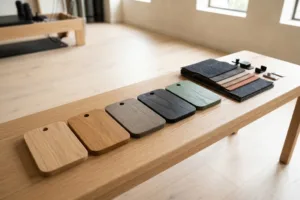
Finish and colour change the picture
The species is only part of the final look. A clear matt lacquer keeps the natural colour. A tinted lacquer can warm or cool it. A stain can move ash towards oak, though The Wood Database notes that ash lacks oak’s wide visible rays, so a trained eye will still see the difference.
Upholstery colour, metal finish and the room’s lighting all shift how a timber reads. It is worth looking at a sample in your own space, under your own lights, before deciding.
How to choose
A simple way to decide:
- Start with the interior. Light, minimal rooms suit beech or ash. Darker, richer schemes suit oak.
- Check the environment. Large humidity swings favour the more stable species, or careful detailing.
- Consider the metalwork. If oak is chosen, plan metal contact and fixings from the start.
- Confirm supply. For large orders, check availability and lead time for the species you want.
- Ask for samples. Look at them with your upholstery and floor before committing.
Round Fit works with any timber species on request, alongside our standard choices. Our customisation page shows the options. If you would like samples, get in touch.