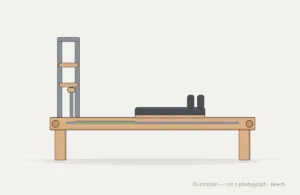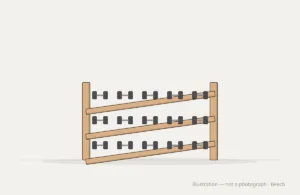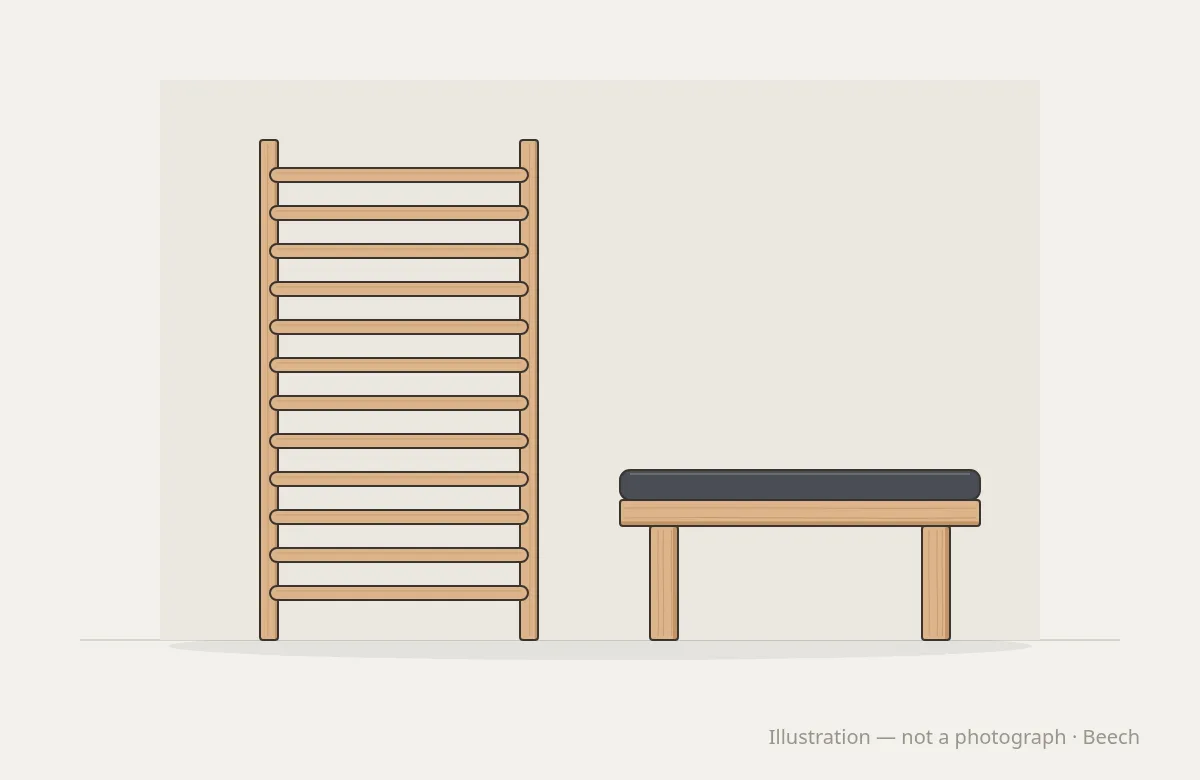
A hotel gym is part of the guest experience. Guests judge it as they judge the bedroom, the restaurant and the spa. A room full of grey catalogue machines can undo the impression that the rest of the hotel has worked hard to create. Equipment in solid timber can carry the hotel’s interior into the gym, so the space feels like part of the property rather than a utility room.
Demand for wellness facilities in hotels is real. Global Wellness Institute research puts the wellness tourism market at about $830 billion in 2023 and forecasts it to pass $1.3 trillion by 2028. Guests increasingly choose where to stay partly on what they can do there.
Wooden equipment still has to perform as commercial equipment. This article sets out the questions worth asking before you choose it.
Is it really solid wood?
“Wooden” can mean very different things. Ask exactly what each part is made of.
- Solid hardwood is strong, dense and repairable. It can be sanded and refinished over its life.
- Plywood is stable and strong, and suits panels, platforms and carcasses.
- Veneered board is a thin layer of timber over a core, often chipboard or MDF. It can look the same on day one, but it is less tolerant of knocks, moisture and repeated fixing, and much harder to repair.
Round Fit uses beech, ash, oak or any other species on request, with plywood where it suits the piece. We never use chipboard or MDF.
Is it designed for commercial use?
Hotel gyms are used unsupervised, at all hours, by guests of every size and ability. Equipment must be designed for that.
The international safety standard for stationary training equipment, EN ISO 20957-1:2024, covers equipment used in studios, clubs, hotels and rehabilitation centres, as well as domestic equipment, and sets general safety requirements and test methods. Ask your supplier which standards their designs follow and how each piece is tested.
Timber joints also need attention. The Wood Handbook from the US Forest Products Laboratory explains that fasteners in wood that goes through repeated wetting and drying can lose much of their holding power, and that bolted joints may need retightening as new timber settles. Good design uses joints and fixings that suit timber, and a good supplier will tell you what routine checks are needed.
Every Round Fit piece is tested before it leaves the workshop, and the frame carries a five-year warranty.
Will the finish survive daily cleaning?
Hotel gym equipment is cleaned constantly, often with strong products chosen for hygiene rather than for timber. The finish has to cope.
- Ask how the finish has been tested. Resistance of furniture surfaces to liquids is assessed under BS EN 12720, which tests how a surface responds to set liquids over set contact times.
- Share the hotel’s actual cleaning and disinfection products with the supplier, and ask whether the finish tolerates them.
- Prefer a matt finish. It does not show streaks and fingerprints, which matters in a room that housekeeping checks every day.
Round Fit equipment is finished in a matt lacquer for daily cleaning.
Is the upholstery commercial grade?
Benches, reformers and mats carry body weight, sweat and cleaning products every day.
Abrasion. Upholstery is usually tested by the Martindale method under BS EN ISO 12947. Results of 40,000 rubs and above are generally treated as contract grade, and 100,000 rubs and above as severe contract.
Cover material. A comparison published by the Chemical Fabrics and Film Association notes that PVC is not subject to hydrolysis to any significant degree and rates well with disinfectants, while polyurethane can break down slowly in heat and humidity and has failed early with some quaternary ammonium cleaners. Check the cover against your cleaning products.
Fire performance. In the UK, contract upholstery is commonly specified to BS 7176. The independent testing organisation SATRA explains that its medium hazard level covers places such as hotel bedrooms and public buildings, and adds a wooden crib ignition test, often called Crib 5. Your fire risk assessment should confirm which level applies.
Round Fit can upholster in a base palette or any custom colour to suit the hotel’s scheme.
Can parts be replaced?
Equipment that lasts needs parts that wear to be replaceable: upholstery, straps, ropes, springs and feet. Ask:
- Which parts are expected to wear, and how often?
- Can they be replaced on site, or does the piece need to go back to the workshop?
- How are replacement parts supplied, and how quickly?
Installation of Round Fit equipment is arranged through local distribution partners, who also assess the wall before wall-mounted pieces are installed.
Does it fit a compact room?
Many hotel gyms are small. Every piece has to earn its place.
- Multi-use pieces do more in less space. A bench that serves several exercises, a plyo box with three heights or a wall-mounted spring wall can replace several single-purpose machines.
- Wall-mounted equipment, such as wall bars or a spring wall, keeps the floor clear.
- Storage designed for the room keeps small equipment tidy, which matters in a space without staff.
Does it match the interior?
This is the main reason to choose wood. Ask whether the supplier can:
- Match the species and finish to the hotel’s joinery or floor.
- Use the hotel’s colour references for stains, painted parts and upholstery.
- Brand pieces subtly, for example with an engraved logo.
- Make lockers, benches, mirror frames and storage in the same timber, so the gym and changing areas read as one scheme.
Round Fit makes equipment and interiors in its own workshop and can match species, finish and colour across the whole order. Pricing is on request, and lead times are typically six to eight weeks for most collections and four to six weeks for Pilates equipment.
See our hotels & clubs solutions. Share your gym plan and discuss your project with us.