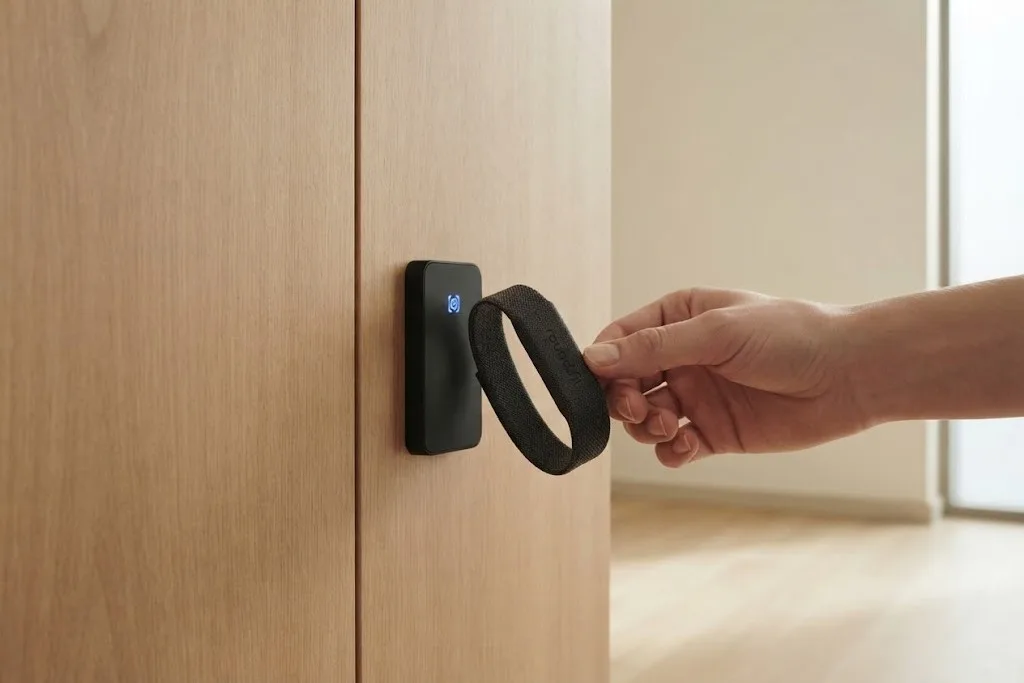
RFID locks have become the standard in many studios, clubs and hotels. Clients open their locker with a wristband, a membership card or sometimes a phone. Staff no longer hand out keys or deal with lost ones. Lockers can be allocated for a session and released automatically.
Fitting an electronic lock into a solid timber door is a different job from fitting it into a metal locker, though. The lock has to sit precisely in the timber, be reachable for servicing and work with the studio’s booking or access system. This article explains how RFID locks work, what to agree before production and how to integrate them well.
How RFID locks work
RFID stands for radio-frequency identification. A reader in the lock communicates with a chip in the client’s wristband or card when it is held close. Most locker locks use high-frequency technology at 13.56 MHz, following the ISO/IEC 14443 Type A standard for contactless cards. This is the same family of technology used for transport cards and building access.
The read range is short. For MIFARE DESFire cards, a widely used chip family, the maximum range is around 10 cm, depending on the reader and antenna. That short range is deliberate. The client has to present the credential to the lock, so lockers do not open by accident as people walk past.
Typical locker locks of this kind run on standard batteries, often four AA cells, and are rated for a wide temperature range, commonly about −20 to 70 °C. Many can be set so that one credential opens only one locker at a time, which stops a single client from occupying several. Staff use master or programming cards to open any locker and change settings.
Security is in the credential
The lock is only as secure as the credential it reads. Not all chips are equal.
The older MIFARE Classic chip used a proprietary cipher called Crypto-1. Security researchers showed in 2008 that it could be broken, and later attacks made cloning easier. The chip’s manufacturer, NXP, has recommended moving to higher-security products. Newer chip families, such as MIFARE DESFire EV1, EV2 and EV3, use 128-bit AES encryption and add protection against man-in-the-middle attacks.
For a studio, this means one simple question for your lock and access provider: which credential will clients use, and what security does it offer? If clients already carry a membership card or wristband, check whether the locks can read it securely, rather than introducing a second credential.
Data protection
RFID credentials can be linked to people. The Information Commissioner’s Office notes that UK GDPR, in Recital 30, lists radio-frequency identification tags among the online identifiers that can be associated with individuals. If a lock system records which credential opened which locker and when, that log may be personal data.
That does not prevent you from using RFID. It means the system’s data handling should be part of your normal data protection planning: what is recorded, how long it is kept and who can see it. Your access control provider should be able to explain this.
Integrating the lock into timber
This is where craft matters. A lock that is fitted carelessly into a timber door looks out of place and causes problems later. Good integration is planned at the drawing stage.
Door thickness. Each lock has a minimum and maximum door thickness. Solid timber doors are usually thicker than metal ones. The door must suit the lock, or the lock must be chosen to suit the door.
The cut-out. The lock body and its reader need precise cut-outs, machined in the workshop rather than on site. A clean cut keeps the door strong and the finish sealed.
Sealing the cut edges. Timber exposed by a cut-out absorbs moisture if it is left bare. The Wood Handbook from the US Forest Products Laboratory explains that wood exchanges moisture with the air and swells as humidity rises. In a changing room, cut edges must be sealed like every other face, or the door can swell around the lock.
Battery access. Batteries need replacing. The battery compartment should be reachable without removing the door or the lock. Check how often the manufacturer expects batteries to be changed, and plan staff access.
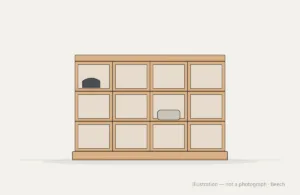
Consistent height. Fix every lock at the same height across a bank of lockers. It looks better, and clients find the reader without searching.
Keep the reader clear. Metal plates, deep recesses or decorative trims close to the reader can affect the read range. Keep the area around it simple.
Agree the system before production
The lock affects the door design, so it must be chosen before doors are made. Before production, agree:
- The lock model and its door thickness range.
- The credential type and its security level.
- How the lock connects to your booking or access system, if at all. Some locks are standalone; others are networked.
- Whether lockers are allocated, free choice or time-limited.
- How staff open lockers in an emergency.
- How batteries are monitored and replaced.
Round Fit treats RFID as the preferred option for lockers. We design the door, cut-out and battery access around the lock you choose, and machine every door in the workshop. Every piece is tested before it leaves the workshop, and installation is arranged through local distribution partners.
Technology and timber together
The aim is a locker that looks like fine furniture and works like a modern access system. Clients should notice the timber and the calm of the room, and barely think about the lock. When the lock is planned from the start, that is easy to achieve.
See our lockers and changing room furniture in Studio Interiors. If you are planning a changing room with RFID locks, get in touch.