The floor is the largest surface in a studio, and the one clients touch most. In yoga they lie, kneel and balance on it. In barre they rise onto the balls of their feet, pulse and sometimes jump. Most of them do it barefoot or in grip socks. A floor that feels hard, cold or slippery undermines a class however good the teaching is.
Flooring is a specialist area, and a studio floor should be specified with a flooring contractor. This article sets out the questions worth asking, so the brief is clear before samples arrive.
What the floor has to do
A yoga or barre floor has to balance several needs.
- Comfort. Enough give to make kneeling and low-impact work comfortable, without feeling soft or unstable underfoot.
- Grip. Secure for bare feet, socks and grip socks, both dry and slightly damp from sweat.
- Cleanability. Quick to clean between classes, with no deep texture that traps dirt.
- Durability. Able to take mats, props, moving barres and constant foot traffic without marking.
- Stability in the room’s conditions. Especially in heated or hot yoga rooms.
No single floor is best for every studio. A dedicated barre room with jumps has different needs from a quiet yin yoga room. A multi-use room has to find a sensible middle ground.
Shock absorption
Sports floors are tested under EN 14904, the European standard for indoor multi-sport surfaces. It covers shock absorption, vertical deformation, friction, ball bounce and resistance to impact and rolling loads.
There are three main types of floor.
- Point-elastic floors, usually synthetic, deform close to the point of impact.
- Area-elastic floors, usually timber on an elastic base, spread an impact over a wider area. They give strong impact absorption but need more upkeep and controlled temperature and humidity.
- Combination floors use an area-elastic base with a point-elastic surface.
Classes in the standard are defined by measured values. The UK ESFA guidelines for school sports floors, for example, list category A3 at a shock absorption of 40 to under 55 and a vertical deformation of 1.8 to under 3.5 mm, and category A4 at 55 to under 75 and 2.3 to under 5 mm.
A studio is not a sports hall, and you may not need a tested multi-sport floor. But the language is useful. If your timetable includes jumping or cardio barre, ask your contractor how much shock absorption the proposed floor provides, and on what basis.
Dance offers a helpful reference point. Dance safety guidance recommends a resilient floor at least, or preferably a sprung floor, covered with a good-quality dance vinyl. Many barre studios borrow this approach.
Grip and slip resistance
Slip resistance in the UK is usually measured with the pendulum test. Results are given as a pendulum test value (PTV). A PTV of 0 to 24 indicates high slip potential, 25 to 35 moderate and 36 or more low. A PTV of 36 or above is expected for new or refurbished commercial floors. The test uses different rubber sliders to represent shod and barefoot conditions.
The Health and Safety Executive’s overview of slips and trips makes the broader point. Slips depend on the floor, the contamination on it, the footwear, the cleaning regime and how people use the space. A floor that tests well when clean and dry can behave differently when it is wet, polished or coated with residue from the wrong cleaning product.
For a studio, the practical questions are:
- What is the PTV in wet conditions, with the barefoot slider where that is relevant?
- What cleaning products and methods does the manufacturer recommend?
- Will mats grip the floor, or slide on it?
Timber, vinyl and other options
Timber and engineered wood are popular in yoga and barre studios. They look warm and feel natural underfoot. They suit a calm, premium interior. Timber is a natural material, though, and it moves. The US Forest Products Laboratory’s Wood Handbook explains that wood gains and loses moisture with the humidity of the surrounding air, and swells and shrinks across the grain as it does. A timber floor in a room that is heated and humidified for hot yoga, then cooled overnight, needs a system and a finish designed for those conditions.
Sports vinyl and dance vinyl give consistent grip, are easy to clean and can be laid over a resilient or sprung subfloor. They are a common choice for barre and dance.
Cork and rubber appear in some yoga rooms. They are warm and comfortable, but check how they respond to sweat, cleaning products and heat.
Heated and hot rooms
Heated yoga changes the brief. Air temperature, humidity and sweat all rise. The floor has to stay stable, hygienic and safe when damp.
Ask your flooring contractor specifically about:
- Performance and slip resistance at the room’s working temperature and humidity.
- How the floor is cleaned and dried after a hot class.
- Ventilation, so the room dries between sessions.
The same applies to any timber equipment in the room. Barres, prop storage and benches should be finished to cope with humidity and frequent cleaning.
Planning the floor with the equipment
Flooring decisions affect equipment, and the reverse.
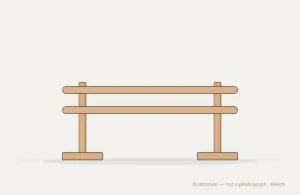
- Freestanding barres should have feet that do not mark or dent the floor. Felt or rubber pads help, but the weight of the barre still sits on a small area.
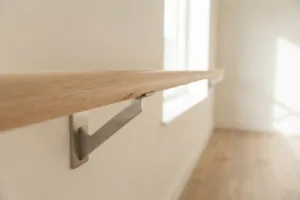
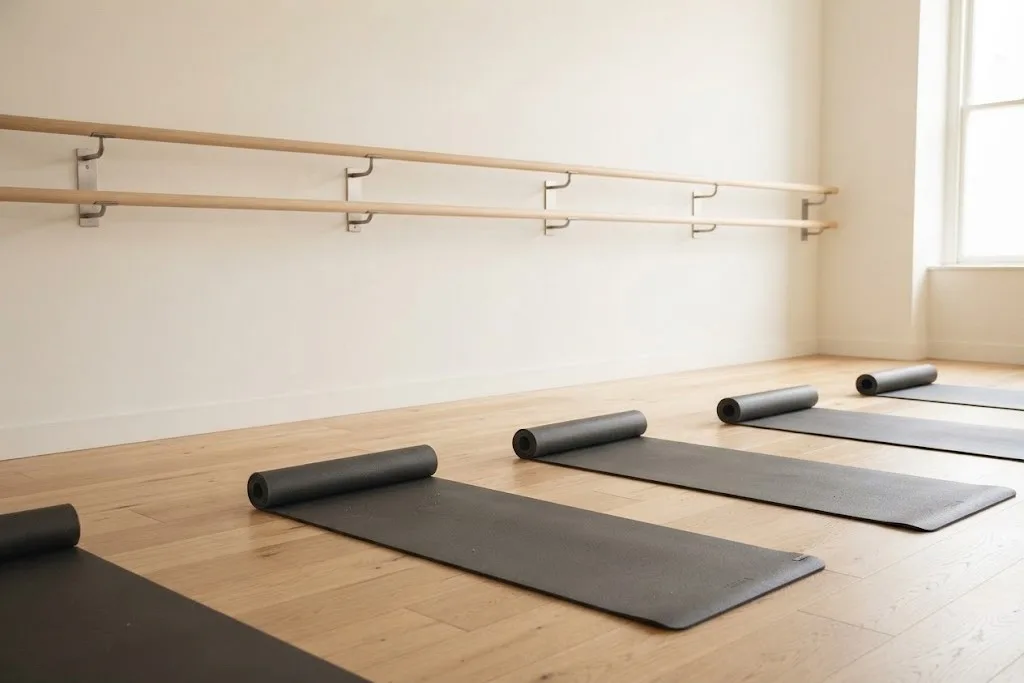
- Wall barres and mirrors are often fixed before the floor is finished. Agree the order of work with your contractor, so skirting, mirror edges and barre brackets line up with the finished floor level.
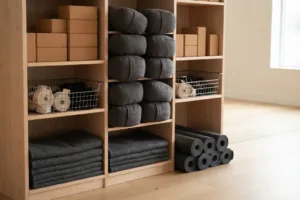
- Storage for mats and props should keep them off the floor, which makes cleaning faster.
- Transitions between the studio floor and the corridor or changing area should be level, to avoid trips.
Round Fit makes barres, prop storage and studio furniture in solid hardwood with a matt lacquer, and can match the timber species to your floor. See our Yoga & Barre collection. If you are planning a floor and equipment together, ask us and we will talk through the layout.