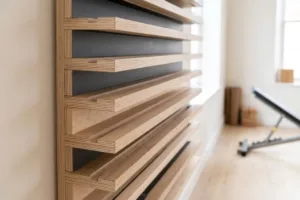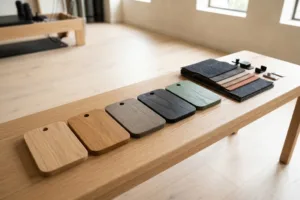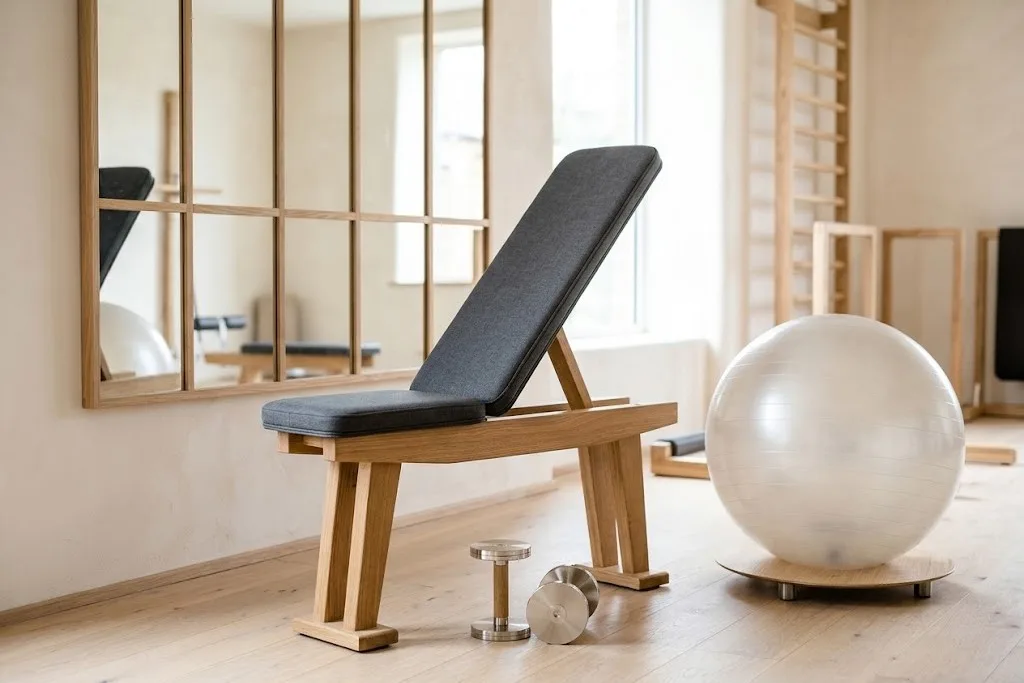
Commercial fitness equipment has a hard life. It is loaded many times a day, moved, wiped down, knocked by weights and leaned on between sets. Many materials can survive that for a while. Solid hardwood is one of the few that can survive it for years and then be repaired, sanded and refinished rather than thrown away.
This article explains why, using published engineering data rather than marketing language. It also sets out where hardwood is not the right answer on its own.
Stiff and strong for its weight
Good equipment should feel solid under load. A reformer frame or a wall bar stile that flexes visibly feels unsafe, even when it is not.
Dense European hardwoods are stiff for their weight. The Wood Database lists European beech at an average dried density of about 710 kg/m³, with an elastic modulus of 14.31 GPa and a modulus of rupture of 110.1 MPa. European ash is a little lighter, at about 680 kg/m³, with an elastic modulus of 12.31 GPa and a modulus of rupture of 103.6 MPa. Ash is also described as shock resistant, which is why it has long been used for tool handles and sports equipment.
These are laboratory figures for small, clear specimens. Real parts contain grain variation, and a responsible maker sizes sections with a margin. But the figures show why a well-sized hardwood rail can carry real loads without feeling hollow or springy.
Hardwood holds fixings well
Most equipment fails at its joints, not in the middle of a beam. How well the timber grips screws and bolts matters as much as its strength.
The US Forest Products Laboratory’s Wood Handbook gives a clear rule. In seasoned wood, the withdrawal resistance of a screw rises with the square of the wood’s specific gravity. Denser timber holds a screw much better than light timber of the same size. The Handbook also notes that screws driven into end grain hold only about 75 per cent of their side-grain value, and that results in end grain are less predictable.
That has direct consequences for design:
- Main fixings should go into side grain wherever possible.
- Lead holes should be drilled to suit the species. The Handbook suggests around 90 per cent of the root diameter for hardwoods when withdrawal is the main load.
- Bolted joints need enough edge and end distance. For hardwoods, the Handbook gives a tension end distance of about five bolt diameters.
Particle-based boards such as chipboard and MDF have no long continuous fibres to grip a thread. They can be fine in furniture that is assembled once and left alone. They are a poor choice for equipment that is loaded, adjusted and serviced for years. This is why Round Fit builds in solid wood and plywood and does not use chipboard or MDF.
Wood moves, so design for it
Timber is hygroscopic. It takes up and gives off moisture until it reaches balance with the surrounding air. The Wood Handbook tabulates this equilibrium moisture content. At around 21 °C, wood settles at about 6.2 per cent moisture at 30 per cent relative humidity, about 9.2 per cent at 50 per cent, and about 12 per cent at 65 per cent.
As moisture content changes, wood shrinks and swells. The movement is not equal in all directions. The Handbook notes that tangential shrinkage is roughly twice radial shrinkage, and movement along the grain is very small. The Wood Database lists European beech at 5.8 per cent radial and 11.7 per cent tangential shrinkage from green to oven-dry, and describes beech as a timber that moves considerably in service.
None of this is a reason to avoid wood. It is a reason to design with it in mind:
- Use the grain orientation that keeps critical dimensions stable.
- Allow wide panels to move instead of locking them rigidly in a frame.
- Dry timber to a moisture content that suits heated interiors before machining.
- Finish all faces, including end grain, so that moisture exchange is slow and even.
Finishes protect, and can be renewed
The Wood Handbook is careful about what a finish does. A finish cannot change the moisture content wood eventually reaches. It only slows the rate at which water enters and leaves. End grain takes up liquid water 10 to 100 times faster than other faces, so sealing it properly matters.
In a studio, the finish also has to cope with sweat, hand contact and daily cleaning. A hard, closed film keeps liquids on the surface long enough to be wiped away. When the surface eventually wears, solid timber can be sanded back and refinished. A laminate or foil over a board cannot be renewed in the same way. Once the surface layer is through, the part is usually replaced.
Where steel belongs
Hardwood is not the best material for every job. Some parts carry concentrated loads through a small area, or need precise, repeatable movement. Pulleys, axles, adjustment mechanisms and certain brackets are examples.
The sensible approach is to use each material where it performs best. Timber carries the main structure and the surfaces people touch. Steel takes the load paths where small, concentrated forces meet. Round Fit makes its steel parts in-house, so timber and metal are designed together rather than bought separately and adapted.
What this means in practice
For an operator, the practical case for solid hardwood comes down to a few points:
- It feels solid. Stiff sections and tight joints give users confidence.
- It holds together. Fixings in dense side grain stay tight through years of use and servicing.
- It can be repaired. Worn surfaces can be refinished, and damaged parts can be remade from the same species.
- It ages honestly. Wood shows its use gradually, without the sudden failure of a peeled foil or chipped laminate.
The condition is that the equipment is designed with wood’s behaviour in mind. Sections need to be sized properly. Joints must suit the grain. Finishes must seal every face. Every Round Fit piece is tested before it leaves the workshop, and the frame carries a five-year warranty.
If you are planning a commercial space, our Strength & Functional collection shows how these principles work in practice. Or tell us about your project and we will suggest timber, sections and finishes to suit it.